| Ultimi arrivi - Mars through Mars Express (ESA - Original Raw Frames & Orbital Panoramas) |

A-h0751_0000_gr2.jpgFrame Mars Express RAW n. h0751_0000gr272 visiteFeb 01, 2007
|
|
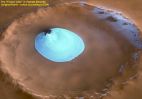
Craters-Lauth_Crater_in_Vastitas_Borealis_Region-Frozen_Lake-W-212-010705-1343-6-3d-01-00.jpgThe misterious "Frozen Lake" of Vastitas Borealis (1 - Natural Colors; credits ESA)84 visiteCaption ESA:"The HRSC on ESA's Mars Express obtained this perspective view on 2 February 2005 during orbit 1343 with a ground resolution of approximately 15 mt per pixel. It shows an unnamed impact crater located on Vastitas Borealis, a broad plain that covers much of Mars's far Northern Latitudes, at approx. 70,5° North Lat. and 103° East Long.
The crater is about 35 Km wide and has a maximum depth of approx. 2 Km beneath the crater rim. The circular patch of bright material located at the centre of the crater is residual water ice.
The colours are very close to natural, but the vertical relief is exaggerated three times. The view is looking East".
Nota: noi crediamo che questo cratere sia molto più enigmatico di quanto non appaia poichè, pur avendo esaminato tutti i frames NASA-MGS relativi alla Regione di Vastitas Borealis (in particolare quelli rapprsentativi dell'area suggerita dalle coordinate ESA), non ci è riuscito di individuare il "laghetto ghiacciato".
Il cratere senza nome che lo dovrebbe contenere, poi, appare solo una volta - e solo in una veduta PARZIALE! - in un frame NASA-Mars Odyssey che Vi proporremo qui di seguito.
Infine, i "colori naturali" di Vastitas Borealis, in accordo ai dati NASA disponibili (i quali sono anche comprensivi di informazioni ottenute sia attraverso vedute telescopiche HST, sia attraverso osservazioni effettuate da Terra), dovrebbero essere molto diversi da quelli suggeriti dall'ESA (noi Vi proporremo tre elaborazioni al riguardo).
Dic 01, 2006
|
|
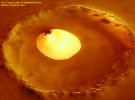
Craters-Lauth_Crater_in_Vastitas_Borealis_Region-Frozen_Lake-W-212-010705-1343-6-3d-01-03.jpgThe misterious "Frozen Lake" of Vastitas Borealis (4 - Extremely Enhanced Natural Colors; credits for the additional process. and color.: Lunar Explorer Italia)74 visitePiena Estate Polare Marziana: polveri rosse ricoprono il cratere senza nome di Vastitas Borealis e colorano, in parte, il suo "laghetto" centrale.
Da notare che, in accordo alle nostre assunzioni di partenza (ed in accordo a regole elementari di logica e di buon senso), un cielo ricco di polveri color arancio, gialle e rossastre (e dunque, di conseguenza, un cielo color rosso/arancio e giallo - di base) si dovrebbe adeguatamente riflettere con questi medesimi colori nelle acque - a questo punto ghiacciate o meno diventa indifferente - del lago di Vastitas.
Ebbene, la regola elementare per cui le acque e/o i ghiacci superficiali, "usualmente", riflettono il colore del cielo, nel frame ESA Originale (fateci caso!) diremmo che NON trova applicazione.
Come mai? Forse abbiamo sbagliato noi...O forse l'immagine ESA è un'mmagine bella ma fasulla? O forse i suoi colori sono stati taroccati (male)?
O magari essa è frutto di incompetenza?
Oppure - chissà... - l'immagine ESA di partenza è un mix di tutte e tre le possibili (e summenzionate) variabili... Decidetelo Voi.MareKromiumDic 01, 2006
|
|
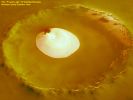
Craters-Lauth_Crater_in_Vastitas_Borealis_Region-Frozen_Lake-W-212-010705-1343-6-3d-01-02.jpgThe misterious "Frozen Lake" of Vastitas Borealis (3 - False Colors; credits for the additional process. and color.: Lunar Explorer Italia)73 visiteQuesta "visione" (sempre di fantasia e sempre solo sino ad un certo punto...) del Lago Ghiacciato di Vastitas si riferisce, invece, all'inizio dell'Estate Polare Marziana.MareKromiumDic 01, 2006
|
|

Craters-Lauth_Crater_in_Vastitas_Borealis_Region-Frozen_Lake-W-212-010705-1343-6-3d-01-01.jpgThe misterious "Frozen Lake" of Vastitas Borealis (2 - False Colors; credits for the additional process. and color.: Lunar Explorer Italia)69 visiteNoi non sappiamo se i riflessi color verde ed azzurro che cogliamo nelle immagini telescopiche di Marte (sia ottenute da Terra, sia dallo Spazio - via HST ad esempio) sìano il prodotto di mere aberrazioni cromatiche o se essi possano effettivamente costituire l'evidenza tangibile, rispettivamente, di forme di vegetazione indigena e/o di acque correnti superficiali.
Quello che sappiamo è che non possiamo - semplicemente - ignorare questi dati in sede di interpretazione "cromatica" delle immagini possedute, qualunque ne sia la fonte.
Questa "visione" (di fantasia, ma sino ad un certo punto...) del Lago Ghiacciato di Vastitas si riferisce alla tarda Primavera Polare Marziana.MareKromiumDic 01, 2006
|
|
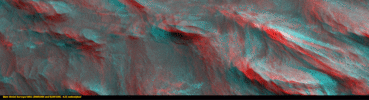
Juventae_Chasma_3D-3.gifJuventae Chasma (High-Def-3D - EDM n.2; credits: ESA)85 visitenessun commentoGen 30, 2006
|
|
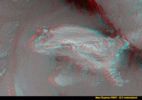
Juventae_Chasma_3D-2.gifJuventae Chasma (High-Def-3D - EDM n.1; credits: ESA)70 visitenessun commentoGen 30, 2006
|
|
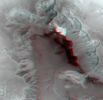
Juventae_Chasma_3D-1.JPGJuventae Chasma (High-Def-3D; credits: ESA)107 visiteSpettacolare: un 3D assolutamente straordinario.
Original caption:"These images, taken by the HR Stereo Camera (HRSC) on board ESA’s Mars Express spacecraft, show the depression of Juventae Chasma, cut into the plains of Lunae Planum on Mars.
The HRSC obtained these images during orbit 243 with a ground resolution of approximately 23,4 mt per pixel. The scenes show the region of Lunae Planum, at approximately 5° South and 297° East.
The depression of Juventae Chasma, located North of Valles Marineris, cuts more than 5000 mt into the plains of Lunae Planum. The floor of Juventae Chasma is partly covered by dunes.
In the valley, to the North-East, there is a mountain composed of bright, layered material. This mountain is approximately 2500 mt high, it has a length of 59 Km and a width of up to 23 Km. The OMEGA spectrometer on board Mars Express discovered sulphate on the surface of Mars and confirmed that this mountain is indeed composed of sulphate deposits". Gen 30, 2006
|
|
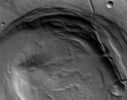
Volcanic_Features-Biblis_Patera-213-190705-1034-6-nd-01-BiblisP_H.jpgBiblis Patera (EDM - credits: ESA/DLR/FU Berlin (G. Neukum))73 visiteOriginal ESA caption:"This image taken by the High Resolution Stereo Camera (HRSC) on board ESA’s Mars Express spacecraft, shows the Biblis Patera Volcano, located in the Western part of the Tharsis rise on Mars.
The HRSC obtained this image on 8 November 2004 during orbit 1034 with a ground resolution of approx. 10,8 mt per pixel. Its shows the region of Biblis Patera at approx. 2,0° North and 236,0° East.
North is to the right".Set 18, 2005
|
|

Claritas_Fossae-5-098-140904-0508-6-3d-01-ClaritasFossae_hires.jpgClaritas Fossae (5 - ESA/ DLR/ FU Berlin - G. Neukum)91 visitenessun commentoApr 18, 2005
|
|

Claritas_Fossae-4-096-140904-0508-6-co-01-ClaritasFossae_hires.jpgClaritas Fossae (4 - ESA/ DLR/ FU Berlin - G. Neukum)76 visiteCaption ESA originale:"The lava blankets of the Solis Planum area cover the eastern parts of the older Claritas Fossae ridge and surround some of the higher ground. The geological history of this region can be reconstructed by analysing the layers of tectonic grabens, impact craters, volcanic features and even small valley networks. The complexity of Claritas Fossae Region suggests that some of the events took place at the same time. Furthermore, the detailed view of the large southern impact crater shows patches of dark material which are located near the central and marginal parts of the impact crater floor. This material may be of volcanic origin".Apr 18, 2005
|
|

Claritas_Fossae-3-096-140904-0508-6-co-01-ClaritasFossae_hires.jpgClaritas Fossae (3 - ESA/ DLR/ FU Berlin - G. Neukum)86 visiteCaption ESA originale:"The displayed region is the eastern part of Claritas Fossae and the western part of Solis Planum at longitude 260° East and latitude of about 28° South.
The diffuse blue-white streaks in the northern parts of the scene (Sx di chi guarda) are clouds or aerosols. The Claritas Fossae (‘fossa’ is Latin for trough----->canale) region is characterised by systems of ‘grabens’ running mainly north-west to south-east. These can be traced several hundred kilometres up to the northern Tharsis shield volcanoes.
A "graben" forms when a block of the planet’s crust drops down between 2 faults, due to extension, or pulling, of the crust. A ‘horst and graben’ system can occur where there are several parallel faults.
Geographically, the grabens separate the eastern volcanic plains of the Solis Planum region from the western Daedalia Planum lava plains.Apr 18, 2005
|
|
| 106 immagini su 9 pagina(e) |
 |
|
|
|
|
|
8 |
|








