| Ultimi arrivi - Mars through Mars Express (ESA - Original Raw Frames & Orbital Panoramas) |
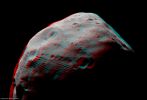
Phobos-404-20080729-5181-6-an-01-Phobos-Flyby_2_H1.jpgPhobos in 3D (red-cyan anaglyph)72 visiteCaption ESA:"On July 23, 2008, the High Resolution Stereo Camera on board ESA’s Mars Express took the highest-resolution full-disc image yet of the surface of the moon Phobos.
This image data was acquired from a distance of about 97 Km with a spatial resolution of about 3,7 m/pixel".MareKromiumLug 31, 2008
|
|
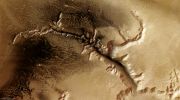
Echus_Chasma-398-260508-2204-6-co-01-H1.jpgEchus Chasma (False Colors)71 visiteThe High-Resolution Stereo Camera (HRSC) on board ESA's Mars Express has returned images of Echus Chasma, one of the largest Water Source Regions on the Red Planet.
The data were acquired on September, 25, 2005.
The pictures are centred at about 1° North and 278° East and have a ground resolution of approx. 17 mt/pixel.
Echus Chasma is an approx. 100 Km long and 10 Km wide incision in the Lunae Planum High Plateau North of Valles Marineris, the "Grand Canyon" of Mars. Echus Chasma is the Water Source Region of Kasei Valles, which extends thousands of Km to the North, and its southern-most part. The images of the Echus Chasma plateau show valleys that are about 10 km long and 1000 m deep. The main valley, Kasei Valles, is about 4 km in depth. The smaller valleys, also called sapping canyons, originate from the discharge of groundwater.
Echus Chasma is bounded to the West by the Echus Chasma Plateau, which lies about 4 Km above Echus' floor. MareKromiumLug 23, 2008
|
|

Echus_Chasma-398-260508-2204-6-co-01-H2.jpgHigh Cliffs Surrounding Echus Chasma on Mars76 visiteWhat created this great cliff on Mars? Did giant waterfalls once plummet through its grooves? With a four-kilometer drop, this high cliff surrounding Echus Chasma, near an impressive impact crater, was carved by either water or lava. A leading hypothesis is that Echus Chasma, at 100-Km long and 10-Km wide, was once one of the largest water sources on Mars. If true, water once held in Echus Chasma likely ran over the Martian Surface to carve the impressive Kasei Valles, which extends over 3000 Km to the North. Even if initially carved by water, lava appears to have later flowed in the valley, leaving an extraordinarily smooth floor. Echus Chasma lies north of tremendous Valles Marineris, the largest canyon in the Solar System. The above image was taken by the robotic Mars Express spacecraft currently orbiting Mars.
Nota Lunexit: checchè ne dica la NASA, questo frame NON E' una fotografia.MareKromiumLug 23, 2008
|
|
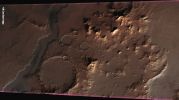
Hellespontus_Region_and_Reull_Vallis.jpgHellespontus and Reull Region (MULTISPECTRUM processing, from an idea of Keith Laney)68 visitenessun commentoMareKromiumLug 13, 2008
|
|
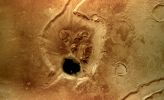
Craters-Unnamed_Crater_at_the_end_of_Mamers_Valles-392-250408-3304-6-co-01.jpgBird's-Eye view of Mamers Valles (MULTISPECTRUM; credits: Lunexit)122 visiteThe High-Resolution Stereo Camera (HRSC) onboard the ESA Spacecraft Mars Express obtained images focusing on a depression that displays a crater at the end of the long, winding Valley System known as Mamers Valles.
The data was obtained on 5 August 2006, with a ground resolution of approx. 14 mt/pixel. The image is centred at approx. 39° North and 17° East on the Planet.
The Mamers Valles System is approx. 1000 Km long, running along the boundary between the Northern Lowlands and Southern Highlands in the Region of Deuteronilus Mensae.
Scientists term a Region such as Mamers Valles ‘fretted terrain’ because it shows numerous deep and wide labyrinth-like valleys and circular depressions which often show structures formed by flowing liquid on their even floors. The structures formed by the flows are thought to be ice-rich debris flows. They show some resemblance to block glaciers seen on Earth.
The patches of rock at the centre of the depression are thought to be remnants of rock detached from the flanks of the depression and transported into its centre MareKromiumMag 22, 2008
|
|
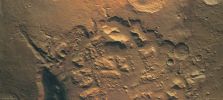
NepenthesMensae-385-090408-5212-6-co1-01.jpgNepenthes Mensae (MULTISPECTRUM; credits: Lunexit)111 visiteThe High Resolution Stereo Camera on board ESA’s Mars Express Orbiter imaged Nepenthes Mensae, a river delta on Mars, on 22 January 2008.
The data was acquired in the Region lying at approx. 3° North and 121° East, with a ground resolution of 15 mt/pixel.
The southern part of the image shows a structure reminiscent of a river delta on Earth, whose material was eroded from a valley, about 30 Km long and upto 1000 mt deep. This formed a fan-shaped deposit at the mouth of the valley. The rim of the deposit stands roughly 300 mt above the floor of the depression.
The resemblance of the structure to river deltas on Earth suggests that it was formed by a similar mechanism. Scientists believe that sediment transported by water was deposited as the flow of the water slowed down where the channel widened and met the mouth of the river.
The pictures show that the Region was affected by two episodes of flooding.
The first left a cone-shaped deposit, reaching far out into the lowland.
The second episode formed the fan with the distinct margin. This margin could indicate the location where sediments flowed into a standing body of water or ice.
Numerous hills and flat-topped mountains visible in the central part of the depression are remnants of the material that was present in the area.
The material was then eroded forming the depression, leaving behind the elevations visible today.MareKromiumMag 05, 2008
|
|
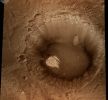
Craters-Pollack_Crater-H1201_0001_ND3_crop_wide-3.jpgPollack Crater and "White Rock" (Natural Colors - Tri-Chromatic Version; credits for the additional process. and color.: Dr Paolo C. Fienga - Lunexit Team)70 visitenessun commentoMareKromiumApr 07, 2008
|
|
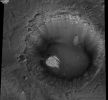
Craters-Pollack_Crater-H1201_0001_ND3_crop_wide-0.jpgPollack Crater and "White Rock" (RAW Frame; credits: ESA - Mars Express)72 visitenessun commentoMareKromiumApr 07, 2008
|
|

Hebes_Chasma.jpgHebes Chasma (Natural Colors + MULTISPECTRUM; credits: ESA and Lunexit)71 visiteThe Region is an "Enclosed Trough" situated in Valles Marineris, the Grand Canyon of Mars, where water is believed to have flowed.
The High Resolution Stereo Camera (HRSC) on ESA's Mars Express studied the area providing new pictorial clues to its history.
Hebes Chasma is located at approx. 1° South Lat. and 282° East Long. Image data was obtained on 16 September 2005 with a ground resolution of approx. 15 mt/pixel.
The Region is an enclosed, almost 8 Km-deep trough in the most northern part of Valles Marineris, the 3000-Km long Grand Canyon of Mars.
The steep flanks of the trough show branched incisions and small veins of rock. Below the flanks, run-off and material from larger landslides is also visible.
A flat-topped mountain is located in the centre of Hebes Chasma.
It reaches 8000 mt above the graben floor and rises to almost the same height as the plains surrounding the trough. MareKromiumApr 05, 2008
|
|
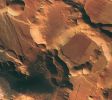
NoctisLabyrinthus.jpgNoctis Labyrinthus (Natural Colors + MULTISPECTRUM; credits: ESA & Lunexit)141 visiteThis image was taken by the High-Resolution Stereo Camera (HRSC), onboard ESA’s Mars Express imaged the Noctis Labyrinthus Region, the ‘Labyrinth of the Night’ on Mars.
The HRSC took these pictures on 25 June 2006 in orbit 3155, with a ground resolution of approx. 16 mt/pixel.MareKromiumApr 05, 2008
|
|

PrometheiPlanum.jpgPromethei Terra (Natural Colors + MULTISPECTRUM; credits: ESA & Lunexit)70 visitePromethei Planum, an area seasonally covered with layer of ice more than 3500 mt thick layer of ice in the Martian South Polar Region, was the subject of the High Resolution Stereo Camera’s focus on 22 September 2005 as Mars Express was in orbit above the Red Planet.
Promethei Planum lies at approx. 76° South Lat. and 105° East Long.
An approx. 100 Km-large and 800 mt-deep impact crater is visible in the Northern part of the image. The crater’s interior is partly covered in ice.
In the centre of the image are structures that may have been created by basaltic lava flow from a volcano. This area is covered in ice. The dark dunes towards the bottom of the image are most likely made up of dust originating from this lava flow or volcanic ash.
A broad sheet of ice, which is an extension of the South Polar Ice Cap is located South of the lava flow. The steep flanks clearly show white, clean ice. The thickness of the ice is between 900 and 1100 mt.MareKromiumApr 05, 2008
|
|
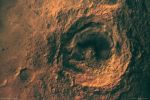
MaunderCrater.jpgMaunder Crater (Natural Colors + MULTISPECTRUM; credits: ESA & Lunexit)89 visiteThe above image shows the striking Maunder crater lying at approx. 50° South Lat. and 2° East Long., in the Noachis Terra Region on Mars.
The High Resolution Stereo Camera (HRSC) on ESA’s Mars Express orbiter took pictures of the Noachis Terra Region during orbits 2412 and 2467 on 29 November and 14 December 2005, respectively, with a ground resolution of approx. 15 mt/pixel.
The Sun illuminates the scene from the North-East (top left in the image).
Maunder crater, named after the British Astronomer Edward W. Maunder, is located halfway between Argyre Planitia and Hellas Planitia on the Southern Highlands of Mars.
With a diameter of 90 Km and a depth of barely 900 mt, the Crater is not one of the largest impact craters on Mars at present, but it used to be much deeper. It has since been filled partially with large amounts of material.MareKromiumApr 05, 2008
|
|
| 106 immagini su 9 pagina(e) |
 |
|
|
|
6 | |
|
|








