| Ultimi arrivi - Mars through Mars Express (ESA - Original Raw Frames & Orbital Panoramas) |

Volcanoes-Arsia_Mons-Eruption-04.jpgArsia Mons is erupting? (Processed Natural Colors; credits for the additional process. and color.: Dr Marco Faccin - Lunexit Team)123 visitenessun commentoMareKromiumLug 18, 2009
|
|
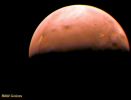
Volcanoes-Arsia_Mons-Eruption-05.jpgArsia Mons is erupting? (RAW Natural Colors; credits for the additional process. and color.: Dr Marco Faccin - Lunexit Team)79 visitenessun commentoMareKromiumLug 18, 2009
|
|
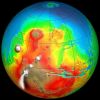
Volcanoes-Arsia_Mons-Eruption-01.jpgArsia Mons is erupting?85 visiteIn questa inequivocabile e spettacolarmente "visiva" ricostruzione del "pennacchio" scaturito dal Vulcano Arsia Mons (un grande complimento al nostro Marco Faccin per l'idea e per l'esecuzione!), ecco che la magnitudine del fenomeno segnalatoVi nella giornata di ieri (16 Luglio 2009) si evidenzia in tutta la sua straordinaria maestosità.
Ma che cosa è successo, esattamente?
Al momento, le Fonti Ufficiali (ESA e soprattutto NASA) non dicono nulla. L'ESA, onore al merito (quando c'é!), ha divulgato l'informazione e le prime immagini; la NASA...nulla. Silenzio assoluto.
Peccato.
Peccato perché, ora come non mai, puntare le ottiche delle Sonde Odyssey e Reconnaissance verso la caldera di Arsia Mons sarebbe una garanzia di immagini straordinarie e, certamente, di assoluto valore storico e scientifico.
Staremo a vedere...MareKromiumLug 17, 2009
|
|
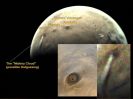
Volcanoes-Arsia_Mons-Eruption-00.jpgArsia Mons is erupting?136 visiteIn data 2 Luglio 2009, sono state ottenute (dalla Sonda ESA "Mars Express") una serie di immagini che SEMBRANO essere la prova visibile della verificazione di un fenomeno vulcanico tutt'altro che residuale nella Provincia Marziana di Tharsis: una nube piuttosto chiara, ma molto densa e compatta (oltre che di dimensioni davvero imponenti - ne stimiamo la lunghezza intorno ai 400/450 Km), pare infatti provenire dal Vulcano Arsia Mons.
La qualità delle immagini ESA (scattate lungo l'arco di circa 30 minuti) è - come sempre... - scarsa e quindi, se non altro per il momento, ci limitiamo a pubblicare l'immagine più significativa (ed in Natural Colors), nel contesto di un piccolo collage il quale Vi sarà di aiuto per capire non solo la possibile origine dello sfogo, ma anche le sue attuali dimensioni (calcolabili agevolmente, una volta tenutosi conto che la caldera di Arsia Mons ha un diametro di circa 110 Km).
Attendiamo le Vostre opinioni ed i Vostri commenti (speculazioni incluse)!MareKromiumLug 16, 2009
|
|
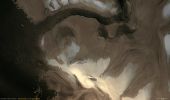
RupesTenuis-428-20081205-5872-6-co-01-RupesTenuis_H1.jpgNorth Polar Features: Rupes Tenuis (Natural Colors; credits: Lunar Explorer Italia)73 visiteCaption ESA:"ESA’s Mars Express Orbiter imaged the snow-laden region of Rupes Tenuis on the Martian North Pole on July, 29th, 2008.
Rupes Tenuis is located at the southern edge of the Martian North Polar Cap, approx. 5500 Km North-East of the Tharsis Province.
The image shows an area located at about 81° North Lat. and 297° East Long. and has a ground resolution of approx. 41 mt/pixel. It covers an area of about 44.000 Km2 (such as almost as large as the Netherlands)".
Nota Lunexit: secondo noi, questa "immagine" (che in realtà dovrebbe essere un fotomosaico) NON E' reale. L'immagine...NON E' un'immagine reale di Marte (è solo una ricostruzione virtuale, nello stile tipico della - sempre più ambigua e sopravvalutata - ESA). MareKromiumMar 08, 2009
|
|
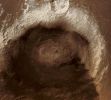
Craters-Crommelin_Crater-PCF-LXTT.jpgCrommelin Crater (Natural Colors; credits for the additional process. and color.: Dr Paolo C. Fienga - Lunar Explorer Italia)78 visiteCoord.: 5,1° North Lat. and 349,8° East Long.MareKromiumFeb 03, 2009
|
|
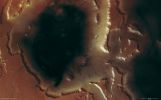
Deuteronilus_Mensae_Region-PCF-LXTT.jpgDeuteronilus Mensae (Enhanced Natural Colors; credits for the additional process. and color.: Dr Paolo C. Fienga - Lunar Explorer Italia70 visiteThis image shows the Deuteronilus Mensae Region on Mars, an area primarily characterized by (peri)glacial features.
It was taken on 14 March 2005 (orbit number 1483) by the High Resolution Stereo Camera (HRSC) onboard ESA's Mars Express with a ground resolution of approx. 29 mt per pixel.
The area is located on the Northern edge of Arabia Terra and borders the Southern High- and Northern Lowlands, at approx. 39° North Lat. and 23° East Long. MareKromiumFeb 01, 2009
|
|

Cydonia_Region-h3253_0000_s12-2.jpgDo you recognize this place? (natural colors; credits: Dr G. Barca & Lunexit)82 visiteUn semplice "Space-quiz": che Regione è quella che vedete in questo frame? Le Vostre risposte - motivate - possono essere inserite nei "Commenti".MareKromiumNov 25, 2008
|
|
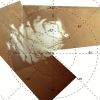
SouthPole-MG_SP_Fig02a_H.jpgThe South Pole of Mars (natural colors; credits: Lunexit)73 visiteCaption ESA:"This is a mosaic of images taken by the Mars Express’s Visible and Infrared Mineralogical Mapping Spectrometer, OMEGA.
It shows the Residual South Polar Cap at the end of Northern Winter on the Red Planet. The cap appears clearly asymmetric, its centre being displaced by 3° from the Geographic Pole".MareKromiumOtt 03, 2008
|
|
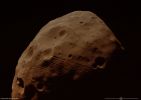
Phobos-401-20080729-5851-6-na-1a-Phobos-Flyby_H1.jpgPhobos in HR (Enhanced Natural Colors; credits for the additional process. and color.: Dr Paolo C. Fienga - Lunexit Team)72 visiteCaption ESA:"On July 23, 2008, the High Resolution Stereo Camera on board the ESA’s Mars Express took the highest-resolution full-disc image yet of the surface of the moon Phobos.
The image data were acquired from a distance of about 97 Km from Phobos' Surface, with a spatial resolution of about 3,7 mt/pixel, during orbit 5851.
These images have surpassed all previous images from other missions in continuous coverage of the illuminated surface at the highest spatial resolution of 3,7 mt/pixel".
This image has been geometrically corrected and exhibits the original illumination and photometric conditions". MareKromiumLug 31, 2008
|
|
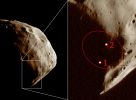
Phobos-402-20080729-5851-6-GRUNT-01-Phobos-Flyby_H1.jpgPhobos and two possible Landing Sites for "GRUNT" (natural colors; credits: Lunexit)70 visiteCaption ESA:"HRSC Stereo Channel 1 image of Phobos with a resolution of 3,7 mt/pixel at its best. The inset to the right shows the potential Landing Region and Sites for the Russia’s Phobos-Grunt sample return mission, due for launch in 2009". MareKromiumLug 31, 2008
|
|
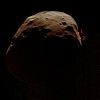
Phobos-403-20080729-5850-6-SRC-01_H1.jpgPhobos and two possible Landing Sites for "GRUNT" (natural colors; credits: Lunexit)70 visiteCaption ESA:"HRSC Super-resolution channel (SRC) image taken on July, 22, 2008 from a distance of approix. 4500 Km, showing the illuminated edge of the potential Landing Site of the Russian "Phobos-Grunt" Mission.
MareKromiumLug 31, 2008
|
|
| 106 immagini su 9 pagina(e) |
 |
|
|
5 | |
|
|
|








