| Ultimi arrivi - Mars through Mars Express (ESA - Original Raw Frames & Orbital Panoramas) |
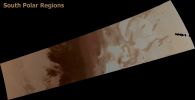
South_Polar_Regions-h1245_0000_nd3~0.jpgThe beautiful Southern Regions of Mars (Natural Colors; credits for the additional process. and color.: Dr Paolo C. Fienga - Lunexit Team)80 visitenessun commentoMareKromiumAgo 02, 2010
|
|

Coprates_Catena-h0438_0000_nd3-00-PCF-LXTT.jpgFrame Mars Express n. h0438_0000_nd3 (natural colors - elab. Lunexit) 77 visitenessun commentoMareKromiumAgo 02, 2010
|
|
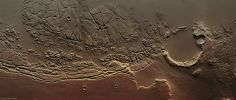
Kasei_Valles_and_Sacra_Fossae-448-20091007-6241-6-co-01_H1.jpgKasei Valles and Sacrae Fossae (Absolute Natural Colors; credits for the additional process. and color.: Dr Paolo C. Fienga - Lunexit Team)73 visiteCaption ESA:"Mars Express flew over the boundary between Kasei Valles and Sacra Fossae and imaged the Region, acquiring spectacular views of the Chaotic Terrain in the area.
The image is centred at about 12° North Latitude and 285° East Longitude and have a ground resolution of approx. 21 mt/pixel.
They cover about 225 x 95 Km (or 21.375 sq Km); an area roughly half the size of the Netherlands".MareKromiumGiu 23, 2010
|
|

Phobos-400-455-20091201.jpgBig Brother and Little Brother70 visitePhobos and Deimos RAW (left panel) and processed images (right panel).
In a first, ESA’s Mars Express Orbiter imaged the Martian Moons Phobos and Deimos together on November, 5th, 2009.
Apart from their ‘wow’ factor, these unique images will help the HRSC team validate and refine existing orbit models of the two moons.
The images were acquired with the Super Resolution Channel (SRC) of the High Resolution Stereo Camera (HRSC). The camera took 130 images of the moons on November 5th at 09:14 CET in a span of 1,5 minutes at intervals of 1", speeding up to 0,5" intervals toward the end. The image resolution is 110 m/pixel for Phobos and 240 m/pixel for Deimos — Deimos was more than twice as far from the camera.
The Super Resolution Channel of the HRSC uses an additional lens, which has a very narrow field of view of just 0,5°, providing four times the magnification than otherwise providing four times the resolution of the HRSC colour stereo channel.
Phobos, the larger of the two moons, orbits closer to the Red Planet, circling it every 7 hours and 39 minutes. It travels faster relative to Mars than the Moon relative to Earth.
Phobos was about 11.800 Km from Mars Express when the images were taken. Deimos, instead, was about 26.200 Km away.MareKromiumFeb 28, 2010
|
|
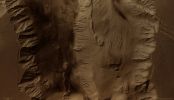
Chasmas-Candor_Chasma.jpgCandor Chasma (Natural Colors; credits: Lunexit)72 visitenessun commentoMareKromiumDic 05, 2009
|
|
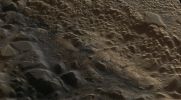
IaniChaos-ESA-PF.jpgIani Chaos (possible Natural Colors; credits ESA - additional color. and process. Dr Paolo C. Fienga)109 visiteIani Chaos on Mars, an area where Light Toned Deposits, or LTD, are known to be present. An analysis of data and images from Mars Express suggests that several LTD, some of the least understood structures on Mars, were formed when large amounts of groundwater burst on to the Surface. Scientists propose that groundwater had a greater role in shaping the Martian Surface than previously believed, and may have sheltered primitive life forms as the Planet started drying up.
This image was obtained with the High Resolution Stereo Camera on board ESA’s Mars Express Spacecraft.
Nota Lunexit: a nostro avviso questa "immagine" NON E' VERA! E' un disegno. Al limite, è la trasposizione digitale di un frame RAW originale unprocessed (ma ne dubitiamo). MareKromiumOtt 22, 2009
|
|
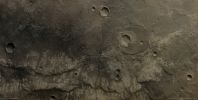
Ma_AdimVallis-ESA-PF.jpgMa'adim Vallis (possible Natural Colors; credits ESA - additional color. and process. Dr Paolo C. Fienga)93 visiteMars Express image of a region close to Ma’adim Vallis, one of the largest canyons on Mars. After Valles Marineris, Ma’adim Vallis is one of the largest canyons on Mars. The imaged region lies South-East of Ma’adim Vallis; the pictures are centred at about 29° South Lat. and 182° East Long. and have a ground resolution of approx. 15 mt/pixel.
Ma’adim Vallis is located between the Volcanic Region of Tharsis, which harbours four volcanoes, including the largest in the Solar System, and the Hellas Planitia Impact Basin.
The canyon, about 20 Km wide and 2 Km deep, originates in the southern highlands close to the ‘Dichotomy Boundary’ and ends in Gusev Crater.
The Dichotomy Boundary is a narrow region separating the Cratered Highlands, located mostly in the Southern Hemisphere of Mars, from the Northern Hemisphere's Lowland Plains.
Nota Lunexit: a nostro avviso questa "immagine" NON E' VERA! E' un disegno. Al limite, è la trasposizione digitale di un frame RAW originale unprocessed (ma ne dubitiamo). MareKromiumOtt 22, 2009
|
|

South_Polar_Regions-Rupes_Tenuis-ESA-PF.jpgRupes Tenuis (possible Natural Colors; credits ESA - additional color. and process. Dr Paolo C. Fienga)88 visiteESA’s Mars Express orbiter imaged the snow-laden Region of Rupes Tenuis on the Martian North Pole on 29 July 2008.
Rupes Tenuis is located at the Southern Edge of the Martian North Polar Cap, approx. 5500 Km northeast of the Tharsis Volcanic Region.
The images are at about 81° north and 297° east and have a ground resolution of approx. 41 mt/pixel. They cover an area of about 44.000 square/Km, almost as large as the Netherlands.
Nota Lunexit: a nostro avviso questa "immagine" NON E' VERA! E' un disegno. Al limite, è la trasposizione digitale di un frame RAW originale unprocessed (ma ne dubitiamo).MareKromiumOtt 22, 2009
|
|

MA_ADIM_VALLIS-440-20090629-6393-6-co-01_H1-1.jpgProximities of Ma'adim Vallis (Natural Colors; credits: ESA)84 visiteCaption ESA:"Mars Express image of a Region close to Ma’adim Vallis, one of the largest - after Vallis Marineris - canyons on Mars.
The imaged Region lies South-East of Ma’adim Vallis; the pictures are centred at about 29° South Lat. and 182° East Long. and have a ground resolution of 15 mt/pixel.
Ma’adim Vallis is located between the Volcanic Province of Tharsis, which harbours 4 volcanoes, including the largest in the Solar System, and the Hellas Planitia Impact Basin.
The canyon, approx. 20 Km wide and 2 Km deep, originates in the Southern Highlands close to the so-called ‘Dichotomy Boundary’ and ends in Gusev Crater.
The Dichotomy Boundary is a narrow Region separating the cratered Highlands, located mostly in the Southern Hemisphere of Mars, from the Northern Hemisphere's Lowland Plains".MareKromiumLug 24, 2009
|
|
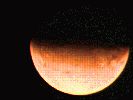
Volcanoes-Arsia_Mons-Eruption-06.gifArsia Mons is erupting? (a GIF-Movie in processed Natural Colors by Dr Marco Faccin - Lunexit Team)93 visiteSolo un'annotazione "tecnica": notate come l'Atmosfera di Marte (tutt'altro che impercettibile ed ultra-sottile...) si evidenzia sul bordo del Pianeta colorandosi, di fotogramma in fotogramma, dello stesso colore della Dominante propria del Filtro impiegato.
Un altro straordinario Lavoro del nostro Marco Faccin, che ringraziamo di Cuore!MareKromiumLug 18, 2009
|
|
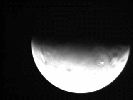
Volcanoes-Arsia_Mons-Eruption-03.gifArsia Mons is erupting? (a GIF-Movie by: Dr Marco Faccin - Lunexit Team)80 visitenessun commentoMareKromiumLug 18, 2009
|
|
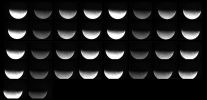
Volcanoes-Arsia_Mons-Eruption-02.jpgArsia Mons is erupting? (ALL available frames - a Photo-Mosaic by Dr Marco Faccin - Lunexit Team)78 visitePer il momento, l'unica ipotesi che noi, come Gruppo Lunar Explorer Italia (LunExIt), possiamo avanzare è orientata verso la verificazione di un fenomeno esplosivo (quello che ha generato la nuvola e poi il pennacchio) di considerevole portata. Se ad esso abbia fatto (e/o stia facendo) seguito una vera e propria eruzione, non lo possiamo sapere.
L'unica certezza è che "qualcosa" è successo.
Marte, se volete, ci ha dato un FORTE segnale di risveglio (ricordate che il vulcanismo è un segno tipico e caratterizzante degli ambienti geologicamente attivi).
Ora noi aspettiamo.
E continuiamo ad osservare...MareKromiumLug 18, 2009
|
|
| 106 immagini su 9 pagina(e) |
 |
|
4 | |
|
|
|
|








