| |

| Ultimi arrivi - After One-Thousand Soles... |

OPP-SOL5111-PIA22929_PANCAMSOL5111_1P581919922EFFD2FCP2682L8M1.jpg...End of Transmissions... - Sol 5111177 visiteCaption NASA:"Taken on June 10, 2018 (such as the 5111th Martian Day, or Sol, of the mission) this “noisy”, incomplete image was the last data NASA's MER Opportunity sent back from Perseverance Valley.
The partial, full-frame image from the Panoramic Camera (PanCam) was sent up to NASA's Mars Reconnaissance Orbiter around 09:45 a.m. PDT (such as 12:45 p.m. EDT) to relay back to Earth as an intense Dust Storm darkened the Skies around the solar-powered Rover. The image was received on Earth at around 10:05 a.m. PDT (1:05 p.m. EDT).
Opportunity took this image with the left (Sx) eye of the PanCam, with its Solar Filter pointed at the Sun. But since the Dust Storm blotted out the Sun, the image is dark. The white speckles are noise from the camera. All PanCam images have noise in them, but the darkness makes it more apparent. The transmission stopped before the full image was transmitted, leaving the bottom of the image incomplete, represented here as black pixels.
While this partial full-frame image was the last that Opportunity transmitted, it was not actually the last set of images from Opportunity. This image was taken at around 9:30 a.m. PDT (12:30 p.m. EDT) on June 10, 2018. Another set of images was taken about three minutes later. The thumbnail versions of the last images taken were transmitted, but the Rover lost contact before transmitting the full-frame versions".MareKromiumNov 17, 2019
|
|

OPP-SOL3973-7153_opportunity-spirit-st-louis-atc-sol3973-pia19393-full2.jpgSpirit of St Louis' Panorama - Sol 3973147 visiteUn solo commento: colori pastellati, densi e falsissimi... Bello il Panorama, comunque.MareKromiumNov 17, 2019
|
|
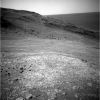
OPP-SOL4406-1N519329440EFFCQK0P1787L0M1.jpgSo it looks like.... - Sol 4406112 visiteMarte cambia sempre, eppure - guardando frames che ci (ri)portano alla memoria "L'Alba di Opportunity", tutto sembra sempre uguale. Ma sarà davvero così?!?...
Forse. O forse no.
Comunque la qualità delle immagini del MER Opportunity, oltre le "Garanzie" (di fabbricazione) e le dette e ripetute "Ottimistiche Previsioni" degli Scienziati che seguono questa Missione da anni, é sempre piuttosto alta. Complimenti!MareKromiumOtt 26, 2019
|
|
OPP-SOL4610-1N537447055EFFCUGPP1954R0M1.jpgOutcrops and Ouposts... - Sol 4610111 visitenessun commentoMareKromiumOtt 26, 2019
|
|
OPP-SOL4736-1N548639530EFFCZH5P1985R0M1.jpgSigns of Silence... - Sol 4736102 visitenessun commentoMareKromiumOtt 26, 2019
|
|
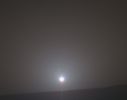
OPP-SOL4999-21503_pia22221_Sol4999-pcam-dawn_800.jpgCold Dawn over Opportunity - Sol 4999 (Approximate True Colors)130 visiteSempre suggestiva l'Alba di Marte...MareKromiumOtt 26, 2019
|
|
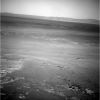
OPP-SOL5074-1N578631423EFFD2E2P1965L0M1.jpgFlat Plain, Dunes and a distant Horizon - Sol 5074102 visitenessun commentoMareKromiumOtt 26, 2019
|
|
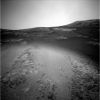
OPP-SOL5083-1N579431743EFFD2FAP1950R0M1.jpgCounterlight - Sol 5083104 visitenessun commentoMareKromiumOtt 26, 2019
|
|
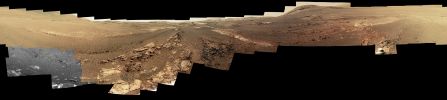
OPP-SOL5084-22342_PIA22909-LegacyPan-True-NASA.jpgPanorama - Sol 5084 (Image-Mosaic - Approximate True Colors)95 visiteCaption NASA:"This 360° panorama is composed of 354 images taken by the MER Opportunity's Panoramic Camera (or "PanCam", for short) from May 13 through June 10, 2018, or Soles (i.e.: Martian Days) 5084 to and through 5111.
This is the last panorama Opportunity acquired before the solar-powered MER succumbed to a Global Martian Dust Storm on the same abovementioned Sol. This version of the scene is presented in Approximate True Colors.
To the right (Dx) of center and near the top of the frame, the Rim of Endeavour Crater rises in the distance. Just to the left (Sx) of that, Rover Tracks begin their descent from over the horizon towards the location that would become Opportunity's final resting spot in Perseverance Valley, where the panorama was taken.
At the bottom, just left of center, is the Rocky Outcrop Opportunity was investigating with the instruments on its Robotic Arm (or RA, for short). To the right of center and halfway down the frame is another Rocky Outcrop — about 23 feet (such as abou 7 meters) distant from the camera — called "Ysleta del Sur," which Opportunity investigated from March 3 through 29, 2018, or Soles 5015 through 5038. In the far right and left of the frame are the bottom of Perseverance Valley and the Floor of Endeavour Crater.
Located on the inner Slopes of the Western Rim of Endeavour Crater, Perseverance Valley is a system of shallow Troughs descending eastward about the length of two football fields from the crest of Endeavour's Rim to its Floor.
This (note: they wrote Approximate) True-Color version combines images collected through three PanCam filters. The filters admit light centered on wavelengths of 753 nanometers (near-infrared), 535 nanometers (green) and 432 nanometers (blue). The three-color bands are combined.
A few frames (bottom left) remain black and white, as the solar-powered rover did not have the time to photograph those locations using the green and violet filters before a severe Mars-wide Dust Storm swept in on June 2018".MareKromiumOtt 26, 2019
|
|

OPP-SOL3466-PIA17585-PCF-LXTT-IPF.jpgOn the Outer Rim of Endeavour Crater (Image-Mosaic - Absolute Natural Colors; credits for the additional process. and color. Dr Paolo C. Fienga/Lunar Explorer Italia/Italian Planetary Foundation)104 visiteThis is an image-mosaic that shows us the lower reaches of an area of Meridiani Planum (please, remember that we are now very close to the Outer Rim of the large Endeavour Crater) that is informally known as "Murray Ridge". The individual images that were used to create this mosaic were all acquired during the 3466th Sol (such as October, 24, 2013 on Earth) of exploration of the Martian peri-Equatorial Region of Meridiani Planum, by using the Navigation Camera (or "NavCam", for short) that is onboard the NASA - Mars Exploration Rover (MER) - "Opportunity".
This Ridge, as we mentioned herebefore, is part of the Outer Rim of Endeavour Crater and it has been identified by the Opportunity's Science Team as an important Site for scientific exploration. The Ridge has been (so far) informally named "Murray Ridge" to honor the late Dr Bruce Murray, who made fundamental advances in Mars Science and who led the NASA's Jet Propulsion Laboratory through a period of great challenges and achievements.
This frame (which is an Original NASA - Mars Exploration Rover (MER) - "Opportunity" Original b/w image published on the NASA - Planetary Photojournal and identified by the ID n. PIA 17585) has been additionally processed (where the additional processing has been based on the assumption that the Atmospheric Opacity - "TAU" - of the pictured area was LOW), Gamma corrected and then colorized in Absolute Natural Colors (such as the colors that a normal - meaning "in the average" - human eye would actually perceive if someone were on the Surface of Mars, near the NASA - Mars Exploration Rover (MER) - Opportunity, and then looked ahead, towards the Surface, Horizon and Sky over Endeavour Crater), by using an original technique created - and, in time, dramatically improved - by the Lunar Explorer Italia Team.
Note: please consider that the Martian Sky (as it has been colored and represented in this picture) appears extremely dark because quite a few of the frames used to make the mosaic were taken during the hours of the Martian Middle/Late Afternoon, such as during that period of the day when the luminosity of the Martian Sky itself (better yetç: that porton of it which is not near, around and/or right above the Sun's disk) drops rapidly and dramatically.MareKromiumNov 25, 2013
|
|

OPP-SOL3355-PIA17271-PCF-LXTT-IPF-2.jpgSouthward View (Absolute Natural Colors; credits for the additional process. and color.: Dr Paolo C. Fienga/Lunar Explorer Italia/Italian Planetary Foundation)63 visiteThis very suggestive picture shows us some of the Terrain that the NASA - Mars Exploration Rover (MER) Opportunity is crossing in a (always relatively speaking) flat area of Endeavour Crater, called "Botany Bay", and located on the way toward "Solander Point," which is visible on the horizon.
The NASA - Mars Exploration Rover (MER) Opportunity used its Rear Hazard-Identification Camera (or HazCam, for short) to record this Southward view at the end of a drive covering about 387 feet (such as a little less than 118 meters) and which took place on the 3.355th Martian Day (or Sol) of Opportunity's work on Mars (such as July, 2nd, 2013 on Earth). Rover planners have been driving Opportunity in reverse, with the aim of to mitigatating a little bit the normal wearand tear on the Front - and so-called - "Wheel Actuators". For scale, the distance between the two Rear Wheels visible in the foreground is about 3,3 feet (a little more than 1 meter). The underside of Opportunity's Deck is visible at the top of the image. The Surface that the Rover (MER) Opportunity is driving upon, while crossing Botany Bay, is a Mosaic Pavement of fractured, light-toned Bedrock (---> the so-called "Martian Paving" of Meridiani Planum). A mixture of dark-toned Basaltic Soil and small Spherules - nicknamed "Blueberries" - fills-up most of the Cracks existing between the Bedrock pieces and, here and there, also thinly covers some of the Bedrock itself.
This frame (which is an Original NASA - Mars Exploration Rover (MER) "Opportunity" b/w image published on the NASA - Planetary Photojournal and identified by the ID n. PIA 17271) has been additionally processed, magnified and then colorized in Absolute Natural Colors (such as the colors that a normal - meaning "in the average" - human eye would actually perceive if someone were on the Surface of Mars, near the NASA - Mars Exploration Rover (MER) Opportunity, and then looked ahead, towards the Horizon and Sky over Endeavour Crater), by using an original technique created - and, in time, dramatically improved - by the Lunar Explorer Italia Team.MareKromiumLug 14, 2013
|
|

OPP-SOL3355-PIA17271-PCF-LXTT-IPF.jpgSouthward View (White-Balanced Natural Colors; credits for the additional process. and color.: Dr Paolo C. Fienga/Lunar Explorer Italia/Italian Planetary Foundation)113 visiteThis very suggestive picture shows us some of the Terrain that the NASA - Mars Exploration Rover (MER) Opportunity is crossing in a (always relatively speaking) flat area of Endeavour Crater, called "Botany Bay", and located on the way toward "Solander Point," which is visible on the horizon.
The NASA - Mars Exploration Rover (MER) Opportunity used its Rear Hazard-Identification Camera (or HazCam, for short) to record this Southward view at the end of a drive covering about 387 feet (such as a little less than 118 meters) and which took place on the 3.355th Martian Day (or Sol) of Opportunity's work on Mars (such as July, 2nd, 2013 on Earth). Rover planners have been driving Opportunity in reverse, with the aim of to mitigatating a little bit the normal wearand tear on the Front - and so-called - "Wheel Actuators". For scale, the distance between the two Rear Wheels visible in the foreground is about 3,3 feet (a little more than 1 meter). The underside of Opportunity's Deck is visible at the top of the image. The Surface that the Rover (MER) Opportunity is driving upon, while crossing Botany Bay, is a Mosaic Pavement of fractured, light-toned Bedrock (---> the so-called "Martian Paving" of Meridiani Planum). A mixture of dark-toned Basaltic Soil and small Spherules - nicknamed "Blueberries" - fills-up most of the Cracks existing between the Bedrock pieces and, here and there, also thinly covers some of the Bedrock itself.
This frame (which is an Original NASA - Mars Exploration Rover (MER) "Opportunity" b/w image published on the NASA - Planetary Photojournal and identified by the ID n. PIA 17271) has been additionally processed, magnified and then colorized in White-Balanced Natural Colors (such as the colors that a normal - meaning "in the average" - human eye would actually perceive if someone were on the Surface of Mars, near the NASA - Mars Exploration Rover (MER) Opportunity, and then looked ahead, towards the Horizon and Sky over Endeavour Crater), by using an original technique created - and, in time, dramatically improved - by the Lunar Explorer Italia Team.MareKromiumLug 14, 2013
|
|
| 2387 immagini su 199 pagina(e) |
2 | |
|
|
|
|
|
|
|
|
|
|
|





