| Ultimi arrivi - After One-Thousand Soles... |

OPP-SOL1065-1P222748165EFF78ESP2666R1M1.jpgHorizon (2) - Sol 106564 visitenessun commentoFeb 01, 2007
|
|

SOL1083-2P222482431EFFASCGP2749R7M1.jpgJust like a long time ago...195 visiteOsservate l'inset in b/n e quindi provate a rispondere a questa domanda: è mai possibile che, a distanza di tre anni dalla prima "Anomalìa", se ne sia verificata una seconda la quale è quasi del tutto identica a quella che la NASA stessa fece fatica a spiegare? Per rinfrescarVi la memoria, ecco che cosa dissero gli Amici di Pasadena della prima Stella Cadente Marziana:"Observing the sky with the green filter of it panoramic camera, the Mars Exploration Rover Spirit came across a surprise: a streak across the sky. The streak, seen in the middle of this mosaic of images taken by the navigation and panoramic cameras, was probably the brightest object in the sky at the time. Scientists theorize that the mystery line could be either a meteorite or one of seven out-of-commission spacecraft still orbiting Mars. Because the object appeared to move 4° of an arc in 15" it is probably not the Russian probes Mars 2, Mars 3, Mars 5 or Phobos 2; or the American probes Mariner 9 or Viking 1. That leaves Viking 2, which has a polar orbit that would fit with the North-South orientation of the streak. In addition, only Viking 1 and 2 were left in orbits that could produce motion as fast as that seen by Spirit. Said Mark Lemmon, a rover team member from Texas A&M University, Texas - "Is this the first image of a meteor on Mars, or an image of a spacecraft sent from another world during the dawn of our robotic space exploration program? We may never know, but we are still looking for clues".
Purtroppo, i "clues" (elementi probatori) di cui Mark Lemmon parlava non sono stati mai trovati. Almeno sino ad oggi...MareKromiumGen 25, 2007
|
|
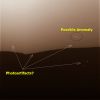
SOL1083-2P222482431EFFASCGP2749R7M1.jpgImage-Artifacts and a (candidate) "Shooting Star"?!? - Sol 1083149 visiteSe ne sono dette tante (e scritte anche di più...), ma la Verità è ancora elusiva, più che mai: il dettaglio cerchiato in questo frame è un semplice image-artifact o si tratta di qualcosa di diverso?
Certo, "quelli che sanno" diranno subito che si tratta di un difetto dell'immagine e, forse, costoro avranno anche ragione...Ma la similitudine (o somiglianza, se Vi piace di più) fra questo "candidate image-artifact/shooting star" ed una "striscia nel cielo" che ha fatto e fa ancora discutere davvero tantissimo, anche alla NASA (era nel cielo di Marte sempre dalla parte di Spirit - che allora si stava avvicinando al Cratere Bonneville), c'è ed è evidente.
E' il segno visibile di un "bolide", come dissero alla NASA ipotizzando anche la natura "artificiale" del bolide stesso - forse la Sonda Viking Orbiter 2 che, entrata in crisi orbitale, abbandonò la sua quieta orbita per precipitare e quindi incenerirsi (come una stella cadente) negli strati superiori dell'atmosfera Marziana?
E' solo una sonda (una delle tante che ruotano attorno a Marte...) in semplice transito?
E' un O.V.N.I.?
O forse - ed infine - è un mero difetto del frame?...
Decidetelo Voi, naturalmente.
Noi una certa idea ce la siamo fatta ma - come si dice? - "non vogliamo condizionare i Lettori con le nostre speculazioni"...Gen 24, 2007
|
|

SOL1083-2P222482233EFFASCGP2673L7M1.jpgPossible "evening colors" of Mars - Sol 108399 visitenessun commentoGen 24, 2007
|
|

OPP-SOL1060-PIA09116.jpgGoing around Victoria...from MRO62 visiteCaption NASA originale:"Three years after embarking on a historic exploration of the red planet and six miles away from its landing site, NASA's Mars Exploration Rover Opportunity is traversing "Victoria Crater" ridge by ridge, peering at layered cliffs in the interior. To identify various alcoves and cliffs along the way, science team members are using names of places visited by the 16th-century Earth explorer Ferdinand Magellan and his crew aboard the ship Victoria, who proved the Earth is round. (All names are unofficial unless approved by the International Astronomical Union.)
This orbital view of "Victoria Crater" was taken by NASA's Mars Reconnaissance Orbiter".Gen 24, 2007
|
|
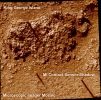
SOL1031-PIA09092-RA6-mi-king-george_annotated.jpgThe "granules" of King George Island62 visiteCaption NASA originale:"This mosaic was made from frames acquired by the MI - Microscopic Imager on NASA's MER Spirit during Spirit's 1031st Martian Day, or Sol, on the Red Planet (such as Nov. 27, 2006). It shows a rock target called "King George Island" after the target was brushed by the Rover's RAT - Rock Abrasion Tool.
The mosaic covers approx. 6 cm (2,4") across and shows the granular nature of the rock exposure. The grains are typically about 1 mm (0,04") wide.
Data from the Rover's Mössbauer Spectrometer provides evidence that they have an enhanced amount of the mineral Hematite relative to surrounding soils".Gen 23, 2007
|
|
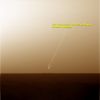
OPP-SOL1063-1P222525781EFF78DYP2665L4M1-01.jpgThe "Twin-Peaks" of Meridiani Planum in the twilight (1)88 visiteDa elevate distanze ed in condizioni di illuminazione appropriate, molti rilievi che di squadrato (o di conico) non hanno nulla possono assumere, specie allorchè la definizione delle immagini non è perfetta, delle apparenze fortemente ingannevoli. Chi non ricorda, ad esempio, i "Twin-Peaks" osservati per mesi dalla Sonda Pathfinder e definiti, dal Prof. Hoagland - come da altri Eso-Archeologi della sua Scuola -, come probabili "candidate degraded pyramids"?
Questa situazione visuale è analoga, solo che i rilievi "pseudo-piramidali" di Meridiani Planum sono molto più lontani (forse 10 Km) da Opportunity rispetto a quanto non lo fossero i Twin-Peaks di Pathfinder.
Ci arriverà mai Opportunity a vederli da vicino?!? Staremo a vedere...MareKromiumGen 22, 2007
|
|

OPP-SOL1063-1P222526312EFF78DYP2665R1M1-02.jpgThe "Twin-Peaks" of Meridiani Planum in the twilight (2)66 visitenessun commentoMareKromiumGen 22, 2007
|
|

OPP-SOL1063-1P222526312EFF78DYP2665R1M1-03.jpgThe "Twin-Peaks" of Meridiani Planum in the twilight (3 - extra detail mgnf)67 visitenessun commentoMareKromiumGen 22, 2007
|
|
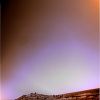
SOL1079-2N222151251EDNASCGP1585L0M1.jpgLate morning at Gusev - Sol 107963 visiteUna nuova elaborazione dei "Colori di Marte" secondo Lunexit che, a quanto sembra, sta iniziando a piacere: cielo scuro e tendenzialmente color arancio/mattone a partire dai 45/50°, un'area più luminosa (bianca e celeste pallida) a ridosso dell'orizzonte ed una regione di transizione fra i 20/25 ed i 35° in cui, come la NASA stessa ci pare che abbia suggerito in passato, il cielo potrebbe assumere una colorazione violetta.
A ridosso del disco solare, invece, mentre alla NASA suggeriscono/suppongono che il cielo dovrebbe apparire color violetto/azzurro pallido (...due to the scattering of the Sunlight...), noi ribattiamo dicendo che la giusta colorazione del Cielo Marziano - specie allorchè il Sole è alto sull'orizzonte - dovrebbe essere di un arancio piuttosto vivace.
Poi, chi vivrà, vedrà...MareKromiumGen 20, 2007
|
|

OPP-SOL1061-1N222384482EFF78DYP1962R0M1.jpgMorning Lights - Sol 106167 visitenessun commentoMareKromiumGen 20, 2007
|
|

OPP-SOL1061-1R222383886EFF78DYP1311R0M1.jpgMorning Lights - Sol 106165 visitenessun commentoMareKromiumGen 20, 2007
|
|
| 2387 immagini su 199 pagina(e) |
 |
|
|
|
|
194 | |
|
|
|
|





