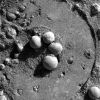
ZZ-ZZ-ZZ-ZZ-ZZ-IMAGE059.jpgHard Rock or Soft Rock?177 visiteDall'Amico e Socio Matteo Fagone (PianetaMarte.net), una interessante - e controversa - serie di riflessioni ed ipotesi collegate a quanto viene mostrato in questo intrigante frame Marziano proveniente dalla Regione di Meridiani.
Buona Lettura!
“Come sapete si è già parlato molto a proposito di queste Stranezze Marziane e già sono state proposte alcune ipotesi sulla loro possibile natura ed origine.
Ricapitolando: potrebbe trattarsi di formazioni sedimentarie prodotte dall'azione dell'acqua, allorché essa si è combinata con altri elementi ora andati perduti.
Oppure potremmo essere davanti a veri e propri fossili. Fossili che ci riporterebbero a Forme di Vita indigene, ormai estinte da ere, anche se c'è qualcuno che ipotizza che i “Mirtilli Marziani” possano essere delle Forme di Vita tuttora attive (“vive”, insomma), fondate su principi organici e metabolici profondamente diversi rispetto a quelli propri dell'ambiente terrestre.
Difficile prendere una posizione definitiva visto il ventaglio di opzioni disponibili (tutte, sebbene ciascuna abbia i propri “pro” ed i propri “contro”, relativamente accettabili).
Ma lasciamo stare questo aspetto della problematica – peraltro affascinante – e soffermiamoci su un aspetto che ora possiamo meglio prendere in considerazione, grazie a questo bellissimo frame: quanto sono dure le sferule? Insomma, se le potessimo prendere in mano si frantumerebbero alla minima pressione? O dovremmo “impegnarci” per schiacciarle? Oppure, nonostante i nostri sforzi “distruttivi”, essere rimarrebbero intatte?
E se invece si appiattissero (così come sembra essere accaduto qualche volta)?
Non si tratta di interrogativi oziosi poichè le implicazioni connesse alle risposte che potremmo dare sono oltremodo serie: di cosa sono fatte le “sferule”? Sono strutture elastiche o rigide?
Vediamo: l'elasticità è direttamente legata – anche – alla temperatura dell'ambiente esterno. Se su Marte facesse davvero molto freddo (come si suppone da sempre), con valori medi ben al di sotto dello zero, dovremmo dedurre che la maggior parte delle strutture elastiche o semirigide eventualmente esistenti sulla superficie del Pianeta Rosso si sarebbero dovute irrigidire in toto per poi diventare oltremodo compatte e dure.
Se questo fosse vero, però, dette strutture, in maniera proporzionale al loro irrigidimento, avrebbero dovuto anche diventare fragili.
Fragili al punto da frantumarsi all’esercizio di pressioni anche (relativamente) modeste, ma questo non pare che accada: strano, non è vero?
Avete notato che alcune delle sferule riprese in questa immagine sono praticamente sprofondate nel terreno? Qualsiasi genere di pressione esse abbiano ricevuto (modesta, ma non insignificante – pensate alla pressione esercitata dal passaggio delle ruote del Rover o dall’imposizione dello Spettrometro Mossbauer) non è stata comunque sufficiente a frantumarle.
Esse sono state spinte dentro il terreno.
Cosa vuol dire?
Riflettete: sono le sferule ad essere solide e compatte, sebbene rigide? O è il terreno Marziano il quale, sebbene compatto (ma certo NON ghiacciato), risulta essere particolarmente soffice (e quindi capace di assecondare la pressione eventualmente ricevuta)?
O forse si tratta di un concorso di cause?
Riguardiamo il frame, teniamo a mente queste considerazioni e quindi diciamo che: forse le temperature superficiali medie di Marte non sono poi così basse come si ritiene e, quindi, le sferule potrebbero essere composte di materiali semirigidi (attenzione: semirigidi potrebbe anche voler dire “organici”…).
E se il suolo fosse realmente (come sembra da svariate immagini) “relativamente soffice”, quale sostanza sarebbe capace di ottenere un tale “miracolo” (visto il “gelo” che dovrebbe caratterizzare l’ambiente Marziano superficiale)?
E se la superficie del Pianeta Rosso fosse realmente “impregnata” di ghiaccio acqua?
Esistono anche delle sacche “quasi superficiali” del prezioso liquido (come su Encelado)?
E se così fosse, come mai queste acque quasi-superficiali non spariscono?
Esistono forse degli elementi ulteriori, contenuti nel suolo Marziano, i quali sono capaci di “ingabbiare” l’acqua esistente impedendole, però, sia di fuoriuscire e zampillare, sia di ghiacciare completamente e sia di evaporare in toto?
Possiamo supporre che su Marte esista un Ciclo dell'Acqua Aperto?...
Voi che dite?!?”.
01/09/07 at 15:48george_p: Mi fa venire in mente una bella frittata!!! Eheh.....
|
|

Titan-PIA09034.jpgCloudless Titan...62 visiteCaption NASA originale:"This image is a composite of several images taken during two separate Titan flybys on Oct. 9 (T19) and Oct. 25 (T20), 2006.
The large circular feature near the center of Titan's disk may be the remnant of a very old impact basin. The mountain ranges to the South-East of the circular feature and the long dark, linear feature to the North-West of the old impact scar may have resulted from tectonic activity on Titan caused by the energy released when the impact occurred.
The Oct. 9 images form the background globe for context and the most recent images from the Oct. 25 flyby are overlaid. The Oct. 9 images were taken at an average distance of about 30,000 Km (approx. 18.000 miles). The Oct. 25 images were taken at a distance of 12.000 Km (about 7.200 miles). The images were taken at wavelengths of 1,3 microns shown in blue, 2 microns shown in green and 5 microns shown in red".MareKromium12/19/06 at 12:00epsilon: Condivido e, checch? ne dica la NASA...i colori no...
|
|
Titan-PIA09034.jpgCloudless Titan...62 visiteCaption NASA originale:"This image is a composite of several images taken during two separate Titan flybys on Oct. 9 (T19) and Oct. 25 (T20), 2006.
The large circular feature near the center of Titan's disk may be the remnant of a very old impact basin. The mountain ranges to the South-East of the circular feature and the long dark, linear feature to the North-West of the old impact scar may have resulted from tectonic activity on Titan caused by the energy released when the impact occurred.
The Oct. 9 images form the background globe for context and the most recent images from the Oct. 25 flyby are overlaid. The Oct. 9 images were taken at an average distance of about 30,000 Km (approx. 18.000 miles). The Oct. 25 images were taken at a distance of 12.000 Km (about 7.200 miles). The images were taken at wavelengths of 1,3 microns shown in blue, 2 microns shown in green and 5 microns shown in red".MareKromium12/18/06 at 15:33Anakin: Bellissima questa immagine di Titano!!!
|
|

The Rings-PIA08290.jpgThe F-Ring (detail mgnf)70 visiteCaption NASA:"For some time, scientists have suspected the presence of tiny moonlets that orbit Saturn in association with the clumpy and braided-looking Ring. As the small satellites move close to the F-Ring core they leave a gravitational signature. In some cases they can draw out material in the form of a "streamer" - a miniature version of the interaction Cassini has witnessed between Prometheus and the F-Ring material. The dynamics of this interaction are the same, but the scale is different.
Scientists speculate that there could be several small moons with a variety of sizes involved in the creation of structures like the one seen here.
The image was taken in visible light with the Cassini spacecraft narrow-angle camera on Sept. 25, 2006 at a distance of approx. 255.000 Km (about 159.000 miles) from Saturn and at phase angle of 29°. Scale in the original image was 1 Km (about 3.873 feet) per pixel. The image has been magnified by a factor of two and contrast enhanced".12/07/06 at 10:31Axel Shaaf: From this picture I believe that it can be argued ...
|
|





