| Ultimi commenti - Mars Reconnaissance Orbiter (MRO) |

ESP_011605_1170_RED_abrowse.jpgDefrosting Malea Patera (Natural Colors; credits: Lunar Explorer Italia)76 visiteMalea Patera is one of a group of ancient volcanoes that ring the Hellas Impact Basin. This HiRISE image was intended to investigate the nature of the volcanic materials at this location. However, the image was taken in early Spring for this location in the Southern Hemisphere and so the ground is covered with bright frost except for some dark splotches found in discrete patches.
This is where the sunlight has penetrated the frost and initiated defrosting around discrete spots.
Clearly something is different about the patches where this defrosting has started before any other locations. One possibility is that these are (frost covered) dark sand dunes that heat up more easily than the surrounding terrain. However, we will need to take a new image in the Summer time to really know what is happening here.
Mars Local Time: 16:11 (middle afternoon)
Coord. (centered): 62,5° South Lat. and 53,3° East Long.
Spacecraft altitude: 249,1 Km (such as about 155,7 miles)
Original image scale range: 24,9 cm/pixel (with 1 x 1 binning) so objects ~75 cm across are resolved
Map projected scale: 25 cm/pixel
Map projection: EQUIRECTANGULAR
Emission Angle: 0,9°
Phase Angle: 72,4°
Solar Incidence Angle: 73° (meaning that the Sun is about 17° above the Local Horizon)
Solar Longitude: 192,6° (Northern Autumn)
Credits: NASA/JPL/University of Arizona
Additional process. and coloring: Lunar Explorer ItaliaMareKromium03/05/09 at 15:42MareKromium: Nessuno sa il motivo esatto per cui il disgelo (th...
|
|
ESP_011605_1170_RED_abrowse.jpgDefrosting Malea Patera (Natural Colors; credits: Lunar Explorer Italia)76 visiteMalea Patera is one of a group of ancient volcanoes that ring the Hellas Impact Basin. This HiRISE image was intended to investigate the nature of the volcanic materials at this location. However, the image was taken in early Spring for this location in the Southern Hemisphere and so the ground is covered with bright frost except for some dark splotches found in discrete patches.
This is where the sunlight has penetrated the frost and initiated defrosting around discrete spots.
Clearly something is different about the patches where this defrosting has started before any other locations. One possibility is that these are (frost covered) dark sand dunes that heat up more easily than the surrounding terrain. However, we will need to take a new image in the Summer time to really know what is happening here.
Mars Local Time: 16:11 (middle afternoon)
Coord. (centered): 62,5° South Lat. and 53,3° East Long.
Spacecraft altitude: 249,1 Km (such as about 155,7 miles)
Original image scale range: 24,9 cm/pixel (with 1 x 1 binning) so objects ~75 cm across are resolved
Map projected scale: 25 cm/pixel
Map projection: EQUIRECTANGULAR
Emission Angle: 0,9°
Phase Angle: 72,4°
Solar Incidence Angle: 73° (meaning that the Sun is about 17° above the Local Horizon)
Solar Longitude: 192,6° (Northern Autumn)
Credits: NASA/JPL/University of Arizona
Additional process. and coloring: Lunar Explorer ItaliaMareKromium03/05/09 at 13:24george_p: Ehm ehehe a prima vista pare una ripresa dall'...
|
|

ESP_011351_0945_RED_abrowse.jpgFans on Ice (Natural Colors; credits: Lunar Explorer Italia)57 visiteEvery Southern Winter the South Polar Region of Mars is covered with an approximately 1 meter deep layer of frozen CO2 (dry ice). In the Spring, when the Sun begins to warm the surface below the translucent ice, gas flow under the ice carries loose dust from the surface up onto the top.
The dust falls to the surface in "Fans", whose orientation is determined by the direction of the local wind flow. Fans from one source region pointing in multiple directions show how the wind direction has changed. Narrow Fans pointing in just one direction are the most recent. Alternatively, the vent from the surface may have re-annealed, such that these Fans were formed over a very limited time span.
Mars Local Time: 18:19 (sunset - early evening)
Coord. (centered): 85,2° South Lat. and 181,6° East Long.
Spacecraft altitude: 247,4 Km (such as about 154,6 miles)
Original image scale range: 99,0 cm/pixel (with 1 x 1 binning) so objects ~2,97 mt across are resolved
Map projected scale: 1 mt/pixel
Map projection: EQUIRECTANGULAR
Emission Angle: 4,2°
Phase Angle: 86,4°
Solar Incidence Angle: 90° (meaning that the Sun is about 0° on the Local Horizon)
Solar Longitude: 181,2° (Northern Autumn)
Credits: NASA/JPL/University of Arizona
Additional process. and coloring: Lunar Explorer ItaliaMareKromium02/20/09 at 12:52MareKromium: Allora? Chi mi individua la Singolarit? e me la sp...
|
|
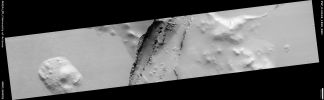
PSP_010638_1890_RED_abrowse-00.jpgAngular Unconformity in Cerberus Fossae (ctx RAW frame)83 visiteThis HiRISE image shows a part of the Cerberus Fossae, a long system of aligned fissures. The Cerberus Fossae were the source of the youngest major volcanic eruption on Mars that covered much of the surrounding area in lava. The region has also seen much other volcanic activity.
The walls of the fissures typically reveal lava layers. At this site, they have cut through an older hill that protrudes above the surrounding plains. The layers within the hill are tilted relative to the overlying rock, which appears to drape the region and runs continuously over the hill and plains.
This tilted contact is known as an Angular Unconformity. It is most likely that this formed when horizontal layers were tilted by faults before the most recent volcanic eruptions, forming the irregular hills.
The hills represent relatively old rock, while the smooth plains and the thin draping cover were formed more recently.MareKromium01/27/09 at 20:51george_p: Son Contento per tutte le notizie e Complimenti.
...
|
|
PSP_010638_1890_RED_abrowse-00.jpgAngular Unconformity in Cerberus Fossae (ctx RAW frame)83 visiteThis HiRISE image shows a part of the Cerberus Fossae, a long system of aligned fissures. The Cerberus Fossae were the source of the youngest major volcanic eruption on Mars that covered much of the surrounding area in lava. The region has also seen much other volcanic activity.
The walls of the fissures typically reveal lava layers. At this site, they have cut through an older hill that protrudes above the surrounding plains. The layers within the hill are tilted relative to the overlying rock, which appears to drape the region and runs continuously over the hill and plains.
This tilted contact is known as an Angular Unconformity. It is most likely that this formed when horizontal layers were tilted by faults before the most recent volcanic eruptions, forming the irregular hills.
The hills represent relatively old rock, while the smooth plains and the thin draping cover were formed more recently.MareKromium01/27/09 at 09:44MareKromium: Buongiorno Amici!
Il problema ? stato risolto ...
|
|
PSP_010638_1890_RED_abrowse-00.jpgAngular Unconformity in Cerberus Fossae (ctx RAW frame)83 visiteThis HiRISE image shows a part of the Cerberus Fossae, a long system of aligned fissures. The Cerberus Fossae were the source of the youngest major volcanic eruption on Mars that covered much of the surrounding area in lava. The region has also seen much other volcanic activity.
The walls of the fissures typically reveal lava layers. At this site, they have cut through an older hill that protrudes above the surrounding plains. The layers within the hill are tilted relative to the overlying rock, which appears to drape the region and runs continuously over the hill and plains.
This tilted contact is known as an Angular Unconformity. It is most likely that this formed when horizontal layers were tilted by faults before the most recent volcanic eruptions, forming the irregular hills.
The hills represent relatively old rock, while the smooth plains and the thin draping cover were formed more recently.MareKromium01/26/09 at 18:22omomoto: ci risiamo? l'umore ? come l'altra volta d...
|
|
PSP_010638_1890_RED_abrowse-00.jpgAngular Unconformity in Cerberus Fossae (ctx RAW frame)83 visiteThis HiRISE image shows a part of the Cerberus Fossae, a long system of aligned fissures. The Cerberus Fossae were the source of the youngest major volcanic eruption on Mars that covered much of the surrounding area in lava. The region has also seen much other volcanic activity.
The walls of the fissures typically reveal lava layers. At this site, they have cut through an older hill that protrudes above the surrounding plains. The layers within the hill are tilted relative to the overlying rock, which appears to drape the region and runs continuously over the hill and plains.
This tilted contact is known as an Angular Unconformity. It is most likely that this formed when horizontal layers were tilted by faults before the most recent volcanic eruptions, forming the irregular hills.
The hills represent relatively old rock, while the smooth plains and the thin draping cover were formed more recently.MareKromium01/26/09 at 14:55cano00: daccordissimo con quanto detto da GEORGE. ciao a t...
|
|
PSP_010638_1890_RED_abrowse-00.jpgAngular Unconformity in Cerberus Fossae (ctx RAW frame)83 visiteThis HiRISE image shows a part of the Cerberus Fossae, a long system of aligned fissures. The Cerberus Fossae were the source of the youngest major volcanic eruption on Mars that covered much of the surrounding area in lava. The region has also seen much other volcanic activity.
The walls of the fissures typically reveal lava layers. At this site, they have cut through an older hill that protrudes above the surrounding plains. The layers within the hill are tilted relative to the overlying rock, which appears to drape the region and runs continuously over the hill and plains.
This tilted contact is known as an Angular Unconformity. It is most likely that this formed when horizontal layers were tilted by faults before the most recent volcanic eruptions, forming the irregular hills.
The hills represent relatively old rock, while the smooth plains and the thin draping cover were formed more recently.MareKromium01/26/09 at 13:57george_p: Ciao a tutti,
concordo con Ivana quando scrive ch...
|
|
PSP_010638_1890_RED_abrowse-00.jpgAngular Unconformity in Cerberus Fossae (ctx RAW frame)83 visiteThis HiRISE image shows a part of the Cerberus Fossae, a long system of aligned fissures. The Cerberus Fossae were the source of the youngest major volcanic eruption on Mars that covered much of the surrounding area in lava. The region has also seen much other volcanic activity.
The walls of the fissures typically reveal lava layers. At this site, they have cut through an older hill that protrudes above the surrounding plains. The layers within the hill are tilted relative to the overlying rock, which appears to drape the region and runs continuously over the hill and plains.
This tilted contact is known as an Angular Unconformity. It is most likely that this formed when horizontal layers were tilted by faults before the most recent volcanic eruptions, forming the irregular hills.
The hills represent relatively old rock, while the smooth plains and the thin draping cover were formed more recently.MareKromium01/26/09 at 11:02MareKromium: Salve a tutti! L'origine del problema non ? ch...
|
|
PSP_010638_1890_RED_abrowse-00.jpgAngular Unconformity in Cerberus Fossae (ctx RAW frame)83 visiteThis HiRISE image shows a part of the Cerberus Fossae, a long system of aligned fissures. The Cerberus Fossae were the source of the youngest major volcanic eruption on Mars that covered much of the surrounding area in lava. The region has also seen much other volcanic activity.
The walls of the fissures typically reveal lava layers. At this site, they have cut through an older hill that protrudes above the surrounding plains. The layers within the hill are tilted relative to the overlying rock, which appears to drape the region and runs continuously over the hill and plains.
This tilted contact is known as an Angular Unconformity. It is most likely that this formed when horizontal layers were tilted by faults before the most recent volcanic eruptions, forming the irregular hills.
The hills represent relatively old rock, while the smooth plains and the thin draping cover were formed more recently.MareKromium01/26/09 at 10:44Ivana Tognoloni: Commenti nella "lista utenti"? Mai visti...
|
|
PSP_010638_1890_RED_abrowse-00.jpgAngular Unconformity in Cerberus Fossae (ctx RAW frame)83 visiteThis HiRISE image shows a part of the Cerberus Fossae, a long system of aligned fissures. The Cerberus Fossae were the source of the youngest major volcanic eruption on Mars that covered much of the surrounding area in lava. The region has also seen much other volcanic activity.
The walls of the fissures typically reveal lava layers. At this site, they have cut through an older hill that protrudes above the surrounding plains. The layers within the hill are tilted relative to the overlying rock, which appears to drape the region and runs continuously over the hill and plains.
This tilted contact is known as an Angular Unconformity. It is most likely that this formed when horizontal layers were tilted by faults before the most recent volcanic eruptions, forming the irregular hills.
The hills represent relatively old rock, while the smooth plains and the thin draping cover were formed more recently.MareKromium01/26/09 at 10:32george_p: questo l'ho notato anche io ma almeno da qualc...
|
|
PSP_010638_1890_RED_abrowse-00.jpgAngular Unconformity in Cerberus Fossae (ctx RAW frame)83 visiteThis HiRISE image shows a part of the Cerberus Fossae, a long system of aligned fissures. The Cerberus Fossae were the source of the youngest major volcanic eruption on Mars that covered much of the surrounding area in lava. The region has also seen much other volcanic activity.
The walls of the fissures typically reveal lava layers. At this site, they have cut through an older hill that protrudes above the surrounding plains. The layers within the hill are tilted relative to the overlying rock, which appears to drape the region and runs continuously over the hill and plains.
This tilted contact is known as an Angular Unconformity. It is most likely that this formed when horizontal layers were tilted by faults before the most recent volcanic eruptions, forming the irregular hills.
The hills represent relatively old rock, while the smooth plains and the thin draping cover were formed more recently.MareKromium01/26/09 at 08:38cano00: io devo segnalare la sparizione dei commenti fatti...
|
|
| 1160 immagini su 97 pagina(e) |
 |
|
|
|
|
82 | |
|
|
|
|





