| Ultimi commenti - Mars Reconnaissance Orbiter (MRO) |

ESP_014159_1670_RED_abrowse-01.jpg"Worm-like" Surface Feature in the Southern Highlands (EDM - Natural Colors; credits: Lunexit)65 visitenessun commentoMareKromium09/07/09 at 16:21John Koenig: La mia impressione ? che quella "roba" s...
|
|
ESP_014159_1670_RED_abrowse-01.jpg"Worm-like" Surface Feature in the Southern Highlands (EDM - Natural Colors; credits: Lunexit)65 visitenessun commentoMareKromium09/07/09 at 16:04Ivana Tognoloni: Che bello...ma cos'è???
|
|
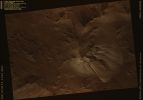
ESP_014153_1430_RED_abrowse.jpgGullies at the Edge of Hale Crater (Natural Colors; credits: Lunexit)58 visiteSeveral years ago, Gullies carved into hill-slopes and the walls of impact craters like the ones pictured here were discovered. Scientists are excited to study these features because, on Earth, they usually form through the action of liquid water - long thought to be absent on the Martian Surface.
Whether Gullies form under today's cold dry conditions is a major question that planetary scientists are trying to answer.
The Gullies pictured here are great examples of what a typical Martian Gully looks like. You can see wide V-shaped channels running downhill (from top to bottom) where the material that carved the Gully flowed. At the bottom of the channel this material empties out onto a fan-shaped mound. Several Gullies are visible here and the fans from each gully overlap one other in complicated ways.
At the tops of the channels, large amphitheater-shaped alcoves are carved in the rock. The material removed from these alcoves likely flowed downhill to the aprons through the Gullies.
Gullies at this site are especially interesting because scientists recently discovered examples at similar locations to be still active. Images separated by several years showed changes in the appearance of some of these Gullies.
Today, planetary scientists are using the HiRISE camera to examine Gullies for ongoing change and investigate what that might mean for the occurrence of liquid water on the Surface of Mars.MareKromium09/07/09 at 07:59walthari: grazie george per i complimenti...quelloche dici s...
|
|
ESP_014153_1430_RED_abrowse.jpgGullies at the Edge of Hale Crater (Natural Colors; credits: Lunexit)58 visiteSeveral years ago, Gullies carved into hill-slopes and the walls of impact craters like the ones pictured here were discovered. Scientists are excited to study these features because, on Earth, they usually form through the action of liquid water - long thought to be absent on the Martian Surface.
Whether Gullies form under today's cold dry conditions is a major question that planetary scientists are trying to answer.
The Gullies pictured here are great examples of what a typical Martian Gully looks like. You can see wide V-shaped channels running downhill (from top to bottom) where the material that carved the Gully flowed. At the bottom of the channel this material empties out onto a fan-shaped mound. Several Gullies are visible here and the fans from each gully overlap one other in complicated ways.
At the tops of the channels, large amphitheater-shaped alcoves are carved in the rock. The material removed from these alcoves likely flowed downhill to the aprons through the Gullies.
Gullies at this site are especially interesting because scientists recently discovered examples at similar locations to be still active. Images separated by several years showed changes in the appearance of some of these Gullies.
Today, planetary scientists are using the HiRISE camera to examine Gullies for ongoing change and investigate what that might mean for the occurrence of liquid water on the Surface of Mars.MareKromium09/06/09 at 19:34george_p: Eccellente avere tra gli amici Lunexit competenti ...
|
|
ESP_014153_1430_RED_abrowse.jpgGullies at the Edge of Hale Crater (Natural Colors; credits: Lunexit)58 visiteSeveral years ago, Gullies carved into hill-slopes and the walls of impact craters like the ones pictured here were discovered. Scientists are excited to study these features because, on Earth, they usually form through the action of liquid water - long thought to be absent on the Martian Surface.
Whether Gullies form under today's cold dry conditions is a major question that planetary scientists are trying to answer.
The Gullies pictured here are great examples of what a typical Martian Gully looks like. You can see wide V-shaped channels running downhill (from top to bottom) where the material that carved the Gully flowed. At the bottom of the channel this material empties out onto a fan-shaped mound. Several Gullies are visible here and the fans from each gully overlap one other in complicated ways.
At the tops of the channels, large amphitheater-shaped alcoves are carved in the rock. The material removed from these alcoves likely flowed downhill to the aprons through the Gullies.
Gullies at this site are especially interesting because scientists recently discovered examples at similar locations to be still active. Images separated by several years showed changes in the appearance of some of these Gullies.
Today, planetary scientists are using the HiRISE camera to examine Gullies for ongoing change and investigate what that might mean for the occurrence of liquid water on the Surface of Mars.MareKromium09/06/09 at 13:03walthari: che immagine meravigliosa!ho l'idea osservando...
|
|

PIA12194.jpgGullies at the Edge of Hale Crater (Natural Colors; credits: NASA/JPL/Univ. of Arizona)55 visiteThis image from the High Resolution Imaging Science Experiment (HiRISE) camera on NASA's Mars Reconnaissance Orbiter shows Gullies near the edge of Hale Crater on Southern Mars. The view covers an area about 1 Km (0,6 miles) across and was taken on Aug. 3, 2009.
Martian Gullies carved into hill slopes and the walls of impact craters were discovered several years ago. Scientists are excited to study these features because, on Earth, they usually form through the action of liquid water -- long thought to be absent on the Martian Surface. Whether liquid water carves gullies under today's cold and dry conditions on Mars is a major question that planetary scientists are trying to answer.
The Gullies pictured here are examples of what a typical Martian Gully looks like. You can see wide V-shaped channels running downhill (from top to bottom) where the material that carved the gully flowed. At the bottom of the channel this material empties out onto a fan-shaped mound. The fans from each gully overlap one other in complicated ways. At the tops of the channels, large amphitheater-shaped alcoves are carved in the rock. The material removed from these alcoves likely flowed downhill to the aprons through the Gullies.
The terrain in this image is at 36,5° South Latitude and 322,7° East Longitude.
Gullies at this site are especially interesting because scientists recently discovered actively changing examples at similar locations. Images separated by several years showed changes in the appearance of some of these Gullies. Today, planetary scientists are using the HiRISE camera to examine Gullies such as the one in this image for change that might provide a clue about whether liquid water occurs on the Surface of Mars.
Full-frame images, catalogued as ESP_014153_1430, are at http://hirise.lpl.arizona.edu/ESP_014153_1430.
The image was taken at 2:21 p.m. Local Mars Time, with the sun 54° above the horizon (S.I.A. = 36°).
The season was Summer in the Southern Hemisphere of Mars.MareKromium09/06/09 at 12:54MareKromium: Ciao Walt Ho pubblicato oggi il ctx frame. Aspetto...
|
|
PIA12194.jpgGullies at the Edge of Hale Crater (Natural Colors; credits: NASA/JPL/Univ. of Arizona)55 visiteThis image from the High Resolution Imaging Science Experiment (HiRISE) camera on NASA's Mars Reconnaissance Orbiter shows Gullies near the edge of Hale Crater on Southern Mars. The view covers an area about 1 Km (0,6 miles) across and was taken on Aug. 3, 2009.
Martian Gullies carved into hill slopes and the walls of impact craters were discovered several years ago. Scientists are excited to study these features because, on Earth, they usually form through the action of liquid water -- long thought to be absent on the Martian Surface. Whether liquid water carves gullies under today's cold and dry conditions on Mars is a major question that planetary scientists are trying to answer.
The Gullies pictured here are examples of what a typical Martian Gully looks like. You can see wide V-shaped channels running downhill (from top to bottom) where the material that carved the gully flowed. At the bottom of the channel this material empties out onto a fan-shaped mound. The fans from each gully overlap one other in complicated ways. At the tops of the channels, large amphitheater-shaped alcoves are carved in the rock. The material removed from these alcoves likely flowed downhill to the aprons through the Gullies.
The terrain in this image is at 36,5° South Latitude and 322,7° East Longitude.
Gullies at this site are especially interesting because scientists recently discovered actively changing examples at similar locations. Images separated by several years showed changes in the appearance of some of these Gullies. Today, planetary scientists are using the HiRISE camera to examine Gullies such as the one in this image for change that might provide a clue about whether liquid water occurs on the Surface of Mars.
Full-frame images, catalogued as ESP_014153_1430, are at http://hirise.lpl.arizona.edu/ESP_014153_1430.
The image was taken at 2:21 p.m. Local Mars Time, with the sun 54° above the horizon (S.I.A. = 36°).
The season was Summer in the Southern Hemisphere of Mars.MareKromium09/05/09 at 14:11walthari: splendido esempio di erosione e trasporto da corsi...
|
|
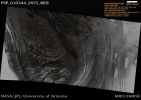
PSP_010344_2655_RED_abrowse.jpgScarp-fed Dark Dunes and NPLD (Natural Colors; credits: Lunexit)56 visiteMultiple levels within the North Polar Layered Deposits (NPLD) are visible in this HiRISE image.
The NPLD are a stack of dusty water-ice layers that are thought to record information about past Martian climates in the same way that Ice-Caps on the Earth record variations in our climate. These Martian layers are visible in the walls of troughs and scarps eroded into the stack.
One such scarp-face is visible on the far left of the full image and decreases in height from left to right.
Scientists continue to debate the length of time required to accumulate this stack of layers with estimates ranging from a few million years to about a billion years. Although we don’t yet know which layer corresponds to which time in Mars’ History, we can still use these layers to try to understand how the climate has changed over this period.
The topmost layers, which are the most recent (far left of the image), are brighter and appear gray-ish in this Natural Color view. They are interpreted to be a mixture of water ice and dust. The lower layering is more complex and appears to be a mixture of bright whiteiish layers (that we think are ice) and dark blue-ish layers (which we think are mostly sand).
A large pit in the center of the image penetrates deeply into this stack of layers and shows these alternating sandy and icy layers extending to depths of hundreds of meters (about 1000 feet).
Erosion of the dark sandy layers releases sandy material which collects into dunes such as the linear example that stretches across the middle of this image.MareKromium08/25/09 at 11:08MareKromium: Gi?, Grande Walthari: sarebbe fantastico. E pensa ...
|
|
PSP_010344_2655_RED_abrowse.jpgScarp-fed Dark Dunes and NPLD (Natural Colors; credits: Lunexit)56 visiteMultiple levels within the North Polar Layered Deposits (NPLD) are visible in this HiRISE image.
The NPLD are a stack of dusty water-ice layers that are thought to record information about past Martian climates in the same way that Ice-Caps on the Earth record variations in our climate. These Martian layers are visible in the walls of troughs and scarps eroded into the stack.
One such scarp-face is visible on the far left of the full image and decreases in height from left to right.
Scientists continue to debate the length of time required to accumulate this stack of layers with estimates ranging from a few million years to about a billion years. Although we don’t yet know which layer corresponds to which time in Mars’ History, we can still use these layers to try to understand how the climate has changed over this period.
The topmost layers, which are the most recent (far left of the image), are brighter and appear gray-ish in this Natural Color view. They are interpreted to be a mixture of water ice and dust. The lower layering is more complex and appears to be a mixture of bright whiteiish layers (that we think are ice) and dark blue-ish layers (which we think are mostly sand).
A large pit in the center of the image penetrates deeply into this stack of layers and shows these alternating sandy and icy layers extending to depths of hundreds of meters (about 1000 feet).
Erosion of the dark sandy layers releases sandy material which collects into dunes such as the linear example that stretches across the middle of this image.MareKromium08/25/09 at 08:20walthari: questi depositi glaciali dovrebbero essere meta di...
|
|

ESP_011884_2045_RED_abrowse-01.jpgUnusual Translucent Surface on the edge of a candidate Collapse Pit (edm frame - inset in False Colors, credits: Dr M. Faccin; inset in Natural Colors, credits: Lunar Explorer Italia)107 visiteOsservate attentamente: appena visibile nell'inset in Colori Naturali, ma del tutto evidente in quello elaborato in Falsi Colori, potete vedere NITIDAMENTE il margine (bordo) inferiore del pozzo (caratterizzato da piccoli accumuli di sabbia e pietrisco) anche guardando ATTRAVERSO LA SUPERFICIE TRASLUCIDA (color ambra nella versione in Colori Naturali e color celeste nella versione in Falsi Colori) che sembra formare una sorta di "anello" (o un numero "9") intorno al bordo superiore del pozzo.
Di qualunque materia si tratti, questo fenomeno a noi sembra straordinario; e a Voi???MareKromium08/24/09 at 18:442di7: eheheh guarda c'? da dire una cosa per?: quand...
|
|
ESP_011884_2045_RED_abrowse-01.jpgUnusual Translucent Surface on the edge of a candidate Collapse Pit (edm frame - inset in False Colors, credits: Dr M. Faccin; inset in Natural Colors, credits: Lunar Explorer Italia)107 visiteOsservate attentamente: appena visibile nell'inset in Colori Naturali, ma del tutto evidente in quello elaborato in Falsi Colori, potete vedere NITIDAMENTE il margine (bordo) inferiore del pozzo (caratterizzato da piccoli accumuli di sabbia e pietrisco) anche guardando ATTRAVERSO LA SUPERFICIE TRASLUCIDA (color ambra nella versione in Colori Naturali e color celeste nella versione in Falsi Colori) che sembra formare una sorta di "anello" (o un numero "9") intorno al bordo superiore del pozzo.
Di qualunque materia si tratti, questo fenomeno a noi sembra straordinario; e a Voi???MareKromium08/24/09 at 18:35titanio44: ? che avremmo bisogno di "vere" immagini...
|
|
ESP_011884_2045_RED_abrowse-01.jpgUnusual Translucent Surface on the edge of a candidate Collapse Pit (edm frame - inset in False Colors, credits: Dr M. Faccin; inset in Natural Colors, credits: Lunar Explorer Italia)107 visiteOsservate attentamente: appena visibile nell'inset in Colori Naturali, ma del tutto evidente in quello elaborato in Falsi Colori, potete vedere NITIDAMENTE il margine (bordo) inferiore del pozzo (caratterizzato da piccoli accumuli di sabbia e pietrisco) anche guardando ATTRAVERSO LA SUPERFICIE TRASLUCIDA (color ambra nella versione in Colori Naturali e color celeste nella versione in Falsi Colori) che sembra formare una sorta di "anello" (o un numero "9") intorno al bordo superiore del pozzo.
Di qualunque materia si tratti, questo fenomeno a noi sembra straordinario; e a Voi???MareKromium08/24/09 at 18:102di7: Grazie titanio. Si, direi che ci sono delle possib...
|
|
| 1160 immagini su 97 pagina(e) |
 |
|
|
|
|
73 | |
|
|
|
|





