| |

| Ultimi commenti - Mars Reconnaissance Orbiter (MRO) |
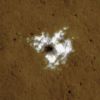
SubsurfaceIce-PIA12220.jpgMaterial excavated by a "Fresh Impact" is identified as Water Ice (Natural Colors; credits: Lunexit)55 visiteThe bright material conspicuous in this image was excavated from below the Surface and deposited nearby by a 2008 impact that dug a crater about 8 meters (26 feet) in diameter.
The extent of the bright patch was large enough for the Compact Reconnaissance Imaging Spectrometer for Mars, an instrument on NASA's Mars Reconnaissance Orbiter, to obtain information confirming the material to be water ice.
This image, covering an area 50 meters (164 feet) across, was taken on Nov. 1, 2008, by the High Resolution Imaging Science Experiment on the same Orbiter. The time frame for the crater-forming impact to have occurred was bracketed by before-and-after images (not shown) taken by the Thermal Emission Imaging System camera aboard NASA's Mars Odyssey Orbiter on Jan. 26, 2008, and by the Context Camera on the Mars Reconnaissance Orbiter on Sept. 18, 2008.
This Crater is at 55,57° North Latitude and 150,62° East Longitude (Vastitas Borealis Region). MareKromium09/26/09 at 14:37Anakin: Si Ufologo, hai detto bene, "...e grandissima...
|
|
SubsurfaceIce-PIA12220.jpgMaterial excavated by a "Fresh Impact" is identified as Water Ice (Natural Colors; credits: Lunexit)55 visiteThe bright material conspicuous in this image was excavated from below the Surface and deposited nearby by a 2008 impact that dug a crater about 8 meters (26 feet) in diameter.
The extent of the bright patch was large enough for the Compact Reconnaissance Imaging Spectrometer for Mars, an instrument on NASA's Mars Reconnaissance Orbiter, to obtain information confirming the material to be water ice.
This image, covering an area 50 meters (164 feet) across, was taken on Nov. 1, 2008, by the High Resolution Imaging Science Experiment on the same Orbiter. The time frame for the crater-forming impact to have occurred was bracketed by before-and-after images (not shown) taken by the Thermal Emission Imaging System camera aboard NASA's Mars Odyssey Orbiter on Jan. 26, 2008, and by the Context Camera on the Mars Reconnaissance Orbiter on Sept. 18, 2008.
This Crater is at 55,57° North Latitude and 150,62° East Longitude (Vastitas Borealis Region). MareKromium09/26/09 at 13:17MareKromium: Grazie di Cuore, a tutti - PCF
|
|
SubsurfaceIce-PIA12220.jpgMaterial excavated by a "Fresh Impact" is identified as Water Ice (Natural Colors; credits: Lunexit)55 visiteThe bright material conspicuous in this image was excavated from below the Surface and deposited nearby by a 2008 impact that dug a crater about 8 meters (26 feet) in diameter.
The extent of the bright patch was large enough for the Compact Reconnaissance Imaging Spectrometer for Mars, an instrument on NASA's Mars Reconnaissance Orbiter, to obtain information confirming the material to be water ice.
This image, covering an area 50 meters (164 feet) across, was taken on Nov. 1, 2008, by the High Resolution Imaging Science Experiment on the same Orbiter. The time frame for the crater-forming impact to have occurred was bracketed by before-and-after images (not shown) taken by the Thermal Emission Imaging System camera aboard NASA's Mars Odyssey Orbiter on Jan. 26, 2008, and by the Context Camera on the Mars Reconnaissance Orbiter on Sept. 18, 2008.
This Crater is at 55,57° North Latitude and 150,62° East Longitude (Vastitas Borealis Region). MareKromium09/26/09 at 11:21Ufologo: ... e grandissima passione!
|
|
SubsurfaceIce-PIA12220.jpgMaterial excavated by a "Fresh Impact" is identified as Water Ice (Natural Colors; credits: Lunexit)55 visiteThe bright material conspicuous in this image was excavated from below the Surface and deposited nearby by a 2008 impact that dug a crater about 8 meters (26 feet) in diameter.
The extent of the bright patch was large enough for the Compact Reconnaissance Imaging Spectrometer for Mars, an instrument on NASA's Mars Reconnaissance Orbiter, to obtain information confirming the material to be water ice.
This image, covering an area 50 meters (164 feet) across, was taken on Nov. 1, 2008, by the High Resolution Imaging Science Experiment on the same Orbiter. The time frame for the crater-forming impact to have occurred was bracketed by before-and-after images (not shown) taken by the Thermal Emission Imaging System camera aboard NASA's Mars Odyssey Orbiter on Jan. 26, 2008, and by the Context Camera on the Mars Reconnaissance Orbiter on Sept. 18, 2008.
This Crater is at 55,57° North Latitude and 150,62° East Longitude (Vastitas Borealis Region). MareKromium09/25/09 at 21:47Anakin: No Paolo, non ? culo. E' il frutto di un lavor...
|
|
SubsurfaceIce-PIA12220.jpgMaterial excavated by a "Fresh Impact" is identified as Water Ice (Natural Colors; credits: Lunexit)55 visiteThe bright material conspicuous in this image was excavated from below the Surface and deposited nearby by a 2008 impact that dug a crater about 8 meters (26 feet) in diameter.
The extent of the bright patch was large enough for the Compact Reconnaissance Imaging Spectrometer for Mars, an instrument on NASA's Mars Reconnaissance Orbiter, to obtain information confirming the material to be water ice.
This image, covering an area 50 meters (164 feet) across, was taken on Nov. 1, 2008, by the High Resolution Imaging Science Experiment on the same Orbiter. The time frame for the crater-forming impact to have occurred was bracketed by before-and-after images (not shown) taken by the Thermal Emission Imaging System camera aboard NASA's Mars Odyssey Orbiter on Jan. 26, 2008, and by the Context Camera on the Mars Reconnaissance Orbiter on Sept. 18, 2008.
This Crater is at 55,57° North Latitude and 150,62° East Longitude (Vastitas Borealis Region). MareKromium09/25/09 at 17:50Ufologo: Io leggo soltanto e m'istruisco; ma guarda Ma...
|
|
SubsurfaceIce-PIA12220.jpgMaterial excavated by a "Fresh Impact" is identified as Water Ice (Natural Colors; credits: Lunexit)55 visiteThe bright material conspicuous in this image was excavated from below the Surface and deposited nearby by a 2008 impact that dug a crater about 8 meters (26 feet) in diameter.
The extent of the bright patch was large enough for the Compact Reconnaissance Imaging Spectrometer for Mars, an instrument on NASA's Mars Reconnaissance Orbiter, to obtain information confirming the material to be water ice.
This image, covering an area 50 meters (164 feet) across, was taken on Nov. 1, 2008, by the High Resolution Imaging Science Experiment on the same Orbiter. The time frame for the crater-forming impact to have occurred was bracketed by before-and-after images (not shown) taken by the Thermal Emission Imaging System camera aboard NASA's Mars Odyssey Orbiter on Jan. 26, 2008, and by the Context Camera on the Mars Reconnaissance Orbiter on Sept. 18, 2008.
This Crater is at 55,57° North Latitude and 150,62° East Longitude (Vastitas Borealis Region). MareKromium09/25/09 at 17:06titanio44: bene bene......ad esempio il cratere" Lunexit...
|
|
SubsurfaceIce-PIA12220.jpgMaterial excavated by a "Fresh Impact" is identified as Water Ice (Natural Colors; credits: Lunexit)55 visiteThe bright material conspicuous in this image was excavated from below the Surface and deposited nearby by a 2008 impact that dug a crater about 8 meters (26 feet) in diameter.
The extent of the bright patch was large enough for the Compact Reconnaissance Imaging Spectrometer for Mars, an instrument on NASA's Mars Reconnaissance Orbiter, to obtain information confirming the material to be water ice.
This image, covering an area 50 meters (164 feet) across, was taken on Nov. 1, 2008, by the High Resolution Imaging Science Experiment on the same Orbiter. The time frame for the crater-forming impact to have occurred was bracketed by before-and-after images (not shown) taken by the Thermal Emission Imaging System camera aboard NASA's Mars Odyssey Orbiter on Jan. 26, 2008, and by the Context Camera on the Mars Reconnaissance Orbiter on Sept. 18, 2008.
This Crater is at 55,57° North Latitude and 150,62° East Longitude (Vastitas Borealis Region). MareKromium09/25/09 at 16:08MareKromium: Grazie Anakin! La verit? ? che, su queste pagine, ...
|
|
SubsurfaceIce-PIA12220.jpgMaterial excavated by a "Fresh Impact" is identified as Water Ice (Natural Colors; credits: Lunexit)55 visiteThe bright material conspicuous in this image was excavated from below the Surface and deposited nearby by a 2008 impact that dug a crater about 8 meters (26 feet) in diameter.
The extent of the bright patch was large enough for the Compact Reconnaissance Imaging Spectrometer for Mars, an instrument on NASA's Mars Reconnaissance Orbiter, to obtain information confirming the material to be water ice.
This image, covering an area 50 meters (164 feet) across, was taken on Nov. 1, 2008, by the High Resolution Imaging Science Experiment on the same Orbiter. The time frame for the crater-forming impact to have occurred was bracketed by before-and-after images (not shown) taken by the Thermal Emission Imaging System camera aboard NASA's Mars Odyssey Orbiter on Jan. 26, 2008, and by the Context Camera on the Mars Reconnaissance Orbiter on Sept. 18, 2008.
This Crater is at 55,57° North Latitude and 150,62° East Longitude (Vastitas Borealis Region). MareKromium09/25/09 at 15:39Anakin: A Cesare quel che è di Cesare
|
|
SubsurfaceIce-PIA12220.jpgMaterial excavated by a "Fresh Impact" is identified as Water Ice (Natural Colors; credits: Lunexit)55 visiteThe bright material conspicuous in this image was excavated from below the Surface and deposited nearby by a 2008 impact that dug a crater about 8 meters (26 feet) in diameter.
The extent of the bright patch was large enough for the Compact Reconnaissance Imaging Spectrometer for Mars, an instrument on NASA's Mars Reconnaissance Orbiter, to obtain information confirming the material to be water ice.
This image, covering an area 50 meters (164 feet) across, was taken on Nov. 1, 2008, by the High Resolution Imaging Science Experiment on the same Orbiter. The time frame for the crater-forming impact to have occurred was bracketed by before-and-after images (not shown) taken by the Thermal Emission Imaging System camera aboard NASA's Mars Odyssey Orbiter on Jan. 26, 2008, and by the Context Camera on the Mars Reconnaissance Orbiter on Sept. 18, 2008.
This Crater is at 55,57° North Latitude and 150,62° East Longitude (Vastitas Borealis Region). MareKromium09/25/09 at 15:30MareKromium: Solo una umile annotazione: anche senza disporre d...
|
|

ESP_014083_0945_RED_abrowse-00.jpgActive Geyser on Mars: the "Region" (Natural Colors; credits: Lunexit)61 visiteCoord.: 85,4° South Lat. and 104,0° East Long.
Spacecraft altitude: about 248 Km
M.L.T.: 16:08 (middle afternoon)
S.I.A.: 69° (with the Sun about 21° above the Local Horizon)
Credits: NASA/JPL/Univ. of Arizona
Additional process. and color.: Lunexit
Attività geotermica su Marte? La risposta, detta quasi sussurrando, ci arriva direttamente dalla NASA ed è "Si": su Marte si manifesta ancora CERTAMENTE un quantum (residuale?) di attività geotermica e la prova è nelle bocche ancora attive di una serie di geysers che vediamo nelle Regioni Sud-Polari (le Regioni che sembrano ospitarne di più, ma certo non le uniche Regioni ancora "vive" di Marte).
Dietro questa semplice (ed affascinante) ammissione, si apre un universo di possibilità, tutte quante accomunate da una circostanza: il sottosuolo di Marte è ancora "vivo" ed è ancora abbastanza "caldo e vivace" da sostenere la verificazione di eventi eruttivi (di modesta scala, ma non per questo di modesta importanza).
A quando la notizia che nel sottosuolo di Marte esistono ancora e, nelle ere, si sono sviluppate ed evolute delle Forme Vitali Indigene?...MareKromium09/24/09 at 08:04Anakin: 1) Nota/Battuta noi siamo pi? avanti a Leonardo te...
|
|
ESP_014083_0945_RED_abrowse-00.jpgActive Geyser on Mars: the "Region" (Natural Colors; credits: Lunexit)61 visiteCoord.: 85,4° South Lat. and 104,0° East Long.
Spacecraft altitude: about 248 Km
M.L.T.: 16:08 (middle afternoon)
S.I.A.: 69° (with the Sun about 21° above the Local Horizon)
Credits: NASA/JPL/Univ. of Arizona
Additional process. and color.: Lunexit
Attività geotermica su Marte? La risposta, detta quasi sussurrando, ci arriva direttamente dalla NASA ed è "Si": su Marte si manifesta ancora CERTAMENTE un quantum (residuale?) di attività geotermica e la prova è nelle bocche ancora attive di una serie di geysers che vediamo nelle Regioni Sud-Polari (le Regioni che sembrano ospitarne di più, ma certo non le uniche Regioni ancora "vive" di Marte).
Dietro questa semplice (ed affascinante) ammissione, si apre un universo di possibilità, tutte quante accomunate da una circostanza: il sottosuolo di Marte è ancora "vivo" ed è ancora abbastanza "caldo e vivace" da sostenere la verificazione di eventi eruttivi (di modesta scala, ma non per questo di modesta importanza).
A quando la notizia che nel sottosuolo di Marte esistono ancora e, nelle ere, si sono sviluppate ed evolute delle Forme Vitali Indigene?...MareKromium09/23/09 at 14:31MareKromium: Buonasera a Tutti!
Un "grazie" partic...
|
|
ESP_014083_0945_RED_abrowse-00.jpgActive Geyser on Mars: the "Region" (Natural Colors; credits: Lunexit)61 visiteCoord.: 85,4° South Lat. and 104,0° East Long.
Spacecraft altitude: about 248 Km
M.L.T.: 16:08 (middle afternoon)
S.I.A.: 69° (with the Sun about 21° above the Local Horizon)
Credits: NASA/JPL/Univ. of Arizona
Additional process. and color.: Lunexit
Attività geotermica su Marte? La risposta, detta quasi sussurrando, ci arriva direttamente dalla NASA ed è "Si": su Marte si manifesta ancora CERTAMENTE un quantum (residuale?) di attività geotermica e la prova è nelle bocche ancora attive di una serie di geysers che vediamo nelle Regioni Sud-Polari (le Regioni che sembrano ospitarne di più, ma certo non le uniche Regioni ancora "vive" di Marte).
Dietro questa semplice (ed affascinante) ammissione, si apre un universo di possibilità, tutte quante accomunate da una circostanza: il sottosuolo di Marte è ancora "vivo" ed è ancora abbastanza "caldo e vivace" da sostenere la verificazione di eventi eruttivi (di modesta scala, ma non per questo di modesta importanza).
A quando la notizia che nel sottosuolo di Marte esistono ancora e, nelle ere, si sono sviluppate ed evolute delle Forme Vitali Indigene?...MareKromium09/23/09 at 12:25walthari: Ciao Titanio44....la verit? ? sotto ai nostri occh...
|
|
| 1160 immagini su 97 pagina(e) |
|
|
|
|
|
70 | |
|
|
|
|
|
|





