| Ultimi commenti - Mars Reconnaissance Orbiter (MRO) |

Psp_010656_2170_red.jpgThe "Omega" Crater of Ismenius Lacus (possible True Colors; credits: Lunar Explorer Italia)61 visite
Per gli amanti dei Misteri Orbitali e delle possibili "Forme Assonanti" (con questa definizione si intendono tutti i rilievi superficiali situati su mondi extraterrestri i quali, in ragione della loro distanza dal punto di osservazione, o per motivi oggettivi - ex.: affinità morfologica -, o per entrambe le ragioni, richiamano alla mente dell'Osservatore dei rilievi superficiali artificiali che sono individuabili sulla Terra), ecco a Voi il (piccolo) "Cratere Omega".
Il nome del cratere (battezzato da noi e quindi, ufficialmente, ancora "Unnamed") lo abbiamo scelto in ragione della sua forma inequivocabile (che ricorda una "Omega", appunto), ma il mistero che lo caratterizza è dato da almeno due eccellenti motivi: 1) la sua forma (che è - quasi - perfettamente circolare e 2) la lacuna di rim sul suo versante Nord (Sx dell'Osservatore).
Una lacuna decisamente bizzarra non solo perchè i suoi margini sono smussati e regolari (vedere per credere!), ma anche perchè, se si fosse trattato - come è comunque probabile che sia - di un cedimento naturale, allora c'è davvero da chiedersi che fine avranno mai fatto i detriti derivati dal crollo...
Insomma: se si vuole, se c'è pazienza nella ricerca e nello studio, se si possiede un pizzico di immaginzione e, soprattutto, se e quando si OSSERVA BENE, di rilievi superifciali ambigui (come minimo) se ne possono trovare OVUNQUE!
Ed è quest'ultimo dato (la localizzazione: OVUNQUE) che ci spinge, talvolta, a ritenere che le storie sull'esistenza di una possibile - ma antichissima - Civiltà Marziana potrebbero possedere un minimo di sostanza (comunque ancora tutta da ricercare e dimostrare, DIMENTICANDO - se possibile - Cydonia Mensae).
MareKromium04/19/10 at 19:25MareKromium: ...!...
|
|

PSP_006969_1725_RED_abrowse-01.jpgThe Floor of Noctis Labyrinthus (extra-detail mgnf - MULTISPECTRUM; credits: Lunexit)58 visiteThe most striking feature of many of these knobs is a thin, bright band which often wraps around the edges near the bottom, as in this extra-detail mgnf. This image was acquired in order to investigate whether this is an exposed layer of rock or the shoreline of a former body of water.
HiRISE resolves details of the bright band that indicate that this is an unusual layer of rock, rather than an old shoreline. In several places, the band is broken up along cracks, sometimes forming boulders. This indicates that the band is solid rock, while material left on a shoreline should be loose sediments. It is now exposed as rings and arcs where erosion has cut deeply enough to expose the layer.
This band must indicate some unusual event in the geologic history of the region when a different type of rock was deposited; it is strikingly different in color from the other rocks. Although it is not a shoreline, it could be material that was deposited on the floor of a much older lake or sea and then buried by other rock; it could also have been laid down by other sedimentary processes or as volcanic ash.
MareKromium04/19/10 at 17:34walthari: la spiegazione ufficiale parla di un contatto lito...
|
|
PSP_006969_1725_RED_abrowse-01.jpgThe Floor of Noctis Labyrinthus (extra-detail mgnf - MULTISPECTRUM; credits: Lunexit)58 visiteThe most striking feature of many of these knobs is a thin, bright band which often wraps around the edges near the bottom, as in this extra-detail mgnf. This image was acquired in order to investigate whether this is an exposed layer of rock or the shoreline of a former body of water.
HiRISE resolves details of the bright band that indicate that this is an unusual layer of rock, rather than an old shoreline. In several places, the band is broken up along cracks, sometimes forming boulders. This indicates that the band is solid rock, while material left on a shoreline should be loose sediments. It is now exposed as rings and arcs where erosion has cut deeply enough to expose the layer.
This band must indicate some unusual event in the geologic history of the region when a different type of rock was deposited; it is strikingly different in color from the other rocks. Although it is not a shoreline, it could be material that was deposited on the floor of a much older lake or sea and then buried by other rock; it could also have been laid down by other sedimentary processes or as volcanic ash.
MareKromium04/18/10 at 16:45MareKromium: Se il "Lavoro" ed il "Ruolo" d...
|
|
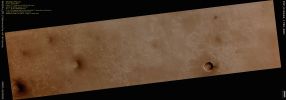
ESP_016644_1780_RED_abrowse-00.jpgOn the Edge of Concepción (CTX Frame - Natural Colors; credits: Dr Paolo C. Fienga - Lunexit Team)70 visiteThis image was acquired by HiRISE on 13 February 2010, on Sol 2153 of Opportunity’s Mission on Mars.
Note the Rover Tracks in the Ripples to the North and North-West of the Rover. Scientists use these high-resolution images (about 25 cm/pixel) to help navigate the Rover. In addition, Rover exploration of areas covered by such high-resolution images provides “ground truth” for the orbital data.MareKromium03/27/10 at 17:07MareKromium: Qualsiasi studio, immagine, ipotesi o argomento su...
|
|
ESP_016644_1780_RED_abrowse-00.jpgOn the Edge of Concepción (CTX Frame - Natural Colors; credits: Dr Paolo C. Fienga - Lunexit Team)70 visiteThis image was acquired by HiRISE on 13 February 2010, on Sol 2153 of Opportunity’s Mission on Mars.
Note the Rover Tracks in the Ripples to the North and North-West of the Rover. Scientists use these high-resolution images (about 25 cm/pixel) to help navigate the Rover. In addition, Rover exploration of areas covered by such high-resolution images provides “ground truth” for the orbital data.MareKromium03/27/10 at 16:18walthari: dobbiamo considerare anche in questo caso oltre ai...
|
|
ESP_016644_1780_RED_abrowse-00.jpgOn the Edge of Concepción (CTX Frame - Natural Colors; credits: Dr Paolo C. Fienga - Lunexit Team)70 visiteThis image was acquired by HiRISE on 13 February 2010, on Sol 2153 of Opportunity’s Mission on Mars.
Note the Rover Tracks in the Ripples to the North and North-West of the Rover. Scientists use these high-resolution images (about 25 cm/pixel) to help navigate the Rover. In addition, Rover exploration of areas covered by such high-resolution images provides “ground truth” for the orbital data.MareKromium03/27/10 at 08:55arcaios: Lo so', forse vi sembrero' troppo petulant...
|
|
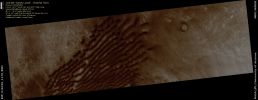
ESP_016036_1370_RED_abrowse-00.jpgDunes in Noachis Terra (CTX Frame - Natural Colors; credits: Dr Paolo C. Fienga - Lunexit Team)58 visiteDunes of sand-sized materials have been trapped on the floors of many Martian Craters.
This is one example, from an Unnamed Crater located in Noachis Terra, West of the giant Hellas Impact Basin.
The most extensive Linear Dunefields known in the Solar System are on Saturn's largest moon Titan.
But Titan, as to Mars, has a very different environment and composition and so, at a meter-scale resolution (not available yet, unfortunately) the Titanian Dunes should look (better yet: they certainly ARE) very different from the Martian ones.MareKromium03/22/10 at 06:58walthari: si riesce anche a capire, dalla geometria delle du...
|
|
ESP_016036_1370_RED_abrowse-00.jpgDunes in Noachis Terra (CTX Frame - Natural Colors; credits: Dr Paolo C. Fienga - Lunexit Team)58 visiteDunes of sand-sized materials have been trapped on the floors of many Martian Craters.
This is one example, from an Unnamed Crater located in Noachis Terra, West of the giant Hellas Impact Basin.
The most extensive Linear Dunefields known in the Solar System are on Saturn's largest moon Titan.
But Titan, as to Mars, has a very different environment and composition and so, at a meter-scale resolution (not available yet, unfortunately) the Titanian Dunes should look (better yet: they certainly ARE) very different from the Martian ones.MareKromium03/21/10 at 21:41MareKromium: Questa, invece, ? proprio bella e, penso, corretta...
|
|
ESP_016032_2600_RED_abrowse-02.jpgNorthern Spring (EDM - Natural Colors; credits: NASA/JPL/Univ. of Arizona)60 visitenessun commentoMareKromium03/21/10 at 21:41MareKromium: Ma no, Walt: ? bellina. Sbagliata, si. Ma bellina....
|
|
ESP_016032_2600_RED_abrowse-02.jpgNorthern Spring (EDM - Natural Colors; credits: NASA/JPL/Univ. of Arizona)60 visitenessun commentoMareKromium03/12/10 at 18:15walthari: una vera ciofeca!!!
|
|
ESP_016032_2600_RED_abrowse-02.jpgNorthern Spring (EDM - Natural Colors; credits: NASA/JPL/Univ. of Arizona)60 visitenessun commentoMareKromium03/12/10 at 16:06MareKromium: ...troppo rosa, troppo luminosa, troppo "puli...
|
|

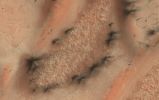
ESP_016032_2600_RED_abrowse-01.jpgNorthern Spring (EDM - Natural Colors; credits: Dr Paolo C. Fienga - Lunexit Team)57 visiteIn this EDM, Streaks of dark Basaltic Sand have been carried from below the ice layer to form Fan-shaped Deposits on top of the seasonal ice.
The similarity in the directions of the fans suggests that they formed at the same time, when the wind direction and speed was the same. They often form along the boundary between the dune and the Surface below the Dunes.MareKromium03/12/10 at 16:02MareKromium: NOTA: in questo caso ho operato la colorizzazione ...
|
|
| 1160 immagini su 97 pagina(e) |
 |
|
|
|
|
58 | |
|
|
|
|





