| Ultimi commenti - Mars Reconnaissance Orbiter (MRO) |
Psp_001497_2480_red-01~0.jpgThe Northern Lakes: Lake "Ginny" (EDM - Natural Colors; credits: Dr Paolo C. Fienga - Lunexit Team) 131 visiteProbabilmente (a differenza di quanto da noi supposto e speculato in passato) questa surface feature non è altro che un deposito di ghiaccio persistente - o di neve - il quale è sopravvissuto al disgelo sia grazie alla sua particolare posizione (in effetti giace leggermente infossato), sia in conseguenza di un benevolo regime dei Venti Dominanti (i quali non sono riusciti a spazzarlo via).
Certo, potrebbe anche trattarsi di un mini-laghetto, però...MareKromium07/13/10 at 11:47Ivana Tognoloni: Certo che e` molto curioso pero`, quanto sara` gr...
|
|

ESP_017897_2045_RED_abrowse-PCF-LXTT.jpgMawrth Vallis (Absolute Natural Colors; credits: Dr Paolo C. Fienga - Lunexit Team)56 visitenessun commentoMareKromium07/04/10 at 12:43MareKromium: Tra i tanti, forse il Lavoro migliore che ho mai r...
|
|
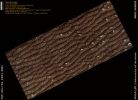
PSP_001736_2605_RED_abrowse.jpgOlympia Undae (Natural Colors; credits for the additional process. and color.: Dr Paolo C. Fienga - Lunexit Team)70 visiteThis observation shows Dark Dunes and light Polygonal Terrain in Olympia Undae, also known as the North Polar Erg.
Two sets of Dunes are obvious. The major set trends North-South, indicating winds from the East or West. Between the crests of these Dunes is a second set oriented mostly East-West.
Zooming in on the Dunes, a rippled texture is apparent, probably due to redistribution of sand at the scale of meters and less. Near the crests of some Dunes are Channel-like features, with some branching downslope. The origin of these Channels is unknown, but they may result from the flow and displacement of sand that was fluidized by sublimating CO2 or water frost.
Bright patches of ground are found in some inter-dune areas, with many having a polygonal texture.
Polygons on Earth form from contraction induced by stresses from dehydration, cooling and other processes, so these features may have a similar origin. The CRISM instrument on MRO and OMEGA on Mars Express indicates that many dunes in Olympia Undae are rich in the mineral Gypsum (---> gesso).MareKromium06/28/10 at 07:32walthari: il buon senso e la cultura di base per "filtr...
|
|
PSP_001736_2605_RED_abrowse.jpgOlympia Undae (Natural Colors; credits for the additional process. and color.: Dr Paolo C. Fienga - Lunexit Team)70 visiteThis observation shows Dark Dunes and light Polygonal Terrain in Olympia Undae, also known as the North Polar Erg.
Two sets of Dunes are obvious. The major set trends North-South, indicating winds from the East or West. Between the crests of these Dunes is a second set oriented mostly East-West.
Zooming in on the Dunes, a rippled texture is apparent, probably due to redistribution of sand at the scale of meters and less. Near the crests of some Dunes are Channel-like features, with some branching downslope. The origin of these Channels is unknown, but they may result from the flow and displacement of sand that was fluidized by sublimating CO2 or water frost.
Bright patches of ground are found in some inter-dune areas, with many having a polygonal texture.
Polygons on Earth form from contraction induced by stresses from dehydration, cooling and other processes, so these features may have a similar origin. The CRISM instrument on MRO and OMEGA on Mars Express indicates that many dunes in Olympia Undae are rich in the mineral Gypsum (---> gesso).MareKromium06/27/10 at 12:05MareKromium: ...Parole Sante Andrea: sta al "Buon Senso&qu...
|
|
PSP_001736_2605_RED_abrowse.jpgOlympia Undae (Natural Colors; credits for the additional process. and color.: Dr Paolo C. Fienga - Lunexit Team)70 visiteThis observation shows Dark Dunes and light Polygonal Terrain in Olympia Undae, also known as the North Polar Erg.
Two sets of Dunes are obvious. The major set trends North-South, indicating winds from the East or West. Between the crests of these Dunes is a second set oriented mostly East-West.
Zooming in on the Dunes, a rippled texture is apparent, probably due to redistribution of sand at the scale of meters and less. Near the crests of some Dunes are Channel-like features, with some branching downslope. The origin of these Channels is unknown, but they may result from the flow and displacement of sand that was fluidized by sublimating CO2 or water frost.
Bright patches of ground are found in some inter-dune areas, with many having a polygonal texture.
Polygons on Earth form from contraction induced by stresses from dehydration, cooling and other processes, so these features may have a similar origin. The CRISM instrument on MRO and OMEGA on Mars Express indicates that many dunes in Olympia Undae are rich in the mineral Gypsum (---> gesso).MareKromium06/27/10 at 11:57andreagg: ... a me voyager piace... ? logico che sta al buon...
|
|
PSP_001736_2605_RED_abrowse.jpgOlympia Undae (Natural Colors; credits for the additional process. and color.: Dr Paolo C. Fienga - Lunexit Team)70 visiteThis observation shows Dark Dunes and light Polygonal Terrain in Olympia Undae, also known as the North Polar Erg.
Two sets of Dunes are obvious. The major set trends North-South, indicating winds from the East or West. Between the crests of these Dunes is a second set oriented mostly East-West.
Zooming in on the Dunes, a rippled texture is apparent, probably due to redistribution of sand at the scale of meters and less. Near the crests of some Dunes are Channel-like features, with some branching downslope. The origin of these Channels is unknown, but they may result from the flow and displacement of sand that was fluidized by sublimating CO2 or water frost.
Bright patches of ground are found in some inter-dune areas, with many having a polygonal texture.
Polygons on Earth form from contraction induced by stresses from dehydration, cooling and other processes, so these features may have a similar origin. The CRISM instrument on MRO and OMEGA on Mars Express indicates that many dunes in Olympia Undae are rich in the mineral Gypsum (---> gesso).MareKromium06/27/10 at 11:43MareKromium: ...!...
|
|
PSP_001736_2605_RED_abrowse.jpgOlympia Undae (Natural Colors; credits for the additional process. and color.: Dr Paolo C. Fienga - Lunexit Team)70 visiteThis observation shows Dark Dunes and light Polygonal Terrain in Olympia Undae, also known as the North Polar Erg.
Two sets of Dunes are obvious. The major set trends North-South, indicating winds from the East or West. Between the crests of these Dunes is a second set oriented mostly East-West.
Zooming in on the Dunes, a rippled texture is apparent, probably due to redistribution of sand at the scale of meters and less. Near the crests of some Dunes are Channel-like features, with some branching downslope. The origin of these Channels is unknown, but they may result from the flow and displacement of sand that was fluidized by sublimating CO2 or water frost.
Bright patches of ground are found in some inter-dune areas, with many having a polygonal texture.
Polygons on Earth form from contraction induced by stresses from dehydration, cooling and other processes, so these features may have a similar origin. The CRISM instrument on MRO and OMEGA on Mars Express indicates that many dunes in Olympia Undae are rich in the mineral Gypsum (---> gesso).MareKromium06/27/10 at 11:27John Koenig: No, Paolo. Dico sul serio. E' ovvio che poi - ...
|
|
PSP_001736_2605_RED_abrowse.jpgOlympia Undae (Natural Colors; credits for the additional process. and color.: Dr Paolo C. Fienga - Lunexit Team)70 visiteThis observation shows Dark Dunes and light Polygonal Terrain in Olympia Undae, also known as the North Polar Erg.
Two sets of Dunes are obvious. The major set trends North-South, indicating winds from the East or West. Between the crests of these Dunes is a second set oriented mostly East-West.
Zooming in on the Dunes, a rippled texture is apparent, probably due to redistribution of sand at the scale of meters and less. Near the crests of some Dunes are Channel-like features, with some branching downslope. The origin of these Channels is unknown, but they may result from the flow and displacement of sand that was fluidized by sublimating CO2 or water frost.
Bright patches of ground are found in some inter-dune areas, with many having a polygonal texture.
Polygons on Earth form from contraction induced by stresses from dehydration, cooling and other processes, so these features may have a similar origin. The CRISM instrument on MRO and OMEGA on Mars Express indicates that many dunes in Olympia Undae are rich in the mineral Gypsum (---> gesso).MareKromium06/27/10 at 11:03MareKromium: ...Quanto sei ottimista, Caro John...Secondo me st...
|
|
PSP_001736_2605_RED_abrowse.jpgOlympia Undae (Natural Colors; credits for the additional process. and color.: Dr Paolo C. Fienga - Lunexit Team)70 visiteThis observation shows Dark Dunes and light Polygonal Terrain in Olympia Undae, also known as the North Polar Erg.
Two sets of Dunes are obvious. The major set trends North-South, indicating winds from the East or West. Between the crests of these Dunes is a second set oriented mostly East-West.
Zooming in on the Dunes, a rippled texture is apparent, probably due to redistribution of sand at the scale of meters and less. Near the crests of some Dunes are Channel-like features, with some branching downslope. The origin of these Channels is unknown, but they may result from the flow and displacement of sand that was fluidized by sublimating CO2 or water frost.
Bright patches of ground are found in some inter-dune areas, with many having a polygonal texture.
Polygons on Earth form from contraction induced by stresses from dehydration, cooling and other processes, so these features may have a similar origin. The CRISM instrument on MRO and OMEGA on Mars Express indicates that many dunes in Olympia Undae are rich in the mineral Gypsum (---> gesso).MareKromium06/25/10 at 21:36John Koenig: Doc, ti assicuro che nel nostro Bel Paese alcuni p...
|
|
PSP_001736_2605_RED_abrowse.jpgOlympia Undae (Natural Colors; credits for the additional process. and color.: Dr Paolo C. Fienga - Lunexit Team)70 visiteThis observation shows Dark Dunes and light Polygonal Terrain in Olympia Undae, also known as the North Polar Erg.
Two sets of Dunes are obvious. The major set trends North-South, indicating winds from the East or West. Between the crests of these Dunes is a second set oriented mostly East-West.
Zooming in on the Dunes, a rippled texture is apparent, probably due to redistribution of sand at the scale of meters and less. Near the crests of some Dunes are Channel-like features, with some branching downslope. The origin of these Channels is unknown, but they may result from the flow and displacement of sand that was fluidized by sublimating CO2 or water frost.
Bright patches of ground are found in some inter-dune areas, with many having a polygonal texture.
Polygons on Earth form from contraction induced by stresses from dehydration, cooling and other processes, so these features may have a similar origin. The CRISM instrument on MRO and OMEGA on Mars Express indicates that many dunes in Olympia Undae are rich in the mineral Gypsum (---> gesso).MareKromium06/25/10 at 21:21titanio44: copiato sicuramente ;O) un grande abbraccio Doc
|
|
PSP_001736_2605_RED_abrowse.jpgOlympia Undae (Natural Colors; credits for the additional process. and color.: Dr Paolo C. Fienga - Lunexit Team)70 visiteThis observation shows Dark Dunes and light Polygonal Terrain in Olympia Undae, also known as the North Polar Erg.
Two sets of Dunes are obvious. The major set trends North-South, indicating winds from the East or West. Between the crests of these Dunes is a second set oriented mostly East-West.
Zooming in on the Dunes, a rippled texture is apparent, probably due to redistribution of sand at the scale of meters and less. Near the crests of some Dunes are Channel-like features, with some branching downslope. The origin of these Channels is unknown, but they may result from the flow and displacement of sand that was fluidized by sublimating CO2 or water frost.
Bright patches of ground are found in some inter-dune areas, with many having a polygonal texture.
Polygons on Earth form from contraction induced by stresses from dehydration, cooling and other processes, so these features may have a similar origin. The CRISM instrument on MRO and OMEGA on Mars Express indicates that many dunes in Olympia Undae are rich in the mineral Gypsum (---> gesso).MareKromium06/25/10 at 18:23MareKromium: Dietro queste elaborazioni - per giuste o errate c...
|
|
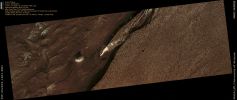
PSP_002839_1825_RED_abrowse-1.jpgAram Chaos (Absolute Natural Colors; credits for the additional process. and color.: Dr Paolo C. Fienga - Lunexit Team)62 visiteAram Chaos appears to be a former impact crater. The terrain is disrupted, giving it a chaotic appearance (hence the name "chaos"). Scientists have postulated that a lake may have once existed inside the crater and sediments were laid down within the lake. The mineral Hematite (rich in Iron) has been detected by orbiting spacecraft within Aram Chaos. Hematite has been identified in several other locations on Mars, including at the Mars Exploration Rover Landing Site in Meridiani Planum. The Hematite at both Meridiani and Aram Chaos most likely formed by precipitation in water.
This HiRISE image shows the light-toned sediments inside Aram Chaos that could have formed in a former lake. Unfortunately, dark debris now obscures much of this sediment, making it difficult to view and interpret the rocks. The light-toned Layered Deposit in the South (left) of the image is higher standing and has a peculiarly-looking pitted surface.
Circular structures with dark centers are likely to be impact craters that have been partly filled with dark debris, including sand. More irregular depressions appear to result from erosion of layered beds within the sediments. Wind could erode materials that are slightly weaker more quickly and produce the irregular topography seen along the surface of the deposit.MareKromium06/25/10 at 18:22MareKromium: Sar? anche "sbagliato", ma un lavoretto ...
|
|
| 1160 immagini su 97 pagina(e) |
 |
|
|
|
|
55 | |
|
|
|
|





