| |

| Ultimi commenti - Mars Reconnaissance Orbiter (MRO) |

Chasma-Echus_Chasma-Fractures-PIA17704-PCF-LXTT-IPF.jpgFeatures of Echus Chasma (EDM - Absolute Natural Colors; credits for the additional process. and color.: Dr Paolo C. Fienga/Lunar Explorer Italia/Italian Planetary Foundation)97 visiteIn this Extra Detail Magnification (or "EDM" for short) - taken from an Original NASA - Mars Reconnaissance Orbiter's False Colors and NON-Map Projected sub-frame -, we can see, with a really great detail, a so-called "Intersection Area" existing between two Fractures (or, perhaps, Fissures and/or Water or Lava-carved narrow Channels) which are both located on the Floor of Echus Chasma (an Equatorial Chasma found in the Lunae Planum High Plateau Region of Mars, slightly to the North of the gigantic Valles Marineris Canyon System, and approx. 100 Km long and 10 Km wide).
Echus Chasma contains several Valleys which range - as far as their depth is concerned - from about 1 to 4 Km, and it is now considered, by Planetary Scientists, to be the Water Source Region that allowed the formation and then the (relevant) water-supply of the Kasei Valles Outflow Channel: a large Valley that extends for thousands of kilometers towards the North of the Red Planet.
Mars Local Time: 14:36 (Early Afternoon)
Coord. (centered): 0,377° North Lat. and 279,483° East Long.
Spacecraft altitude: 269,1 Km (such as about 161,111 miles)
Original image scale range: 53,8 cm/pixel (with 2 x 2 binning) so objects ~ 1 mt and 62 cm across are resolved
Map projected scale: 50 cm/pixel
Map projection: EQUIRECTANGULAR
Emission Angle: 7,7°
Phase Angle: 47,6°
Solar Incidence Angle: 40° (meaning that the Sun was about 50° above the Local Horizon at the time the picture was taken)
Solar Longitude: 27,0° (Northern Spring - Southern Fall)
Credits: NASA/JPL/University of Arizona
Additional process. and coloring: Lunar Explorer Italia
This picture (which is a crop taken from a NASA - Original Mars Reconnaissance Orbiter False Colors and NON-Map Projected sub-frame identified by the serial n. ESP_033591_1805-1) has been additionally processed, magnified, contrast enhanced, Gamma corrected, and then re-colorized in Absolute Natural Colors (such as the colors that a human eye would actually perceive if someone were onboard the NASA - Mars Reconnaissance Orbiter and then looked down, towards the Surface of Mars), by using an original technique created - and, in time, dramatically improved - by the Lunar Explorer Italia Team.MareKromium12/19/13 at 15:22paolocf1963: ...ed infatti la NASA, tanto per non smentirsi mai...
|
|
Chasma-Echus_Chasma-Fractures-PIA17704-PCF-LXTT-IPF.jpgFeatures of Echus Chasma (EDM - Absolute Natural Colors; credits for the additional process. and color.: Dr Paolo C. Fienga/Lunar Explorer Italia/Italian Planetary Foundation)97 visiteIn this Extra Detail Magnification (or "EDM" for short) - taken from an Original NASA - Mars Reconnaissance Orbiter's False Colors and NON-Map Projected sub-frame -, we can see, with a really great detail, a so-called "Intersection Area" existing between two Fractures (or, perhaps, Fissures and/or Water or Lava-carved narrow Channels) which are both located on the Floor of Echus Chasma (an Equatorial Chasma found in the Lunae Planum High Plateau Region of Mars, slightly to the North of the gigantic Valles Marineris Canyon System, and approx. 100 Km long and 10 Km wide).
Echus Chasma contains several Valleys which range - as far as their depth is concerned - from about 1 to 4 Km, and it is now considered, by Planetary Scientists, to be the Water Source Region that allowed the formation and then the (relevant) water-supply of the Kasei Valles Outflow Channel: a large Valley that extends for thousands of kilometers towards the North of the Red Planet.
Mars Local Time: 14:36 (Early Afternoon)
Coord. (centered): 0,377° North Lat. and 279,483° East Long.
Spacecraft altitude: 269,1 Km (such as about 161,111 miles)
Original image scale range: 53,8 cm/pixel (with 2 x 2 binning) so objects ~ 1 mt and 62 cm across are resolved
Map projected scale: 50 cm/pixel
Map projection: EQUIRECTANGULAR
Emission Angle: 7,7°
Phase Angle: 47,6°
Solar Incidence Angle: 40° (meaning that the Sun was about 50° above the Local Horizon at the time the picture was taken)
Solar Longitude: 27,0° (Northern Spring - Southern Fall)
Credits: NASA/JPL/University of Arizona
Additional process. and coloring: Lunar Explorer Italia
This picture (which is a crop taken from a NASA - Original Mars Reconnaissance Orbiter False Colors and NON-Map Projected sub-frame identified by the serial n. ESP_033591_1805-1) has been additionally processed, magnified, contrast enhanced, Gamma corrected, and then re-colorized in Absolute Natural Colors (such as the colors that a human eye would actually perceive if someone were onboard the NASA - Mars Reconnaissance Orbiter and then looked down, towards the Surface of Mars), by using an original technique created - and, in time, dramatically improved - by the Lunar Explorer Italia Team.MareKromium12/19/13 at 12:58walthari: l'origine potrebbe essere anche tettonica, ma ...
|
|
Chasma-Echus_Chasma-Fractures-PIA17704-PCF-LXTT-IPF.jpgFeatures of Echus Chasma (EDM - Absolute Natural Colors; credits for the additional process. and color.: Dr Paolo C. Fienga/Lunar Explorer Italia/Italian Planetary Foundation)97 visiteIn this Extra Detail Magnification (or "EDM" for short) - taken from an Original NASA - Mars Reconnaissance Orbiter's False Colors and NON-Map Projected sub-frame -, we can see, with a really great detail, a so-called "Intersection Area" existing between two Fractures (or, perhaps, Fissures and/or Water or Lava-carved narrow Channels) which are both located on the Floor of Echus Chasma (an Equatorial Chasma found in the Lunae Planum High Plateau Region of Mars, slightly to the North of the gigantic Valles Marineris Canyon System, and approx. 100 Km long and 10 Km wide).
Echus Chasma contains several Valleys which range - as far as their depth is concerned - from about 1 to 4 Km, and it is now considered, by Planetary Scientists, to be the Water Source Region that allowed the formation and then the (relevant) water-supply of the Kasei Valles Outflow Channel: a large Valley that extends for thousands of kilometers towards the North of the Red Planet.
Mars Local Time: 14:36 (Early Afternoon)
Coord. (centered): 0,377° North Lat. and 279,483° East Long.
Spacecraft altitude: 269,1 Km (such as about 161,111 miles)
Original image scale range: 53,8 cm/pixel (with 2 x 2 binning) so objects ~ 1 mt and 62 cm across are resolved
Map projected scale: 50 cm/pixel
Map projection: EQUIRECTANGULAR
Emission Angle: 7,7°
Phase Angle: 47,6°
Solar Incidence Angle: 40° (meaning that the Sun was about 50° above the Local Horizon at the time the picture was taken)
Solar Longitude: 27,0° (Northern Spring - Southern Fall)
Credits: NASA/JPL/University of Arizona
Additional process. and coloring: Lunar Explorer Italia
This picture (which is a crop taken from a NASA - Original Mars Reconnaissance Orbiter False Colors and NON-Map Projected sub-frame identified by the serial n. ESP_033591_1805-1) has been additionally processed, magnified, contrast enhanced, Gamma corrected, and then re-colorized in Absolute Natural Colors (such as the colors that a human eye would actually perceive if someone were onboard the NASA - Mars Reconnaissance Orbiter and then looked down, towards the Surface of Mars), by using an original technique created - and, in time, dramatically improved - by the Lunar Explorer Italia Team.MareKromium12/19/13 at 12:13Anakin: Canyon creati dall'erosione dell'acqua. Cr...
|
|
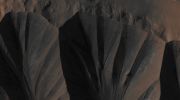
Gullies-ESP_020661_1440-PCF-LXTT-IPF.jpgGullies in Gasa Crater (Absolute Natural Colors; credits for the additional process. and color.: Dr Paolo C. Fienga/Lunar Explorer Italia/Italian Planetary Foundation)78 visiteThe so-called "Gully Landforms" - just like the ones shown here, in this NASA - Mars Reconnaissance Orbiter image - can often be found in the Inner Rims (or even below, along the Inner Slopes) of many Impact Craters that are located at the Martian Mid-Latitudes. Some changes in these Gully Landforms were first seen in frames taken by the NASA - Mars Global Surveyor - Mars Orbiter Camera (MGS-MOC) in the AD 2006, and studying such activity has been a high priority for HiRISE ever since (and, in fact, many examples of New Deposits located inside Gully Landforms are now well known).
This frame shows a New Deposit inside some Gully Landforms located on the Inner Rim of Gasa Crater; a very (relatively speaking) "fresh" approx. 7-Km diameter Impact Crater that is found in the Southern Mid-Latitudes of the Red Planet (to be precise, at 35,72° South Latitude and 129.45° East Longitude). Said New Deposit appears of a distinctive gray color, with some patches of white Material too, in this Absolute Natural Color version of the NASA - Mars Reconnaissance Orbiter image n. ESP_020661_1440. The picture was acquired during the Southern Spring of Mars, but the Flow that formed the Deposit occurred in the preceding Winter.
As a matter of fact, the current Gully Activities appear to be concentrated in periods going from the late Winter to the early Spring of Mars, and this circumstance may be a consequence of the Sublimation of the Seasonal Carbon Dioxide (CO2) Frost (which, by the way, is well visible in several Gully "Alcoves" during Wintertime).
Mars Local Time: 15:49 (Middle Afternoon)
Coord. (centered): 35,729° North Lat. and 129,386° East Long.
Spacecraft altitude: 258,2 Km (such as about 160,3 miles)
Original image scale range: 25,8 cm/pixel (with 1 x 1 binning) so objects ~ 78 cm across are resolved
Map projected scale: 25 cm/pixel
Map projection: EQUIRECTANGULAR
Emission Angle: 11,0°
Sun-Mars-Spacecraft (or Phase) Angle: 47,6°
Solar Incidence Angle: 58° (meaning that the Sun was about 32° above the Local Horizon at the time the picture was taken)
Solar Longitude: 203,7° (Northern Fall - Southern Spring)
Credits: NASA/JPL/University of Arizona
Additional process. and coloring: Lunar Explorer Italia
This picture (which is an Original Mars Reconnaissance Orbiter EDM enhanced color frame, identified by the serial n. ESP_020661_1440) has been additionally processed and then re-colorized in Absolute Natural Colors (such as the colors that a human eye would actually perceive if someone were onboard the NASA - Mars Reconnaissance Orbiter and then looked down, towards the Surface of Mars), by using an original technique created - and, in time, dramatically improved - by the Lunar Explorer Italia Team.MareKromium12/18/13 at 20:05walthari: meraviglioso reticolo idrografico innestato nell i...
|
|

Nili_Fossae-PCF-LXTT-02.jpgFeatures of Nili Fossae (Natural Colors; credits for the additional process. and color.: Dr Paolo C. Fienga - Lunexit Team)327 visitenessun commentoMareKromium12/15/13 at 16:38walthari: alla sinistra della formazione dunale si vedono di...
|
|
Nili_Fossae-PCF-LXTT-02.jpgFeatures of Nili Fossae (Natural Colors; credits for the additional process. and color.: Dr Paolo C. Fienga - Lunexit Team)327 visitenessun commentoMareKromium10/01/13 at 14:28paolocf1963: BELLA Anakin, BELLA! E ci st?.... Ma, ad oggi, una...
|
|
Nili_Fossae-PCF-LXTT-02.jpgFeatures of Nili Fossae (Natural Colors; credits for the additional process. and color.: Dr Paolo C. Fienga - Lunexit Team)327 visitenessun commentoMareKromium10/01/13 at 13:30Anakin: Ghiaccio. Brina. Acqua allo stato solido fuoriusci...
|
|
Nili_Fossae-PCF-LXTT-02.jpgFeatures of Nili Fossae (Natural Colors; credits for the additional process. and color.: Dr Paolo C. Fienga - Lunexit Team)327 visitenessun commentoMareKromium10/01/13 at 10:26paolocf1963: ...Ed ecco le "Famose Dune Argentee". Qu...
|
|

Meridiani_Planum-ESP_032098_1785-PCF-LXTT-IPF.jpgFeatures of Meridiani Planum (Absolute Natural Colors; credits for the additional process. and color.: Dr Paolo C. Fienga/Lunar Explorer Italia/Italian Planetary Foundation)85 visiteIn this frame, taken by the NASA - Mars Reconnaissance Orbiter on the date of June, 1st, 2013, we can see a few interesting (although very common) Surface Features which characterize the Meridiani Planum Region of Mars. In particular, we can see an old and (still) Unnamed Impact Crater - with the "usual" Dunefield on its Floor - that is located on the very upper portion of the frame and just below a (relatively) Sand-free section of Surface known as "Martian Paving". Afterwards, moving down towards the South (such as towards the lower portion of the frame), we can find an area where there are many Sand Ripples and a few small Impact Craters. Finally, on the very lowest portion of the picture, we can also see more Sand Ripples, a number of Sand Dunes, several very small Impact Craters and quite a few Rocky Outcrops.
However, the Martian Surface pictured here, in our opinion (as IPF), and contrary to the common idea of how the Meridiani Planum Region of Mars is - generally - characterized and known (such as an almost totally plain and reliefs-free Region), is really far from being flat at all: as a matter of fact, if you observe the picture carefully, you will be able to notice that the whole area which has been photographed by the NASA - Mars Reconnaissance Orbiter (and, particularly, the area visible in the central and lower portion of the frame - meaning the one located to the South of the main visible Feature, such as the Unnamed Impact Crater) appears to show several points of Subsidence, a few Ridges and some (most likely very short and small) Hillocks.
Mars Local Time: 14:09 (Early Afternoon)
Coord. (centered): 1,584° South Lat. and 3,132° East Long.
Spacecraft altitude: 268,9 Km (such as about 166,986 miles)
Original image scale range: 26,9 cm/pixel (with 1 x 1 binning) so objects ~ 81 cm across are resolved
Map projected scale: 25 cm/pixel
Map projection: EQUIRECTANGULAR
Emission Angle: 0,0°
Phase Angle: 34,0°
Solar Incidence Angle: 34° (meaning that the Sun was about 56° above the Local Horizon at the time the picture was taken)
Solar Longitude: 328,5° (Northern Winter - Southern Summer)
Credits: NASA/JPL/University of Arizona
Additional process. and coloring: Lunar Explorer Italia
This picturee (which is a NASA - Original Mars Reconnaissance Orbiter NON-Map Projected b/w frame identified by the serial n. ESP_032098_1785) has been additionally processed and then colorized in Absolute Natural Colors (such as the colors that a human eye would actually perceive if someone were onboard the NASA - Mars Reconnaissance Orbiter and then looked down, towards the Surface of Mars), by using an original technique created - and, in time, dramatically improved - by the Lunar Explorer Italia Team.MareKromium08/26/13 at 08:48Anakin: io non vedo nulla :(
|
|
Meridiani_Planum-ESP_032098_1785-PCF-LXTT-IPF.jpgFeatures of Meridiani Planum (Absolute Natural Colors; credits for the additional process. and color.: Dr Paolo C. Fienga/Lunar Explorer Italia/Italian Planetary Foundation)85 visiteIn this frame, taken by the NASA - Mars Reconnaissance Orbiter on the date of June, 1st, 2013, we can see a few interesting (although very common) Surface Features which characterize the Meridiani Planum Region of Mars. In particular, we can see an old and (still) Unnamed Impact Crater - with the "usual" Dunefield on its Floor - that is located on the very upper portion of the frame and just below a (relatively) Sand-free section of Surface known as "Martian Paving". Afterwards, moving down towards the South (such as towards the lower portion of the frame), we can find an area where there are many Sand Ripples and a few small Impact Craters. Finally, on the very lowest portion of the picture, we can also see more Sand Ripples, a number of Sand Dunes, several very small Impact Craters and quite a few Rocky Outcrops.
However, the Martian Surface pictured here, in our opinion (as IPF), and contrary to the common idea of how the Meridiani Planum Region of Mars is - generally - characterized and known (such as an almost totally plain and reliefs-free Region), is really far from being flat at all: as a matter of fact, if you observe the picture carefully, you will be able to notice that the whole area which has been photographed by the NASA - Mars Reconnaissance Orbiter (and, particularly, the area visible in the central and lower portion of the frame - meaning the one located to the South of the main visible Feature, such as the Unnamed Impact Crater) appears to show several points of Subsidence, a few Ridges and some (most likely very short and small) Hillocks.
Mars Local Time: 14:09 (Early Afternoon)
Coord. (centered): 1,584° South Lat. and 3,132° East Long.
Spacecraft altitude: 268,9 Km (such as about 166,986 miles)
Original image scale range: 26,9 cm/pixel (with 1 x 1 binning) so objects ~ 81 cm across are resolved
Map projected scale: 25 cm/pixel
Map projection: EQUIRECTANGULAR
Emission Angle: 0,0°
Phase Angle: 34,0°
Solar Incidence Angle: 34° (meaning that the Sun was about 56° above the Local Horizon at the time the picture was taken)
Solar Longitude: 328,5° (Northern Winter - Southern Summer)
Credits: NASA/JPL/University of Arizona
Additional process. and coloring: Lunar Explorer Italia
This picturee (which is a NASA - Original Mars Reconnaissance Orbiter NON-Map Projected b/w frame identified by the serial n. ESP_032098_1785) has been additionally processed and then colorized in Absolute Natural Colors (such as the colors that a human eye would actually perceive if someone were onboard the NASA - Mars Reconnaissance Orbiter and then looked down, towards the Surface of Mars), by using an original technique created - and, in time, dramatically improved - by the Lunar Explorer Italia Team.MareKromium08/25/13 at 16:58paolocf1963: Cerco l'originale, isolo il dettaglio e lo pub...
|
|
Meridiani_Planum-ESP_032098_1785-PCF-LXTT-IPF.jpgFeatures of Meridiani Planum (Absolute Natural Colors; credits for the additional process. and color.: Dr Paolo C. Fienga/Lunar Explorer Italia/Italian Planetary Foundation)85 visiteIn this frame, taken by the NASA - Mars Reconnaissance Orbiter on the date of June, 1st, 2013, we can see a few interesting (although very common) Surface Features which characterize the Meridiani Planum Region of Mars. In particular, we can see an old and (still) Unnamed Impact Crater - with the "usual" Dunefield on its Floor - that is located on the very upper portion of the frame and just below a (relatively) Sand-free section of Surface known as "Martian Paving". Afterwards, moving down towards the South (such as towards the lower portion of the frame), we can find an area where there are many Sand Ripples and a few small Impact Craters. Finally, on the very lowest portion of the picture, we can also see more Sand Ripples, a number of Sand Dunes, several very small Impact Craters and quite a few Rocky Outcrops.
However, the Martian Surface pictured here, in our opinion (as IPF), and contrary to the common idea of how the Meridiani Planum Region of Mars is - generally - characterized and known (such as an almost totally plain and reliefs-free Region), is really far from being flat at all: as a matter of fact, if you observe the picture carefully, you will be able to notice that the whole area which has been photographed by the NASA - Mars Reconnaissance Orbiter (and, particularly, the area visible in the central and lower portion of the frame - meaning the one located to the South of the main visible Feature, such as the Unnamed Impact Crater) appears to show several points of Subsidence, a few Ridges and some (most likely very short and small) Hillocks.
Mars Local Time: 14:09 (Early Afternoon)
Coord. (centered): 1,584° South Lat. and 3,132° East Long.
Spacecraft altitude: 268,9 Km (such as about 166,986 miles)
Original image scale range: 26,9 cm/pixel (with 1 x 1 binning) so objects ~ 81 cm across are resolved
Map projected scale: 25 cm/pixel
Map projection: EQUIRECTANGULAR
Emission Angle: 0,0°
Phase Angle: 34,0°
Solar Incidence Angle: 34° (meaning that the Sun was about 56° above the Local Horizon at the time the picture was taken)
Solar Longitude: 328,5° (Northern Winter - Southern Summer)
Credits: NASA/JPL/University of Arizona
Additional process. and coloring: Lunar Explorer Italia
This picturee (which is a NASA - Original Mars Reconnaissance Orbiter NON-Map Projected b/w frame identified by the serial n. ESP_032098_1785) has been additionally processed and then colorized in Absolute Natural Colors (such as the colors that a human eye would actually perceive if someone were onboard the NASA - Mars Reconnaissance Orbiter and then looked down, towards the Surface of Mars), by using an original technique created - and, in time, dramatically improved - by the Lunar Explorer Italia Team.MareKromium08/25/13 at 14:51cano00: un poco tutta l?area circostante i "portali&q...
|
|
Meridiani_Planum-ESP_032098_1785-PCF-LXTT-IPF.jpgFeatures of Meridiani Planum (Absolute Natural Colors; credits for the additional process. and color.: Dr Paolo C. Fienga/Lunar Explorer Italia/Italian Planetary Foundation)85 visiteIn this frame, taken by the NASA - Mars Reconnaissance Orbiter on the date of June, 1st, 2013, we can see a few interesting (although very common) Surface Features which characterize the Meridiani Planum Region of Mars. In particular, we can see an old and (still) Unnamed Impact Crater - with the "usual" Dunefield on its Floor - that is located on the very upper portion of the frame and just below a (relatively) Sand-free section of Surface known as "Martian Paving". Afterwards, moving down towards the South (such as towards the lower portion of the frame), we can find an area where there are many Sand Ripples and a few small Impact Craters. Finally, on the very lowest portion of the picture, we can also see more Sand Ripples, a number of Sand Dunes, several very small Impact Craters and quite a few Rocky Outcrops.
However, the Martian Surface pictured here, in our opinion (as IPF), and contrary to the common idea of how the Meridiani Planum Region of Mars is - generally - characterized and known (such as an almost totally plain and reliefs-free Region), is really far from being flat at all: as a matter of fact, if you observe the picture carefully, you will be able to notice that the whole area which has been photographed by the NASA - Mars Reconnaissance Orbiter (and, particularly, the area visible in the central and lower portion of the frame - meaning the one located to the South of the main visible Feature, such as the Unnamed Impact Crater) appears to show several points of Subsidence, a few Ridges and some (most likely very short and small) Hillocks.
Mars Local Time: 14:09 (Early Afternoon)
Coord. (centered): 1,584° South Lat. and 3,132° East Long.
Spacecraft altitude: 268,9 Km (such as about 166,986 miles)
Original image scale range: 26,9 cm/pixel (with 1 x 1 binning) so objects ~ 81 cm across are resolved
Map projected scale: 25 cm/pixel
Map projection: EQUIRECTANGULAR
Emission Angle: 0,0°
Phase Angle: 34,0°
Solar Incidence Angle: 34° (meaning that the Sun was about 56° above the Local Horizon at the time the picture was taken)
Solar Longitude: 328,5° (Northern Winter - Southern Summer)
Credits: NASA/JPL/University of Arizona
Additional process. and coloring: Lunar Explorer Italia
This picturee (which is a NASA - Original Mars Reconnaissance Orbiter NON-Map Projected b/w frame identified by the serial n. ESP_032098_1785) has been additionally processed and then colorized in Absolute Natural Colors (such as the colors that a human eye would actually perceive if someone were onboard the NASA - Mars Reconnaissance Orbiter and then looked down, towards the Surface of Mars), by using an original technique created - and, in time, dramatically improved - by the Lunar Explorer Italia Team.MareKromium08/25/13 at 10:30cicas65: si le vedo anche io!
|
|
| 1160 immagini su 97 pagina(e) |
|
|
|
|
|
11 | |
|
|
|
|
|
|





