| Ultimi commenti - Mars Reconnaissance Orbiter (MRO) |

Craters-Gale_Crater-ESP_028256_9022-EB-MF-LXTT-IPF.jpgFeatures of Gale Crater (Natural Colors; credits for the additional process. and color.: Elisabetta Bonora and Marco Faccin/Lunar Explorer Italia/Italian Planetary Foundation)111 visitenessun commentoMareKromium05/26/17 at 07:37AndreaGG: Forse una specie di geyser?
|
|
Craters-Gale_Crater-ESP_028256_9022-EB-MF-LXTT-IPF.jpgFeatures of Gale Crater (Natural Colors; credits for the additional process. and color.: Elisabetta Bonora and Marco Faccin/Lunar Explorer Italia/Italian Planetary Foundation)111 visitenessun commentoMareKromium05/25/17 at 09:59Anakin: Marte. Area ?anomala? sul pianeta: inspiegabile pe...
|
|

PSP_001942_2310_RED_abrowse-00.jpgSigns of Fluids and Ice in an Unnamed Crater in Acidalia Planitia (CTX Frame - Absolute Natural Colors; credits for the additional process. and color.: Dr Paolo C. Fienga - Lunexit Team) 192 visiteThis image shows an Unnamed Crater approx. 11 Km (about 7 miles) in diameter, located in Acidalia Planitia, part of the Northern Plains. Several features in and around this Crater are suggestive of fluids and ice at and near the surface.
The muted topography of the Crater and its surroundings, the relatively shallow floor (300 mt or 330 yards), the convex slope of its Walls — all are consistent with ice being present under the Surface, mixed with rocks and soil. Ice would have acted as a lubricant, facilitating the flow of rocks and soils and hence smoothing landscape's features such as ridges and Craters' Rims.
The concentric and radial fissures in the Crater's Floor may indicate decrease of volume due to loss of underground ice. Piles of rocks aligned along these fissures and arranged forming polygons are similar to features observed in terrestrial periglacial regions such as Antarctica.
Antarctica's features are produced by repeated expansion and contraction of subsurface soil and ice, due to seasonal temperature oscillations.
The funnel-shaped depressions visible in the Crater's Floor could be Collapse Pits, further evidence of ice decay; alternatively, they could be smoothed-out small Impact Craters.
MareKromium10/05/15 at 08:53Anakin: Bravo Geroge. Noi siamo marziani :-)
|
|
PSP_001942_2310_RED_abrowse-00.jpgSigns of Fluids and Ice in an Unnamed Crater in Acidalia Planitia (CTX Frame - Absolute Natural Colors; credits for the additional process. and color.: Dr Paolo C. Fienga - Lunexit Team) 192 visiteThis image shows an Unnamed Crater approx. 11 Km (about 7 miles) in diameter, located in Acidalia Planitia, part of the Northern Plains. Several features in and around this Crater are suggestive of fluids and ice at and near the surface.
The muted topography of the Crater and its surroundings, the relatively shallow floor (300 mt or 330 yards), the convex slope of its Walls — all are consistent with ice being present under the Surface, mixed with rocks and soil. Ice would have acted as a lubricant, facilitating the flow of rocks and soils and hence smoothing landscape's features such as ridges and Craters' Rims.
The concentric and radial fissures in the Crater's Floor may indicate decrease of volume due to loss of underground ice. Piles of rocks aligned along these fissures and arranged forming polygons are similar to features observed in terrestrial periglacial regions such as Antarctica.
Antarctica's features are produced by repeated expansion and contraction of subsurface soil and ice, due to seasonal temperature oscillations.
The funnel-shaped depressions visible in the Crater's Floor could be Collapse Pits, further evidence of ice decay; alternatively, they could be smoothed-out small Impact Craters.
MareKromium10/02/15 at 11:26KKK: ...Io, per ora, ho solo letto il libro: BELLISSIMO...
|
|
PSP_001942_2310_RED_abrowse-00.jpgSigns of Fluids and Ice in an Unnamed Crater in Acidalia Planitia (CTX Frame - Absolute Natural Colors; credits for the additional process. and color.: Dr Paolo C. Fienga - Lunexit Team) 192 visiteThis image shows an Unnamed Crater approx. 11 Km (about 7 miles) in diameter, located in Acidalia Planitia, part of the Northern Plains. Several features in and around this Crater are suggestive of fluids and ice at and near the surface.
The muted topography of the Crater and its surroundings, the relatively shallow floor (300 mt or 330 yards), the convex slope of its Walls — all are consistent with ice being present under the Surface, mixed with rocks and soil. Ice would have acted as a lubricant, facilitating the flow of rocks and soils and hence smoothing landscape's features such as ridges and Craters' Rims.
The concentric and radial fissures in the Crater's Floor may indicate decrease of volume due to loss of underground ice. Piles of rocks aligned along these fissures and arranged forming polygons are similar to features observed in terrestrial periglacial regions such as Antarctica.
Antarctica's features are produced by repeated expansion and contraction of subsurface soil and ice, due to seasonal temperature oscillations.
The funnel-shaped depressions visible in the Crater's Floor could be Collapse Pits, further evidence of ice decay; alternatively, they could be smoothed-out small Impact Craters.
MareKromium10/02/15 at 10:51george_p: In fondo noi lunexiani abbiamo anche sangue marzia...
|
|
PSP_001942_2310_RED_abrowse-00.jpgSigns of Fluids and Ice in an Unnamed Crater in Acidalia Planitia (CTX Frame - Absolute Natural Colors; credits for the additional process. and color.: Dr Paolo C. Fienga - Lunexit Team) 192 visiteThis image shows an Unnamed Crater approx. 11 Km (about 7 miles) in diameter, located in Acidalia Planitia, part of the Northern Plains. Several features in and around this Crater are suggestive of fluids and ice at and near the surface.
The muted topography of the Crater and its surroundings, the relatively shallow floor (300 mt or 330 yards), the convex slope of its Walls — all are consistent with ice being present under the Surface, mixed with rocks and soil. Ice would have acted as a lubricant, facilitating the flow of rocks and soils and hence smoothing landscape's features such as ridges and Craters' Rims.
The concentric and radial fissures in the Crater's Floor may indicate decrease of volume due to loss of underground ice. Piles of rocks aligned along these fissures and arranged forming polygons are similar to features observed in terrestrial periglacial regions such as Antarctica.
Antarctica's features are produced by repeated expansion and contraction of subsurface soil and ice, due to seasonal temperature oscillations.
The funnel-shaped depressions visible in the Crater's Floor could be Collapse Pits, further evidence of ice decay; alternatively, they could be smoothed-out small Impact Craters.
MareKromium10/02/15 at 08:38walthari: :-) non vedo l'ora di vederlo...
|
|
PSP_001942_2310_RED_abrowse-00.jpgSigns of Fluids and Ice in an Unnamed Crater in Acidalia Planitia (CTX Frame - Absolute Natural Colors; credits for the additional process. and color.: Dr Paolo C. Fienga - Lunexit Team) 192 visiteThis image shows an Unnamed Crater approx. 11 Km (about 7 miles) in diameter, located in Acidalia Planitia, part of the Northern Plains. Several features in and around this Crater are suggestive of fluids and ice at and near the surface.
The muted topography of the Crater and its surroundings, the relatively shallow floor (300 mt or 330 yards), the convex slope of its Walls — all are consistent with ice being present under the Surface, mixed with rocks and soil. Ice would have acted as a lubricant, facilitating the flow of rocks and soils and hence smoothing landscape's features such as ridges and Craters' Rims.
The concentric and radial fissures in the Crater's Floor may indicate decrease of volume due to loss of underground ice. Piles of rocks aligned along these fissures and arranged forming polygons are similar to features observed in terrestrial periglacial regions such as Antarctica.
Antarctica's features are produced by repeated expansion and contraction of subsurface soil and ice, due to seasonal temperature oscillations.
The funnel-shaped depressions visible in the Crater's Floor could be Collapse Pits, further evidence of ice decay; alternatively, they could be smoothed-out small Impact Craters.
MareKromium10/02/15 at 08:15Anakin: Ieri sono andato a vedere Sopravvissuto - The Mart...
|
|

Chasma_Boreale-TRA_000840_2750_IRB-004-PCF-LXTT.jpgOn the Edge of Chasma Boreale (Natural Colors; credits for the additional process. and color.: Dr Paolo C. Fienga - Lunexit Team)281 visitenessun commentoMareKromium03/07/14 at 09:13KKK: ...Gasp, devo cercarlo, poich? non ricordo come ab...
|
|
Chasma_Boreale-TRA_000840_2750_IRB-004-PCF-LXTT.jpgOn the Edge of Chasma Boreale (Natural Colors; credits for the additional process. and color.: Dr Paolo C. Fienga - Lunexit Team)281 visitenessun commentoMareKromium03/07/14 at 09:03Anakin: mi posti il link di Big G?
|
|
Chasma_Boreale-TRA_000840_2750_IRB-004-PCF-LXTT.jpgOn the Edge of Chasma Boreale (Natural Colors; credits for the additional process. and color.: Dr Paolo C. Fienga - Lunexit Team)281 visitenessun commentoMareKromium03/07/14 at 08:12KKK: Si: ? una Scoperta di Big "G" ed ? anche...
|
|
Chasma_Boreale-TRA_000840_2750_IRB-004-PCF-LXTT.jpgOn the Edge of Chasma Boreale (Natural Colors; credits for the additional process. and color.: Dr Paolo C. Fienga - Lunexit Team)281 visitenessun commentoMareKromium03/07/14 at 07:48Anakin: E questa: http : / / en. wikipedia. org / wiki / M...
|
|
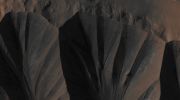
Gullies-ESP_020661_1440-PCF-LXTT-IPF.jpgGullies in Gasa Crater (Absolute Natural Colors; credits for the additional process. and color.: Dr Paolo C. Fienga/Lunar Explorer Italia/Italian Planetary Foundation)78 visiteThe so-called "Gully Landforms" - just like the ones shown here, in this NASA - Mars Reconnaissance Orbiter image - can often be found in the Inner Rims (or even below, along the Inner Slopes) of many Impact Craters that are located at the Martian Mid-Latitudes. Some changes in these Gully Landforms were first seen in frames taken by the NASA - Mars Global Surveyor - Mars Orbiter Camera (MGS-MOC) in the AD 2006, and studying such activity has been a high priority for HiRISE ever since (and, in fact, many examples of New Deposits located inside Gully Landforms are now well known).
This frame shows a New Deposit inside some Gully Landforms located on the Inner Rim of Gasa Crater; a very (relatively speaking) "fresh" approx. 7-Km diameter Impact Crater that is found in the Southern Mid-Latitudes of the Red Planet (to be precise, at 35,72° South Latitude and 129.45° East Longitude). Said New Deposit appears of a distinctive gray color, with some patches of white Material too, in this Absolute Natural Color version of the NASA - Mars Reconnaissance Orbiter image n. ESP_020661_1440. The picture was acquired during the Southern Spring of Mars, but the Flow that formed the Deposit occurred in the preceding Winter.
As a matter of fact, the current Gully Activities appear to be concentrated in periods going from the late Winter to the early Spring of Mars, and this circumstance may be a consequence of the Sublimation of the Seasonal Carbon Dioxide (CO2) Frost (which, by the way, is well visible in several Gully "Alcoves" during Wintertime).
Mars Local Time: 15:49 (Middle Afternoon)
Coord. (centered): 35,729° North Lat. and 129,386° East Long.
Spacecraft altitude: 258,2 Km (such as about 160,3 miles)
Original image scale range: 25,8 cm/pixel (with 1 x 1 binning) so objects ~ 78 cm across are resolved
Map projected scale: 25 cm/pixel
Map projection: EQUIRECTANGULAR
Emission Angle: 11,0°
Sun-Mars-Spacecraft (or Phase) Angle: 47,6°
Solar Incidence Angle: 58° (meaning that the Sun was about 32° above the Local Horizon at the time the picture was taken)
Solar Longitude: 203,7° (Northern Fall - Southern Spring)
Credits: NASA/JPL/University of Arizona
Additional process. and coloring: Lunar Explorer Italia
This picture (which is an Original Mars Reconnaissance Orbiter EDM enhanced color frame, identified by the serial n. ESP_020661_1440) has been additionally processed and then re-colorized in Absolute Natural Colors (such as the colors that a human eye would actually perceive if someone were onboard the NASA - Mars Reconnaissance Orbiter and then looked down, towards the Surface of Mars), by using an original technique created - and, in time, dramatically improved - by the Lunar Explorer Italia Team.MareKromium12/19/13 at 15:25paolocf1963: GRANDE WALT!
|
|
| 1160 immagini su 97 pagina(e) |
 |
|
|
|
|
10 | |
|
|
|
|





