| Ultimi commenti - The Sun: just a star, like many others... |

Sunspots-090602.jpgSunspots and Clouds in Solar Cycle 2475 visiteDa "NASA - Picture of the Day" del giorno 4 Giugno 2009:"On June 2nd, 2009, clouds over Stuttgart, Germany parted to reveal what has become a relatively rare sight, spots on the Sun. In fact, the roughly 11-year solar activity cycle is still in a surprisingly deep minimum and the years 2008 and 2009 have had the lowest Sunspot counts since the 1950s. Even the latest prediction is that the new cycle, Solar Cycle 24, will reach a maximum in May 2013 with a below-average sunspot count. The Solar Cycle 24 Sunspots recorded here are in active region AR 1019.
Previously, only two cycle 24 active regions with Sunspots, AR 1018 and AR 1017, were seen in May".MareKromium06/05/09 at 11:48MareKromium: ..."puzza" condivisa. In questo (oggi co...
|
|
Sunspots-090602.jpgSunspots and Clouds in Solar Cycle 2475 visiteDa "NASA - Picture of the Day" del giorno 4 Giugno 2009:"On June 2nd, 2009, clouds over Stuttgart, Germany parted to reveal what has become a relatively rare sight, spots on the Sun. In fact, the roughly 11-year solar activity cycle is still in a surprisingly deep minimum and the years 2008 and 2009 have had the lowest Sunspot counts since the 1950s. Even the latest prediction is that the new cycle, Solar Cycle 24, will reach a maximum in May 2013 with a below-average sunspot count. The Solar Cycle 24 Sunspots recorded here are in active region AR 1019.
Previously, only two cycle 24 active regions with Sunspots, AR 1018 and AR 1017, were seen in May".MareKromium06/05/09 at 06:25enzomancuso: Sperando che la tanto temuta tempesta solare del 2...
|
|
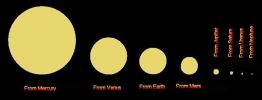
000-The_Sun_from_Space.JPGThe Sun from all the Planets of the Solar System181 visiteCome appare (o meglio: "Quanto grande" dovrebbe apparire) il Disco Solare allorchè osservato da un Mondo diverso dalla Terra?
Senza pretesa di assolutezza matematica, questa Tavola dovrebbe fornirVi un'idea più precisa della questione su cui tanto ci siamo arrovellati sino ad ora.
Nota: i diversi diametri sono stati ipotizzati ragionando in termini di UA (Unità Astronomiche), laddove 1 UA = distanza Sole / Terra = 149.597.970 Km
ergo la distanza fra il Sole e Mercurio viene fatta mediamente pari a (circa *) 0,4 UA
fra il Sole e Venere è mediamente pari a (circa) 0,7 UA
fra il Sole e Marte è mediamente pari a (circa) 1,5 UA
fra il Sole e Giove è mediamente pari a (circa) 5,2 UA
fra il Sole e Saturno è mediamente pari a (circa) 9,5 UA
fra il Sole ed Urano è mediamente pari a (circa) 19,6 UA
fra il Sole e Nettuno è mediamente pari a (circa) 30 UA
fra il Sole ed il Sistema Binario Plutone-Caronte è mediamente pari a (circa) 39 UA
* diciamo circa perchè le orbite dei diversi Pianeti attorno al Sole NON descrivono cerchi perfetti (e quindi con raggio - distanza dal Sole - fisso), bensì delle ellissi più o meno allungate (le quali implicano l'esistenza di un "perielio" - o punto di massima vicinanza del Corpo Celeste considerato rispetto al Sole - ed un "afelio" - o punto di massima lontananza del Corpo Celeste considerato rispetto al Sole.MareKromium02/07/09 at 12:26MareKromium: Beh, "piccolo"...ehmmm...Mercurio ? pur ...
|
|
000-The_Sun_from_Space.JPGThe Sun from all the Planets of the Solar System181 visiteCome appare (o meglio: "Quanto grande" dovrebbe apparire) il Disco Solare allorchè osservato da un Mondo diverso dalla Terra?
Senza pretesa di assolutezza matematica, questa Tavola dovrebbe fornirVi un'idea più precisa della questione su cui tanto ci siamo arrovellati sino ad ora.
Nota: i diversi diametri sono stati ipotizzati ragionando in termini di UA (Unità Astronomiche), laddove 1 UA = distanza Sole / Terra = 149.597.970 Km
ergo la distanza fra il Sole e Mercurio viene fatta mediamente pari a (circa *) 0,4 UA
fra il Sole e Venere è mediamente pari a (circa) 0,7 UA
fra il Sole e Marte è mediamente pari a (circa) 1,5 UA
fra il Sole e Giove è mediamente pari a (circa) 5,2 UA
fra il Sole e Saturno è mediamente pari a (circa) 9,5 UA
fra il Sole ed Urano è mediamente pari a (circa) 19,6 UA
fra il Sole e Nettuno è mediamente pari a (circa) 30 UA
fra il Sole ed il Sistema Binario Plutone-Caronte è mediamente pari a (circa) 39 UA
* diciamo circa perchè le orbite dei diversi Pianeti attorno al Sole NON descrivono cerchi perfetti (e quindi con raggio - distanza dal Sole - fisso), bensì delle ellissi più o meno allungate (le quali implicano l'esistenza di un "perielio" - o punto di massima vicinanza del Corpo Celeste considerato rispetto al Sole - ed un "afelio" - o punto di massima lontananza del Corpo Celeste considerato rispetto al Sole.MareKromium02/07/09 at 12:06Anakin: Domanda/considerazione istintiva: da Mercurio il S...
|
|

A-THE SUN-SOHO.jpgThe Sun, stars and planets from Soho166 visite...che si vede con grande chiarezza nell'immagine più grande, circa ad ore 01:00 del disco solare.
Ricordate quanto scrivemmo, nella Sezione dedicata a Mercurio, a proposito di un enigmatico "corpo celeste" il quale orbiterebbe intorno al Sole lungo un'orbita ancora più interna rispetto a quella dello stesso Mercurio? Ecco, l'immagine da alcuni Studiosi ritenuta come una prova fondamentale dell'esistenza di "qualcosa" nelle immediate vicinanze del Sole (il Decimo Pianeta) è proprio quella che Vi abbiamo offerto nel frame precedente. 06/18/08 at 12:30MareKromium: Carissimo Anakin, lo strumento che "oscura&qu...
|
|
A-THE SUN-SOHO.jpgThe Sun, stars and planets from Soho166 visite...che si vede con grande chiarezza nell'immagine più grande, circa ad ore 01:00 del disco solare.
Ricordate quanto scrivemmo, nella Sezione dedicata a Mercurio, a proposito di un enigmatico "corpo celeste" il quale orbiterebbe intorno al Sole lungo un'orbita ancora più interna rispetto a quella dello stesso Mercurio? Ecco, l'immagine da alcuni Studiosi ritenuta come una prova fondamentale dell'esistenza di "qualcosa" nelle immediate vicinanze del Sole (il Decimo Pianeta) è proprio quella che Vi abbiamo offerto nel frame precedente. 06/18/08 at 09:49charlie64: Mitico! grazie Anakin.
|
|
A-THE SUN-SOHO.jpgThe Sun, stars and planets from Soho166 visite...che si vede con grande chiarezza nell'immagine più grande, circa ad ore 01:00 del disco solare.
Ricordate quanto scrivemmo, nella Sezione dedicata a Mercurio, a proposito di un enigmatico "corpo celeste" il quale orbiterebbe intorno al Sole lungo un'orbita ancora più interna rispetto a quella dello stesso Mercurio? Ecco, l'immagine da alcuni Studiosi ritenuta come una prova fondamentale dell'esistenza di "qualcosa" nelle immediate vicinanze del Sole (il Decimo Pianeta) è proprio quella che Vi abbiamo offerto nel frame precedente. 06/18/08 at 08:24Anakin: X Charlie
Ecco, tipo questa. Generalmente ? con...
|
|

A-The Sun from Spitzer - spicules_sst_big.jpgSun "Spicules" from the Sptizer Space Telescope (SST)145 visiteCaption NASA originale: "Pictured above is perhaps the highest resolution image yet of the enigmatic "Solar Flux Tubes" known as "Spicules". Spicules dot the above frame of solar active region, but they are particularly evident as a carpet of dark tubes on the right. Time-sequenced images have recently shown that spicules "Life-span" is of about 5 minutes, starting out as tall tubes of rapidly rising gas but eventually fading as the gas peaks and falls back down to the Sun". 05/26/08 at 08:49MareKromium: Grande Anakin, ti ho risposto via e-mail. Poi scri...
|
|
A-The Sun from Spitzer - spicules_sst_big.jpgSun "Spicules" from the Sptizer Space Telescope (SST)145 visiteCaption NASA originale: "Pictured above is perhaps the highest resolution image yet of the enigmatic "Solar Flux Tubes" known as "Spicules". Spicules dot the above frame of solar active region, but they are particularly evident as a carpet of dark tubes on the right. Time-sequenced images have recently shown that spicules "Life-span" is of about 5 minutes, starting out as tall tubes of rapidly rising gas but eventually fading as the gas peaks and falls back down to the Sun". 05/26/08 at 07:44Anakin: Sono andato sul primo link postato da charlie, e c...
|
|
A-The Sun from Spitzer - spicules_sst_big.jpgSun "Spicules" from the Sptizer Space Telescope (SST)145 visiteCaption NASA originale: "Pictured above is perhaps the highest resolution image yet of the enigmatic "Solar Flux Tubes" known as "Spicules". Spicules dot the above frame of solar active region, but they are particularly evident as a carpet of dark tubes on the right. Time-sequenced images have recently shown that spicules "Life-span" is of about 5 minutes, starting out as tall tubes of rapidly rising gas but eventually fading as the gas peaks and falls back down to the Sun". 05/25/08 at 14:35charlie64: Non lo so. Noi in Sardegna abbiamo fatto lo switch...
|
|
A-The Sun from Spitzer - spicules_sst_big.jpgSun "Spicules" from the Sptizer Space Telescope (SST)145 visiteCaption NASA originale: "Pictured above is perhaps the highest resolution image yet of the enigmatic "Solar Flux Tubes" known as "Spicules". Spicules dot the above frame of solar active region, but they are particularly evident as a carpet of dark tubes on the right. Time-sequenced images have recently shown that spicules "Life-span" is of about 5 minutes, starting out as tall tubes of rapidly rising gas but eventually fading as the gas peaks and falls back down to the Sun". 05/25/08 at 14:33Anubi: si vede Rai News 24 per chi ha Sky?
|
|
A-The Sun from Spitzer - spicules_sst_big.jpgSun "Spicules" from the Sptizer Space Telescope (SST)145 visiteCaption NASA originale: "Pictured above is perhaps the highest resolution image yet of the enigmatic "Solar Flux Tubes" known as "Spicules". Spicules dot the above frame of solar active region, but they are particularly evident as a carpet of dark tubes on the right. Time-sequenced images have recently shown that spicules "Life-span" is of about 5 minutes, starting out as tall tubes of rapidly rising gas but eventually fading as the gas peaks and falls back down to the Sun". 05/25/08 at 14:33charlie64: Verr? seguito in diretta su Rai News 24 sul digita...
|
|
| 199 immagini su 17 pagina(e) |
 |
|
|
|
|
9 | |
|
|
|
|








