| Ultimi commenti - The Sun: just a star, like many others... |
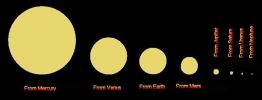
000-The_Sun_from_Space.JPGThe Sun from all the Planets of the Solar System181 visiteCome appare (o meglio: "Quanto grande" dovrebbe apparire) il Disco Solare allorchè osservato da un Mondo diverso dalla Terra?
Senza pretesa di assolutezza matematica, questa Tavola dovrebbe fornirVi un'idea più precisa della questione su cui tanto ci siamo arrovellati sino ad ora.
Nota: i diversi diametri sono stati ipotizzati ragionando in termini di UA (Unità Astronomiche), laddove 1 UA = distanza Sole / Terra = 149.597.970 Km
ergo la distanza fra il Sole e Mercurio viene fatta mediamente pari a (circa *) 0,4 UA
fra il Sole e Venere è mediamente pari a (circa) 0,7 UA
fra il Sole e Marte è mediamente pari a (circa) 1,5 UA
fra il Sole e Giove è mediamente pari a (circa) 5,2 UA
fra il Sole e Saturno è mediamente pari a (circa) 9,5 UA
fra il Sole ed Urano è mediamente pari a (circa) 19,6 UA
fra il Sole e Nettuno è mediamente pari a (circa) 30 UA
fra il Sole ed il Sistema Binario Plutone-Caronte è mediamente pari a (circa) 39 UA
* diciamo circa perchè le orbite dei diversi Pianeti attorno al Sole NON descrivono cerchi perfetti (e quindi con raggio - distanza dal Sole - fisso), bensì delle ellissi più o meno allungate (le quali implicano l'esistenza di un "perielio" - o punto di massima vicinanza del Corpo Celeste considerato rispetto al Sole - ed un "afelio" - o punto di massima lontananza del Corpo Celeste considerato rispetto al Sole.MareKromium01/13/13 at 09:47Anakin: bisogna tener conto che gli americani e i russi no...
|
|
000-The_Sun_from_Space.JPGThe Sun from all the Planets of the Solar System181 visiteCome appare (o meglio: "Quanto grande" dovrebbe apparire) il Disco Solare allorchè osservato da un Mondo diverso dalla Terra?
Senza pretesa di assolutezza matematica, questa Tavola dovrebbe fornirVi un'idea più precisa della questione su cui tanto ci siamo arrovellati sino ad ora.
Nota: i diversi diametri sono stati ipotizzati ragionando in termini di UA (Unità Astronomiche), laddove 1 UA = distanza Sole / Terra = 149.597.970 Km
ergo la distanza fra il Sole e Mercurio viene fatta mediamente pari a (circa *) 0,4 UA
fra il Sole e Venere è mediamente pari a (circa) 0,7 UA
fra il Sole e Marte è mediamente pari a (circa) 1,5 UA
fra il Sole e Giove è mediamente pari a (circa) 5,2 UA
fra il Sole e Saturno è mediamente pari a (circa) 9,5 UA
fra il Sole ed Urano è mediamente pari a (circa) 19,6 UA
fra il Sole e Nettuno è mediamente pari a (circa) 30 UA
fra il Sole ed il Sistema Binario Plutone-Caronte è mediamente pari a (circa) 39 UA
* diciamo circa perchè le orbite dei diversi Pianeti attorno al Sole NON descrivono cerchi perfetti (e quindi con raggio - distanza dal Sole - fisso), bensì delle ellissi più o meno allungate (le quali implicano l'esistenza di un "perielio" - o punto di massima vicinanza del Corpo Celeste considerato rispetto al Sole - ed un "afelio" - o punto di massima lontananza del Corpo Celeste considerato rispetto al Sole.MareKromium01/12/13 at 11:32paolocf1963: ...e probabilmente con Rovers, difficilmente con A...
|
|
000-The_Sun_from_Space.JPGThe Sun from all the Planets of the Solar System181 visiteCome appare (o meglio: "Quanto grande" dovrebbe apparire) il Disco Solare allorchè osservato da un Mondo diverso dalla Terra?
Senza pretesa di assolutezza matematica, questa Tavola dovrebbe fornirVi un'idea più precisa della questione su cui tanto ci siamo arrovellati sino ad ora.
Nota: i diversi diametri sono stati ipotizzati ragionando in termini di UA (Unità Astronomiche), laddove 1 UA = distanza Sole / Terra = 149.597.970 Km
ergo la distanza fra il Sole e Mercurio viene fatta mediamente pari a (circa *) 0,4 UA
fra il Sole e Venere è mediamente pari a (circa) 0,7 UA
fra il Sole e Marte è mediamente pari a (circa) 1,5 UA
fra il Sole e Giove è mediamente pari a (circa) 5,2 UA
fra il Sole e Saturno è mediamente pari a (circa) 9,5 UA
fra il Sole ed Urano è mediamente pari a (circa) 19,6 UA
fra il Sole e Nettuno è mediamente pari a (circa) 30 UA
fra il Sole ed il Sistema Binario Plutone-Caronte è mediamente pari a (circa) 39 UA
* diciamo circa perchè le orbite dei diversi Pianeti attorno al Sole NON descrivono cerchi perfetti (e quindi con raggio - distanza dal Sole - fisso), bensì delle ellissi più o meno allungate (le quali implicano l'esistenza di un "perielio" - o punto di massima vicinanza del Corpo Celeste considerato rispetto al Sole - ed un "afelio" - o punto di massima lontananza del Corpo Celeste considerato rispetto al Sole.MareKromium01/12/13 at 11:06Anakin: Fin quando non ci andremo direttamente... Fra qual...
|
|
000-The_Sun_from_Space.JPGThe Sun from all the Planets of the Solar System181 visiteCome appare (o meglio: "Quanto grande" dovrebbe apparire) il Disco Solare allorchè osservato da un Mondo diverso dalla Terra?
Senza pretesa di assolutezza matematica, questa Tavola dovrebbe fornirVi un'idea più precisa della questione su cui tanto ci siamo arrovellati sino ad ora.
Nota: i diversi diametri sono stati ipotizzati ragionando in termini di UA (Unità Astronomiche), laddove 1 UA = distanza Sole / Terra = 149.597.970 Km
ergo la distanza fra il Sole e Mercurio viene fatta mediamente pari a (circa *) 0,4 UA
fra il Sole e Venere è mediamente pari a (circa) 0,7 UA
fra il Sole e Marte è mediamente pari a (circa) 1,5 UA
fra il Sole e Giove è mediamente pari a (circa) 5,2 UA
fra il Sole e Saturno è mediamente pari a (circa) 9,5 UA
fra il Sole ed Urano è mediamente pari a (circa) 19,6 UA
fra il Sole e Nettuno è mediamente pari a (circa) 30 UA
fra il Sole ed il Sistema Binario Plutone-Caronte è mediamente pari a (circa) 39 UA
* diciamo circa perchè le orbite dei diversi Pianeti attorno al Sole NON descrivono cerchi perfetti (e quindi con raggio - distanza dal Sole - fisso), bensì delle ellissi più o meno allungate (le quali implicano l'esistenza di un "perielio" - o punto di massima vicinanza del Corpo Celeste considerato rispetto al Sole - ed un "afelio" - o punto di massima lontananza del Corpo Celeste considerato rispetto al Sole.MareKromium01/12/13 at 10:50paolocf1963: Salve Amici!
A proposito dell'illuminazione...
|
|

Solar_Corona~0.jpgDeep Coronal Holes116 visiteCaption NASA:"This ominous, dark shape sprawling across the face of the Sun is a Coronal Hole -- a low density region extending above the Surface where the Solar Magnetic Field opens freely into interplanetary space.
Studied extensively from space since the 1960s in UltraViolet and X-Ray Light, Coronal Holes are known to be the source of the high-speed Solar Wind (such as atoms and electrons which flow outward along the open Magnetic Field lines). During periods of low activity, Coronal Holes typically cover regions just above the Sun's Poles.
But this extensive Coronal Hole dominated the Sun's Northern Hemisphere earlier this week, captured here in Extreme UV Light by cameras onboard the Solar Dynamics Observatory. The solar wind streaming from this Coronal Hole triggered auroral displays on Earth".MareKromium11/30/12 at 08:23pierluigi: Ciao a tutti ragazzi, quella dei buchi neri e'...
|
|
Solar_Corona~0.jpgDeep Coronal Holes116 visiteCaption NASA:"This ominous, dark shape sprawling across the face of the Sun is a Coronal Hole -- a low density region extending above the Surface where the Solar Magnetic Field opens freely into interplanetary space.
Studied extensively from space since the 1960s in UltraViolet and X-Ray Light, Coronal Holes are known to be the source of the high-speed Solar Wind (such as atoms and electrons which flow outward along the open Magnetic Field lines). During periods of low activity, Coronal Holes typically cover regions just above the Sun's Poles.
But this extensive Coronal Hole dominated the Sun's Northern Hemisphere earlier this week, captured here in Extreme UV Light by cameras onboard the Solar Dynamics Observatory. The solar wind streaming from this Coronal Hole triggered auroral displays on Earth".MareKromium11/30/12 at 06:53Anakin: Sì Paolo, grazie!
|
|
Solar_Corona~0.jpgDeep Coronal Holes116 visiteCaption NASA:"This ominous, dark shape sprawling across the face of the Sun is a Coronal Hole -- a low density region extending above the Surface where the Solar Magnetic Field opens freely into interplanetary space.
Studied extensively from space since the 1960s in UltraViolet and X-Ray Light, Coronal Holes are known to be the source of the high-speed Solar Wind (such as atoms and electrons which flow outward along the open Magnetic Field lines). During periods of low activity, Coronal Holes typically cover regions just above the Sun's Poles.
But this extensive Coronal Hole dominated the Sun's Northern Hemisphere earlier this week, captured here in Extreme UV Light by cameras onboard the Solar Dynamics Observatory. The solar wind streaming from this Coronal Hole triggered auroral displays on Earth".MareKromium11/30/12 at 06:18AndreaGG: A me interessa molto il tuo punto di vista! ;)
|
|
Solar_Corona~0.jpgDeep Coronal Holes116 visiteCaption NASA:"This ominous, dark shape sprawling across the face of the Sun is a Coronal Hole -- a low density region extending above the Surface where the Solar Magnetic Field opens freely into interplanetary space.
Studied extensively from space since the 1960s in UltraViolet and X-Ray Light, Coronal Holes are known to be the source of the high-speed Solar Wind (such as atoms and electrons which flow outward along the open Magnetic Field lines). During periods of low activity, Coronal Holes typically cover regions just above the Sun's Poles.
But this extensive Coronal Hole dominated the Sun's Northern Hemisphere earlier this week, captured here in Extreme UV Light by cameras onboard the Solar Dynamics Observatory. The solar wind streaming from this Coronal Hole triggered auroral displays on Earth".MareKromium11/29/12 at 19:09paolocf1963: Se Vi va, Vi racconto quello che penso, dopo aver ...
|
|
Solar_Corona~0.jpgDeep Coronal Holes116 visiteCaption NASA:"This ominous, dark shape sprawling across the face of the Sun is a Coronal Hole -- a low density region extending above the Surface where the Solar Magnetic Field opens freely into interplanetary space.
Studied extensively from space since the 1960s in UltraViolet and X-Ray Light, Coronal Holes are known to be the source of the high-speed Solar Wind (such as atoms and electrons which flow outward along the open Magnetic Field lines). During periods of low activity, Coronal Holes typically cover regions just above the Sun's Poles.
But this extensive Coronal Hole dominated the Sun's Northern Hemisphere earlier this week, captured here in Extreme UV Light by cameras onboard the Solar Dynamics Observatory. The solar wind streaming from this Coronal Hole triggered auroral displays on Earth".MareKromium11/29/12 at 18:58AndreaGG: MK mi corregga se sbaglio... Attualmente la teoria...
|
|
Solar_Corona~0.jpgDeep Coronal Holes116 visiteCaption NASA:"This ominous, dark shape sprawling across the face of the Sun is a Coronal Hole -- a low density region extending above the Surface where the Solar Magnetic Field opens freely into interplanetary space.
Studied extensively from space since the 1960s in UltraViolet and X-Ray Light, Coronal Holes are known to be the source of the high-speed Solar Wind (such as atoms and electrons which flow outward along the open Magnetic Field lines). During periods of low activity, Coronal Holes typically cover regions just above the Sun's Poles.
But this extensive Coronal Hole dominated the Sun's Northern Hemisphere earlier this week, captured here in Extreme UV Light by cameras onboard the Solar Dynamics Observatory. The solar wind streaming from this Coronal Hole triggered auroral displays on Earth".MareKromium11/29/12 at 15:34Anakin: ma è un buco o un corpo di materia tangibile?
|
|
Solar_Corona~0.jpgDeep Coronal Holes116 visiteCaption NASA:"This ominous, dark shape sprawling across the face of the Sun is a Coronal Hole -- a low density region extending above the Surface where the Solar Magnetic Field opens freely into interplanetary space.
Studied extensively from space since the 1960s in UltraViolet and X-Ray Light, Coronal Holes are known to be the source of the high-speed Solar Wind (such as atoms and electrons which flow outward along the open Magnetic Field lines). During periods of low activity, Coronal Holes typically cover regions just above the Sun's Poles.
But this extensive Coronal Hole dominated the Sun's Northern Hemisphere earlier this week, captured here in Extreme UV Light by cameras onboard the Solar Dynamics Observatory. The solar wind streaming from this Coronal Hole triggered auroral displays on Earth".MareKromium11/29/12 at 15:13MareKromium: Astronomers have discovered what may be the most m...
|
|
Solar_Corona~0.jpgDeep Coronal Holes116 visiteCaption NASA:"This ominous, dark shape sprawling across the face of the Sun is a Coronal Hole -- a low density region extending above the Surface where the Solar Magnetic Field opens freely into interplanetary space.
Studied extensively from space since the 1960s in UltraViolet and X-Ray Light, Coronal Holes are known to be the source of the high-speed Solar Wind (such as atoms and electrons which flow outward along the open Magnetic Field lines). During periods of low activity, Coronal Holes typically cover regions just above the Sun's Poles.
But this extensive Coronal Hole dominated the Sun's Northern Hemisphere earlier this week, captured here in Extreme UV Light by cameras onboard the Solar Dynamics Observatory. The solar wind streaming from this Coronal Hole triggered auroral displays on Earth".MareKromium11/29/12 at 13:43Anakin: Hanno scoperto un Buco Nero supergigante. Le sue d...
|
|
| 199 immagini su 17 pagina(e) |
 |
3 | |
|
|
|
|
|
|
|
|








