| |

| Ultimi commenti - Pluto and Charon: The "Double Planet" |
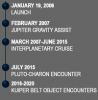
ZZ-ZZ-ZZ-ZZ-ZZ-ZZ-ZZ-ZZ-ZZ-ZZ-Timeline.jpgThe "Timeline" to Pluto...and beyond81 visiteLa schedula temporale (o "Timeline") che illustra il prossimo futuro della Sonda New Horizons, dal giorno della partenza, passando attraverso l'incontro con Giove (che le servirà da "Fionda Gravitazionale"), sino al passaggio ravvicinato con Plutone, nel Luglio 2015 e poi...L'immersione nella Fascia di Kuiper e l'incontro (probabile) con uno o due oggetti, tra il 2016 ed il 2020.
New Horizons, come tutte le Sonde destinate ad attraversare il Sistema Solare, sarà precisa e puntuale al suo appuntamento con la Storia: non ci sono dubbi.
Siatelo anche Voi!... 01/07/16 at 11:20KKK: :-)
|
|
ZZ-ZZ-ZZ-ZZ-ZZ-ZZ-ZZ-ZZ-ZZ-ZZ-Timeline.jpgThe "Timeline" to Pluto...and beyond81 visiteLa schedula temporale (o "Timeline") che illustra il prossimo futuro della Sonda New Horizons, dal giorno della partenza, passando attraverso l'incontro con Giove (che le servirà da "Fionda Gravitazionale"), sino al passaggio ravvicinato con Plutone, nel Luglio 2015 e poi...L'immersione nella Fascia di Kuiper e l'incontro (probabile) con uno o due oggetti, tra il 2016 ed il 2020.
New Horizons, come tutte le Sonde destinate ad attraversare il Sistema Solare, sarà precisa e puntuale al suo appuntamento con la Storia: non ci sono dubbi.
Siatelo anche Voi!... 01/07/16 at 11:17walthari: :-)
|
|

ZZ-ZZ-ZZ-ZZ-ZZ-ZZ-Charon-PIA19709-PCF-LXTT-IPF.jpgCharon (Absolute Natural Colors; credits for the additional process. and color.: Dr Paolo C. Fienga - Lunexit Team)86 visiteRemarkable new details of Pluto's largest moon Charon are revealed in this wonderful image from New Horizons' Long Range Reconnaissance Imager (or "LORRI", for short), that was taken late on July 13, 2015, from a distance of about 289.000 miles (such as approx. 465.099,26 Km). A swath of Cliffs and Troughs stretches about 600 miles (approx. 1609,34 Km) from left (Sx) to right (Dx), suggesting the occurrence, in a remote past, of a widespread fracturing of Charon's Crust (likely a result of internal processes). At the upper righ (Dx) of the framet, along the moon's curving edge, there is a Canyon that is estimated to be approx. 4 to 6 miles (such as about 6,437 to roughly 9,656 Km) deep.
The Mission Scientists are surprised by the apparent lack of Impact Craters on Charon. South of the moon's Equator, at the bottom of this image, Terrain is lit by the slanting Rays of the Sun, and thus creating shadows that make it easier to distinguish its real Topography. Even here, however, relatively few Impact Craters are visible, and this circumstance indicates a (relatively speaking) young Surface that, probably, has been often reshaped by Geologic Activites.
In Charon's North Polar Regions, a dark marking - which was already prominent in the NASA - New Horizons Spacecraft' approach images - is now seen to have a diffuse (---> lighter in color) Boundary, suggesting that it could be a thin Deposit of Dark Material. Underlying, it is a distinct, sharply bounded, Angular Surface Feature; higher resolution images still to come are expected to shed more light on this truly enigmatic Region.
The image (which is an Original NASA - New Horizons Spacecraft's falsely colored and NON Map-Projected frame published on the NASA - Planetary Phojournal with the ID n. 19709) has been additionally processed, magnified to aid the visibility of the details, contrast enhanced and sharpened, Gamma corrected and then re-colorized (according to an educated guess carried out by Dr Paolo C. Fienga-LXTT-IPF) in Absolute Natural Colors (such as the colors that a normal human eye would actually perceive if someone were onboard the NASA - New Horizons Spacecraft and then looked ahead, towards the Plutonian moon Charon), by using an original technique created - and, in time, dramatically improved - by the Lunar Explorer Italia Team.MareKromium01/07/16 at 11:15KKK: Metano, Etano ed altri Idrocarburi Aromatici proba...
|
|
ZZ-ZZ-ZZ-ZZ-ZZ-ZZ-ZZ-ZZ-ZZ-ZZ-Timeline.jpgThe "Timeline" to Pluto...and beyond81 visiteLa schedula temporale (o "Timeline") che illustra il prossimo futuro della Sonda New Horizons, dal giorno della partenza, passando attraverso l'incontro con Giove (che le servirà da "Fionda Gravitazionale"), sino al passaggio ravvicinato con Plutone, nel Luglio 2015 e poi...L'immersione nella Fascia di Kuiper e l'incontro (probabile) con uno o due oggetti, tra il 2016 ed il 2020.
New Horizons, come tutte le Sonde destinate ad attraversare il Sistema Solare, sarà precisa e puntuale al suo appuntamento con la Storia: non ci sono dubbi.
Siatelo anche Voi!... 01/07/16 at 11:13KKK: ...diciamo con Noi.... che ne abbiamo tutti bisogn...
|
|
ZZ-ZZ-ZZ-ZZ-ZZ-ZZ-ZZ-ZZ-ZZ-ZZ-Timeline.jpgThe "Timeline" to Pluto...and beyond81 visiteLa schedula temporale (o "Timeline") che illustra il prossimo futuro della Sonda New Horizons, dal giorno della partenza, passando attraverso l'incontro con Giove (che le servirà da "Fionda Gravitazionale"), sino al passaggio ravvicinato con Plutone, nel Luglio 2015 e poi...L'immersione nella Fascia di Kuiper e l'incontro (probabile) con uno o due oggetti, tra il 2016 ed il 2020.
New Horizons, come tutte le Sonde destinate ad attraversare il Sistema Solare, sarà precisa e puntuale al suo appuntamento con la Storia: non ci sono dubbi.
Siatelo anche Voi!... 01/07/16 at 10:18walthari: Buon anno a te Anakin e che la Forza sia sempre co...
|
|
ZZ-ZZ-ZZ-ZZ-ZZ-ZZ-Charon-PIA19709-PCF-LXTT-IPF.jpgCharon (Absolute Natural Colors; credits for the additional process. and color.: Dr Paolo C. Fienga - Lunexit Team)86 visiteRemarkable new details of Pluto's largest moon Charon are revealed in this wonderful image from New Horizons' Long Range Reconnaissance Imager (or "LORRI", for short), that was taken late on July 13, 2015, from a distance of about 289.000 miles (such as approx. 465.099,26 Km). A swath of Cliffs and Troughs stretches about 600 miles (approx. 1609,34 Km) from left (Sx) to right (Dx), suggesting the occurrence, in a remote past, of a widespread fracturing of Charon's Crust (likely a result of internal processes). At the upper righ (Dx) of the framet, along the moon's curving edge, there is a Canyon that is estimated to be approx. 4 to 6 miles (such as about 6,437 to roughly 9,656 Km) deep.
The Mission Scientists are surprised by the apparent lack of Impact Craters on Charon. South of the moon's Equator, at the bottom of this image, Terrain is lit by the slanting Rays of the Sun, and thus creating shadows that make it easier to distinguish its real Topography. Even here, however, relatively few Impact Craters are visible, and this circumstance indicates a (relatively speaking) young Surface that, probably, has been often reshaped by Geologic Activites.
In Charon's North Polar Regions, a dark marking - which was already prominent in the NASA - New Horizons Spacecraft' approach images - is now seen to have a diffuse (---> lighter in color) Boundary, suggesting that it could be a thin Deposit of Dark Material. Underlying, it is a distinct, sharply bounded, Angular Surface Feature; higher resolution images still to come are expected to shed more light on this truly enigmatic Region.
The image (which is an Original NASA - New Horizons Spacecraft's falsely colored and NON Map-Projected frame published on the NASA - Planetary Phojournal with the ID n. 19709) has been additionally processed, magnified to aid the visibility of the details, contrast enhanced and sharpened, Gamma corrected and then re-colorized (according to an educated guess carried out by Dr Paolo C. Fienga-LXTT-IPF) in Absolute Natural Colors (such as the colors that a normal human eye would actually perceive if someone were onboard the NASA - New Horizons Spacecraft and then looked ahead, towards the Plutonian moon Charon), by using an original technique created - and, in time, dramatically improved - by the Lunar Explorer Italia Team.MareKromium01/07/16 at 09:35Anakin: Metano nel sottosulo
|
|
ZZ-ZZ-ZZ-ZZ-ZZ-ZZ-ZZ-ZZ-ZZ-ZZ-Timeline.jpgThe "Timeline" to Pluto...and beyond81 visiteLa schedula temporale (o "Timeline") che illustra il prossimo futuro della Sonda New Horizons, dal giorno della partenza, passando attraverso l'incontro con Giove (che le servirà da "Fionda Gravitazionale"), sino al passaggio ravvicinato con Plutone, nel Luglio 2015 e poi...L'immersione nella Fascia di Kuiper e l'incontro (probabile) con uno o due oggetti, tra il 2016 ed il 2020.
New Horizons, come tutte le Sonde destinate ad attraversare il Sistema Solare, sarà precisa e puntuale al suo appuntamento con la Storia: non ci sono dubbi.
Siatelo anche Voi!... 01/07/16 at 09:33Anakin: Buon Anno. Mi sono assentato qualche giorno per an...
|
|
ZZ-ZZ-ZZ-ZZ-ZZ-ZZ-ZZ-ZZ-ZZ-ZZ-Timeline.jpgThe "Timeline" to Pluto...and beyond81 visiteLa schedula temporale (o "Timeline") che illustra il prossimo futuro della Sonda New Horizons, dal giorno della partenza, passando attraverso l'incontro con Giove (che le servirà da "Fionda Gravitazionale"), sino al passaggio ravvicinato con Plutone, nel Luglio 2015 e poi...L'immersione nella Fascia di Kuiper e l'incontro (probabile) con uno o due oggetti, tra il 2016 ed il 2020.
New Horizons, come tutte le Sonde destinate ad attraversare il Sistema Solare, sarà precisa e puntuale al suo appuntamento con la Storia: non ci sono dubbi.
Siatelo anche Voi!... 01/03/16 at 17:11KKK: A Te!
|
|
ZZ-ZZ-ZZ-ZZ-ZZ-ZZ-ZZ-ZZ-ZZ-ZZ-Timeline.jpgThe "Timeline" to Pluto...and beyond81 visiteLa schedula temporale (o "Timeline") che illustra il prossimo futuro della Sonda New Horizons, dal giorno della partenza, passando attraverso l'incontro con Giove (che le servirà da "Fionda Gravitazionale"), sino al passaggio ravvicinato con Plutone, nel Luglio 2015 e poi...L'immersione nella Fascia di Kuiper e l'incontro (probabile) con uno o due oggetti, tra il 2016 ed il 2020.
New Horizons, come tutte le Sonde destinate ad attraversare il Sistema Solare, sarà precisa e puntuale al suo appuntamento con la Storia: non ci sono dubbi.
Siatelo anche Voi!... 01/03/16 at 15:18Omomoto: Esserci sarebbe davvero un bell'augurio per il...
|
|
ZZ-ZZ-ZZ-ZZ-ZZ-ZZ-Charon-PIA19709-PCF-LXTT-IPF.jpgCharon (Absolute Natural Colors; credits for the additional process. and color.: Dr Paolo C. Fienga - Lunexit Team)86 visiteRemarkable new details of Pluto's largest moon Charon are revealed in this wonderful image from New Horizons' Long Range Reconnaissance Imager (or "LORRI", for short), that was taken late on July 13, 2015, from a distance of about 289.000 miles (such as approx. 465.099,26 Km). A swath of Cliffs and Troughs stretches about 600 miles (approx. 1609,34 Km) from left (Sx) to right (Dx), suggesting the occurrence, in a remote past, of a widespread fracturing of Charon's Crust (likely a result of internal processes). At the upper righ (Dx) of the framet, along the moon's curving edge, there is a Canyon that is estimated to be approx. 4 to 6 miles (such as about 6,437 to roughly 9,656 Km) deep.
The Mission Scientists are surprised by the apparent lack of Impact Craters on Charon. South of the moon's Equator, at the bottom of this image, Terrain is lit by the slanting Rays of the Sun, and thus creating shadows that make it easier to distinguish its real Topography. Even here, however, relatively few Impact Craters are visible, and this circumstance indicates a (relatively speaking) young Surface that, probably, has been often reshaped by Geologic Activites.
In Charon's North Polar Regions, a dark marking - which was already prominent in the NASA - New Horizons Spacecraft' approach images - is now seen to have a diffuse (---> lighter in color) Boundary, suggesting that it could be a thin Deposit of Dark Material. Underlying, it is a distinct, sharply bounded, Angular Surface Feature; higher resolution images still to come are expected to shed more light on this truly enigmatic Region.
The image (which is an Original NASA - New Horizons Spacecraft's falsely colored and NON Map-Projected frame published on the NASA - Planetary Phojournal with the ID n. 19709) has been additionally processed, magnified to aid the visibility of the details, contrast enhanced and sharpened, Gamma corrected and then re-colorized (according to an educated guess carried out by Dr Paolo C. Fienga-LXTT-IPF) in Absolute Natural Colors (such as the colors that a normal human eye would actually perceive if someone were onboard the NASA - New Horizons Spacecraft and then looked ahead, towards the Plutonian moon Charon), by using an original technique created - and, in time, dramatically improved - by the Lunar Explorer Italia Team.MareKromium01/02/16 at 20:40AndreaGG: Ah ok, la convergenza era col commento scritto qui...
|
|
ZZ-ZZ-ZZ-ZZ-ZZ-ZZ-Charon-PIA19709-PCF-LXTT-IPF.jpgCharon (Absolute Natural Colors; credits for the additional process. and color.: Dr Paolo C. Fienga - Lunexit Team)86 visiteRemarkable new details of Pluto's largest moon Charon are revealed in this wonderful image from New Horizons' Long Range Reconnaissance Imager (or "LORRI", for short), that was taken late on July 13, 2015, from a distance of about 289.000 miles (such as approx. 465.099,26 Km). A swath of Cliffs and Troughs stretches about 600 miles (approx. 1609,34 Km) from left (Sx) to right (Dx), suggesting the occurrence, in a remote past, of a widespread fracturing of Charon's Crust (likely a result of internal processes). At the upper righ (Dx) of the framet, along the moon's curving edge, there is a Canyon that is estimated to be approx. 4 to 6 miles (such as about 6,437 to roughly 9,656 Km) deep.
The Mission Scientists are surprised by the apparent lack of Impact Craters on Charon. South of the moon's Equator, at the bottom of this image, Terrain is lit by the slanting Rays of the Sun, and thus creating shadows that make it easier to distinguish its real Topography. Even here, however, relatively few Impact Craters are visible, and this circumstance indicates a (relatively speaking) young Surface that, probably, has been often reshaped by Geologic Activites.
In Charon's North Polar Regions, a dark marking - which was already prominent in the NASA - New Horizons Spacecraft' approach images - is now seen to have a diffuse (---> lighter in color) Boundary, suggesting that it could be a thin Deposit of Dark Material. Underlying, it is a distinct, sharply bounded, Angular Surface Feature; higher resolution images still to come are expected to shed more light on this truly enigmatic Region.
The image (which is an Original NASA - New Horizons Spacecraft's falsely colored and NON Map-Projected frame published on the NASA - Planetary Phojournal with the ID n. 19709) has been additionally processed, magnified to aid the visibility of the details, contrast enhanced and sharpened, Gamma corrected and then re-colorized (according to an educated guess carried out by Dr Paolo C. Fienga-LXTT-IPF) in Absolute Natural Colors (such as the colors that a normal human eye would actually perceive if someone were onboard the NASA - New Horizons Spacecraft and then looked ahead, towards the Plutonian moon Charon), by using an original technique created - and, in time, dramatically improved - by the Lunar Explorer Italia Team.MareKromium01/02/16 at 18:30KKK: Infatti: ?, come l'APOD originale, un Sito non...
|
|
ZZ-ZZ-ZZ-ZZ-ZZ-ZZ-Charon-PIA19709-PCF-LXTT-IPF.jpgCharon (Absolute Natural Colors; credits for the additional process. and color.: Dr Paolo C. Fienga - Lunexit Team)86 visiteRemarkable new details of Pluto's largest moon Charon are revealed in this wonderful image from New Horizons' Long Range Reconnaissance Imager (or "LORRI", for short), that was taken late on July 13, 2015, from a distance of about 289.000 miles (such as approx. 465.099,26 Km). A swath of Cliffs and Troughs stretches about 600 miles (approx. 1609,34 Km) from left (Sx) to right (Dx), suggesting the occurrence, in a remote past, of a widespread fracturing of Charon's Crust (likely a result of internal processes). At the upper righ (Dx) of the framet, along the moon's curving edge, there is a Canyon that is estimated to be approx. 4 to 6 miles (such as about 6,437 to roughly 9,656 Km) deep.
The Mission Scientists are surprised by the apparent lack of Impact Craters on Charon. South of the moon's Equator, at the bottom of this image, Terrain is lit by the slanting Rays of the Sun, and thus creating shadows that make it easier to distinguish its real Topography. Even here, however, relatively few Impact Craters are visible, and this circumstance indicates a (relatively speaking) young Surface that, probably, has been often reshaped by Geologic Activites.
In Charon's North Polar Regions, a dark marking - which was already prominent in the NASA - New Horizons Spacecraft' approach images - is now seen to have a diffuse (---> lighter in color) Boundary, suggesting that it could be a thin Deposit of Dark Material. Underlying, it is a distinct, sharply bounded, Angular Surface Feature; higher resolution images still to come are expected to shed more light on this truly enigmatic Region.
The image (which is an Original NASA - New Horizons Spacecraft's falsely colored and NON Map-Projected frame published on the NASA - Planetary Phojournal with the ID n. 19709) has been additionally processed, magnified to aid the visibility of the details, contrast enhanced and sharpened, Gamma corrected and then re-colorized (according to an educated guess carried out by Dr Paolo C. Fienga-LXTT-IPF) in Absolute Natural Colors (such as the colors that a normal human eye would actually perceive if someone were onboard the NASA - New Horizons Spacecraft and then looked ahead, towards the Plutonian moon Charon), by using an original technique created - and, in time, dramatically improved - by the Lunar Explorer Italia Team.MareKromium01/02/16 at 16:26walthari: infatti Andrea non ci sono commenti se non quelli ...
|
|
| 195 immagini su 17 pagina(e) |
|
|
|
|
|
7 | |
|
|
|
|
|
|





