| |

| Ultimi commenti - Jupiter: the "King" and His Moons |

Ganymede-P-51236218280_1b20779992_o.pngGanymede95 visitenessun commentoMareKromium06/10/21 at 18:15MareKromium: ...Grazie Anakin. Purtroppo, per quanto riguarda T...
|
|
Ganymede-P-51236218280_1b20779992_o.pngGanymede95 visitenessun commentoMareKromium06/10/21 at 13:26Anakin: 110 con lode e bacio accademico, Mare. E' esat...
|
|
Ganymede-P-51236218280_1b20779992_o.pngGanymede95 visitenessun commentoMareKromium06/10/21 at 10:05MareKromium: Per noi "umani", solo tecnologicamente. ...
|
|
Ganymede-P-51236218280_1b20779992_o.pngGanymede95 visitenessun commentoMareKromium06/10/21 at 08:09Anakin: ... sembra la Luna con quel cratere... e come infl...
|
|
Ganymede-P-51236218280_1b20779992_o.pngGanymede95 visitenessun commentoMareKromium06/09/21 at 21:14MareKromium: Saranno migliorati gli strumenti, penso...
|
|
Ganymede-P-51236218280_1b20779992_o.pngGanymede95 visitenessun commentoMareKromium06/09/21 at 19:34walthari: ma che strano...
|
|
Ganymede-P-51236218280_1b20779992_o.pngGanymede95 visitenessun commentoMareKromium06/09/21 at 10:19MareKromium: Ma guarda come cambiano i colori dei Corpi Celesti...
|
|

Io-Loki_Patera-PIA00320-PCF-LXTT-IPF.jpgVolcanic Plains and Paterae on Io: Loki Patera (Absolute Natural Colors; credits for the additional process. and color.: Dr Paolo C. Fienga/Lunar Explorer Italia/Italian Planetary Foundation)94 visiteA huge area of Io's Volcanic Plains is well shown in this mosaic of pictures taken by the NASA - Voyager 1 Space Probe. Numerous Volcanic Calderas and Lava Flows are visible here, including the Loki Patera (an active Lava Lake), which is the large shield-shaped and dark red Surface Feature visible in the lower right portion of the mosaic. As a matter of fact, the (sometime) intense light emitted from the Lava that boils inside Loki Patera can even be seen through telescopes, all the way from Earth, and these observations tell us that Loki has been active continuously (or at least every time an astronomer took a good look at it...) since the Voyager 1 Fly-By, which occurred in the month of March of the AD 1979.
The composition of Io's Volcanic Plains and Lava Flows has not been completely determined yet but, in the light of the information that we already possess (and, in particular, once we duly consider the orange-yellow color that can be seen over most of the Surface of Io), it is reasonable to say that they could dominantly consist of Sulphur, with Surface Frosts made of Sulphur Dioxide, Silicates (such as Basalts) encrusted with Sulphur and Sulphur Dioxide Condensates. The bright whitish patches, on the other hand, could probably consist of freshly deposited Sulphur Dioxide Frost. The dark red (and, sometime, almost black) spots, including Loki, are hot Sulphur Lava Lakes, which may remain molten even for a long time, thanks to the intrusions of molten Silicate Magma that (probably in an almost continuous way) comes up from deep inside Io. However, the very ultimate source of heat that keeps Io active, must be the Tidal (Frictional) Heating, due to the perpetual flexure of Io that is caused by the powerful Gravitational Influence of both Jupiter and Europa.
This picture (which is an Original NASA - Voyager 1 Space Proble color image mosaic published on the NASA - Planetary Photojournal with the n. PIA 00320) has been additionally processed and then re-colorized in Absolute Natural Colors (such as the colors that a human eye would actually perceive if someone were onboard the NASA - Voyager 1 Space Probe and then looked outside, towards the limb of the Jovian moon Io), by using an original technique created - and, in time, dramatically improved - by the Lunar Explorer Italia Team. Different colors, as well as different shades of the same color, mean, among others, the existence of different Elements present on the Surface of Io, each having a different Albedo (---> Reflectivity) and Chemical Composition.MareKromium11/16/20 at 12:24MareKromium: Qualcosa che non saprei spiegare... ;-)
|
|
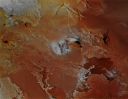
Io-Galai_Patera-PIA00324-PCF-LXTT-IPF.jpgVolcanic Plains and Paterae on Io: Galai Patera (Absolute Natural Colors; credits for the additional process. and color.: Dr Paolo C. Fienga/Lunar Explorer Italia/Italian Planetary Foundation)106 visiteIo's Volcanic Plains and at least 9 (nine) Paterae are shown, once again, in this really beautiful and highly suggestive NASA - Voyager 1 Space Probe image, which spans an area of about 1030 Km (such as approx. 640 miles) from left to right. North is at about the 01:30 o'clock position on the frame. A number of active Volcanic Calderae and huge Lava Flows are visible here: the most important (both for size and activity) is the dark red "teardrop-shaped" Surface Feature visible near the center of the frame, slightly to the right, which is Galai Patera, an approx. 100-Km-long (such as about 62 miles) Lava-flooded Caldera (---> Collapsed Vent). As we have already mentioned in yesterday's APOD, the exact composition of Io's Volcanic Plains and Lava Flows has not been determined yet; however, the prevalent yellow, brown, and orange materials may consist, dominantly, of Sulphur, with Surface Frosts made of Sulphur Dioxide and Silicates (such as Basalt), encrusted with Sulphur and Sulphur Dioxide Condensates. The dark red (and, sometime, almost black) spots visible all around the frame, of course including Galai Patera, are hot Sulphur Lava Lakes, which may remain molten for a long time, thanks to the intrusions of molten Silicate Magma that (probably in an almost continuous way) comes up from deep inside Io. Finally, the whitish patches visible at the upper left corner, in the center and on the lower left side of the picture are, most likely, Fresh Deposits of Sulphur Dioxide Frost.
This picture (which is an Original NASA - Voyager 1 Space Proble color image mosaic published on the NASA - Planetary Photojournal with the n. PIA 00324) has been additionally processed and then re-colorized in Absolute Natural Colors (such as the colors that a human eye would actually perceive if someone were onboard the NASA - Voyager 1 Space Probe and then looked outside, towards the limb of the Jovian moon Io), by using an original technique created - and, in time, dramatically improved - by the Lunar Explorer Italia Team. Different colors, as well as different shades of the same color, mean, among others, the existence of different Elements present on the Surface of Io, each having a different Albedo (---> Reflectivity) and Chemical Composition.MareKromium10/11/20 at 12:22MareKromium: L'Orgoglio ha un peso in me, anche se so che ?...
|
|
Io-Galai_Patera-PIA00324-PCF-LXTT-IPF.jpgVolcanic Plains and Paterae on Io: Galai Patera (Absolute Natural Colors; credits for the additional process. and color.: Dr Paolo C. Fienga/Lunar Explorer Italia/Italian Planetary Foundation)106 visiteIo's Volcanic Plains and at least 9 (nine) Paterae are shown, once again, in this really beautiful and highly suggestive NASA - Voyager 1 Space Probe image, which spans an area of about 1030 Km (such as approx. 640 miles) from left to right. North is at about the 01:30 o'clock position on the frame. A number of active Volcanic Calderae and huge Lava Flows are visible here: the most important (both for size and activity) is the dark red "teardrop-shaped" Surface Feature visible near the center of the frame, slightly to the right, which is Galai Patera, an approx. 100-Km-long (such as about 62 miles) Lava-flooded Caldera (---> Collapsed Vent). As we have already mentioned in yesterday's APOD, the exact composition of Io's Volcanic Plains and Lava Flows has not been determined yet; however, the prevalent yellow, brown, and orange materials may consist, dominantly, of Sulphur, with Surface Frosts made of Sulphur Dioxide and Silicates (such as Basalt), encrusted with Sulphur and Sulphur Dioxide Condensates. The dark red (and, sometime, almost black) spots visible all around the frame, of course including Galai Patera, are hot Sulphur Lava Lakes, which may remain molten for a long time, thanks to the intrusions of molten Silicate Magma that (probably in an almost continuous way) comes up from deep inside Io. Finally, the whitish patches visible at the upper left corner, in the center and on the lower left side of the picture are, most likely, Fresh Deposits of Sulphur Dioxide Frost.
This picture (which is an Original NASA - Voyager 1 Space Proble color image mosaic published on the NASA - Planetary Photojournal with the n. PIA 00324) has been additionally processed and then re-colorized in Absolute Natural Colors (such as the colors that a human eye would actually perceive if someone were onboard the NASA - Voyager 1 Space Probe and then looked outside, towards the limb of the Jovian moon Io), by using an original technique created - and, in time, dramatically improved - by the Lunar Explorer Italia Team. Different colors, as well as different shades of the same color, mean, among others, the existence of different Elements present on the Surface of Io, each having a different Albedo (---> Reflectivity) and Chemical Composition.MareKromium10/10/20 at 19:28walthari: un giorno tra qui e qualche decennio succeder? qua...
|
|
Io-Galai_Patera-PIA00324-PCF-LXTT-IPF.jpgVolcanic Plains and Paterae on Io: Galai Patera (Absolute Natural Colors; credits for the additional process. and color.: Dr Paolo C. Fienga/Lunar Explorer Italia/Italian Planetary Foundation)106 visiteIo's Volcanic Plains and at least 9 (nine) Paterae are shown, once again, in this really beautiful and highly suggestive NASA - Voyager 1 Space Probe image, which spans an area of about 1030 Km (such as approx. 640 miles) from left to right. North is at about the 01:30 o'clock position on the frame. A number of active Volcanic Calderae and huge Lava Flows are visible here: the most important (both for size and activity) is the dark red "teardrop-shaped" Surface Feature visible near the center of the frame, slightly to the right, which is Galai Patera, an approx. 100-Km-long (such as about 62 miles) Lava-flooded Caldera (---> Collapsed Vent). As we have already mentioned in yesterday's APOD, the exact composition of Io's Volcanic Plains and Lava Flows has not been determined yet; however, the prevalent yellow, brown, and orange materials may consist, dominantly, of Sulphur, with Surface Frosts made of Sulphur Dioxide and Silicates (such as Basalt), encrusted with Sulphur and Sulphur Dioxide Condensates. The dark red (and, sometime, almost black) spots visible all around the frame, of course including Galai Patera, are hot Sulphur Lava Lakes, which may remain molten for a long time, thanks to the intrusions of molten Silicate Magma that (probably in an almost continuous way) comes up from deep inside Io. Finally, the whitish patches visible at the upper left corner, in the center and on the lower left side of the picture are, most likely, Fresh Deposits of Sulphur Dioxide Frost.
This picture (which is an Original NASA - Voyager 1 Space Proble color image mosaic published on the NASA - Planetary Photojournal with the n. PIA 00324) has been additionally processed and then re-colorized in Absolute Natural Colors (such as the colors that a human eye would actually perceive if someone were onboard the NASA - Voyager 1 Space Probe and then looked outside, towards the limb of the Jovian moon Io), by using an original technique created - and, in time, dramatically improved - by the Lunar Explorer Italia Team. Different colors, as well as different shades of the same color, mean, among others, the existence of different Elements present on the Surface of Io, each having a different Albedo (---> Reflectivity) and Chemical Composition.MareKromium10/09/20 at 16:21MareKromium: Ti quoto.
|
|
Io-Galai_Patera-PIA00324-PCF-LXTT-IPF.jpgVolcanic Plains and Paterae on Io: Galai Patera (Absolute Natural Colors; credits for the additional process. and color.: Dr Paolo C. Fienga/Lunar Explorer Italia/Italian Planetary Foundation)106 visiteIo's Volcanic Plains and at least 9 (nine) Paterae are shown, once again, in this really beautiful and highly suggestive NASA - Voyager 1 Space Probe image, which spans an area of about 1030 Km (such as approx. 640 miles) from left to right. North is at about the 01:30 o'clock position on the frame. A number of active Volcanic Calderae and huge Lava Flows are visible here: the most important (both for size and activity) is the dark red "teardrop-shaped" Surface Feature visible near the center of the frame, slightly to the right, which is Galai Patera, an approx. 100-Km-long (such as about 62 miles) Lava-flooded Caldera (---> Collapsed Vent). As we have already mentioned in yesterday's APOD, the exact composition of Io's Volcanic Plains and Lava Flows has not been determined yet; however, the prevalent yellow, brown, and orange materials may consist, dominantly, of Sulphur, with Surface Frosts made of Sulphur Dioxide and Silicates (such as Basalt), encrusted with Sulphur and Sulphur Dioxide Condensates. The dark red (and, sometime, almost black) spots visible all around the frame, of course including Galai Patera, are hot Sulphur Lava Lakes, which may remain molten for a long time, thanks to the intrusions of molten Silicate Magma that (probably in an almost continuous way) comes up from deep inside Io. Finally, the whitish patches visible at the upper left corner, in the center and on the lower left side of the picture are, most likely, Fresh Deposits of Sulphur Dioxide Frost.
This picture (which is an Original NASA - Voyager 1 Space Proble color image mosaic published on the NASA - Planetary Photojournal with the n. PIA 00324) has been additionally processed and then re-colorized in Absolute Natural Colors (such as the colors that a human eye would actually perceive if someone were onboard the NASA - Voyager 1 Space Probe and then looked outside, towards the limb of the Jovian moon Io), by using an original technique created - and, in time, dramatically improved - by the Lunar Explorer Italia Team. Different colors, as well as different shades of the same color, mean, among others, the existence of different Elements present on the Surface of Io, each having a different Albedo (---> Reflectivity) and Chemical Composition.MareKromium10/09/20 at 14:46Anakin: Credo che ormai non sia fantascienza nemmeno oggi?...
|
|
| 164 immagini su 14 pagina(e) |
|
|
|
5 | |
|
|
|
|
|
|
|
|





