| Ultimi commenti - Saturn: the "Ringed Beauty" and His Moons |
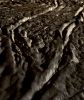
Enceladus-PIA12208.jpgPerspective view of Baghdad Sulcus, Enceladus (Natural Colors; credits: Lunexit)56 visiteThis perspective view of Baghdad Sulcus was generated using high resolution images of Enceladus acquired in August 2008 at 12 to 30 meters (40 to 100 feet) resolution, together with a new topographic map of the region produced by Dr. Paul Schenk (http://www.lpi.usra.edu/lpi/schenk/) at the Lunar and Planetary Institute in Houston, TX. Lower resolution images to either side were acquired at 50 to 80 meter (165 to 260 feet) resolution.
Baghdad Sulcus is one of several prominent linear structures, dubbed “Tiger Stripes”, within the geologically active South Polar Region of Enceladus. This view shows a wedge-shaped area between two prominent branches of Baghdad Sulcus. Each branch consists of two large parallel ridges up to 2 Km (approx. 1,2 mile) across separated by a deep V-shaped medial trough.
The ridges are 80 to 100 meters (approximately 260 to 325 feet) high. The medial troughs between the ridges are 200 to 250 meters (650 to 820 feet) deep. The maximum separation between the two branches is about 12 Km (about 7.5 miles).
Troughs such as those shown here are probably the source of numerous jets making up the large active water vapor plume over the South Pole of Enceladus. The floors of the medial troughs are often broken up into smaller ridges. These could be blocks of crust that have slid down the walls of the trough or fractured blocks pushed up from below. Relief has been exaggerated by a factor of ~10 to enhance clarity.
The raw data from which this product was developed were retrieved from the Planetary Data System's Cassini archives. The Cassini-Huygens mission is a cooperative project of NASA, the European Space Agency and the Italian Space Agency. The Jet Propulsion Laboratory, a division of the California Institute of Technology in Pasadena, manages the mission for NASA's Science Mission Directorate, Washington, D.C. The Cassini orbiter and its two onboard cameras were designed, developed and assembled at JPL. The imaging operations center is based at the Space Science Institute in Boulder, Colo. (http://ciclops.org)MareKromium09/25/09 at 12:56Anakin: Che Forza!! Ma Cassini è arrivata così vicino?
|
|

TheRings-GIF-W00059891.gifSaturn's "Moons-Carousel" (GIF-Movie; credits: Dr G. Barca)55 visitenessun commentoMareKromium09/18/09 at 11:15enzomancuso: spettacolare! - enzo
|
|
TheRings-GIF-W00059891.gifSaturn's "Moons-Carousel" (GIF-Movie; credits: Dr G. Barca)55 visitenessun commentoMareKromium09/17/09 at 20:22george_p: Che Bellooo!!! Grazie - Giorgio
|
|

The_Rings-PIA11662.jpgAnother "Vertical Structure" in the "F"-Ring55 visiteCaption NASA:"As Saturn approaches its August 2009 Equinox, a shadow is cast by a narrow, vertically extended feature in the F-Ring.
Scientists are working to understand the origin of structures such as this one, but they think this image may show the shadow of an object on an inclined orbit which has punched through the F-Ring and dragged material along in its path.
The second (bottom) version of the image has been brightened to enhance the visibility of the ring and shadow. Background stars appear elongated in the image because of the camera's exposure time.
This image and others like it (see PIA11663) are only possible around the time of Saturn's Equinox which occurs every half-Saturn-year (equivalent to about 15 Earth years). The illumination geometry that accompanies Equinox lowers the Sun's angle to the Ring-Plane and causes out-of-plane structures to cast long shadows across the Rings. Cassini's cameras have spotted not only the predictable shadows of some of Saturn's moons (see PIA11657), but also the shadows of newly revealed vertical structures in the Rings themselves (see PIA11654).
This view looks toward the unilluminated side of the Rings from about 27° above the RingPlane.
The image was taken in Visible Light with the Cassini Spacecraft narrow-angle camera on June 11, 2009. The view was acquired at a distance of approx. 866.000 Km (about 538.000 miles) from Saturn and at a Sun-Saturn-Spacecraft, or Phase, Angle of 30°. Image scale is roughly 5 Km (a little more than 3 miles) per pixel".MareKromium08/10/09 at 15:30george_p: Grande Paolo, come al solito sei superesauriente.....
|
|
The_Rings-PIA11662.jpgAnother "Vertical Structure" in the "F"-Ring55 visiteCaption NASA:"As Saturn approaches its August 2009 Equinox, a shadow is cast by a narrow, vertically extended feature in the F-Ring.
Scientists are working to understand the origin of structures such as this one, but they think this image may show the shadow of an object on an inclined orbit which has punched through the F-Ring and dragged material along in its path.
The second (bottom) version of the image has been brightened to enhance the visibility of the ring and shadow. Background stars appear elongated in the image because of the camera's exposure time.
This image and others like it (see PIA11663) are only possible around the time of Saturn's Equinox which occurs every half-Saturn-year (equivalent to about 15 Earth years). The illumination geometry that accompanies Equinox lowers the Sun's angle to the Ring-Plane and causes out-of-plane structures to cast long shadows across the Rings. Cassini's cameras have spotted not only the predictable shadows of some of Saturn's moons (see PIA11657), but also the shadows of newly revealed vertical structures in the Rings themselves (see PIA11654).
This view looks toward the unilluminated side of the Rings from about 27° above the RingPlane.
The image was taken in Visible Light with the Cassini Spacecraft narrow-angle camera on June 11, 2009. The view was acquired at a distance of approx. 866.000 Km (about 538.000 miles) from Saturn and at a Sun-Saturn-Spacecraft, or Phase, Angle of 30°. Image scale is roughly 5 Km (a little more than 3 miles) per pixel".MareKromium08/09/09 at 15:45MareKromium: Carissimo Giorgio,
sul come s?ano fatti gli An...
|
|
The_Rings-PIA11662.jpgAnother "Vertical Structure" in the "F"-Ring55 visiteCaption NASA:"As Saturn approaches its August 2009 Equinox, a shadow is cast by a narrow, vertically extended feature in the F-Ring.
Scientists are working to understand the origin of structures such as this one, but they think this image may show the shadow of an object on an inclined orbit which has punched through the F-Ring and dragged material along in its path.
The second (bottom) version of the image has been brightened to enhance the visibility of the ring and shadow. Background stars appear elongated in the image because of the camera's exposure time.
This image and others like it (see PIA11663) are only possible around the time of Saturn's Equinox which occurs every half-Saturn-year (equivalent to about 15 Earth years). The illumination geometry that accompanies Equinox lowers the Sun's angle to the Ring-Plane and causes out-of-plane structures to cast long shadows across the Rings. Cassini's cameras have spotted not only the predictable shadows of some of Saturn's moons (see PIA11657), but also the shadows of newly revealed vertical structures in the Rings themselves (see PIA11654).
This view looks toward the unilluminated side of the Rings from about 27° above the RingPlane.
The image was taken in Visible Light with the Cassini Spacecraft narrow-angle camera on June 11, 2009. The view was acquired at a distance of approx. 866.000 Km (about 538.000 miles) from Saturn and at a Sun-Saturn-Spacecraft, or Phase, Angle of 30°. Image scale is roughly 5 Km (a little more than 3 miles) per pixel".MareKromium08/09/09 at 15:16george_p: ma allora la spiegazione di polveri e macigni orbi...
|
|
The_Rings-PIA11662.jpgAnother "Vertical Structure" in the "F"-Ring55 visiteCaption NASA:"As Saturn approaches its August 2009 Equinox, a shadow is cast by a narrow, vertically extended feature in the F-Ring.
Scientists are working to understand the origin of structures such as this one, but they think this image may show the shadow of an object on an inclined orbit which has punched through the F-Ring and dragged material along in its path.
The second (bottom) version of the image has been brightened to enhance the visibility of the ring and shadow. Background stars appear elongated in the image because of the camera's exposure time.
This image and others like it (see PIA11663) are only possible around the time of Saturn's Equinox which occurs every half-Saturn-year (equivalent to about 15 Earth years). The illumination geometry that accompanies Equinox lowers the Sun's angle to the Ring-Plane and causes out-of-plane structures to cast long shadows across the Rings. Cassini's cameras have spotted not only the predictable shadows of some of Saturn's moons (see PIA11657), but also the shadows of newly revealed vertical structures in the Rings themselves (see PIA11654).
This view looks toward the unilluminated side of the Rings from about 27° above the RingPlane.
The image was taken in Visible Light with the Cassini Spacecraft narrow-angle camera on June 11, 2009. The view was acquired at a distance of approx. 866.000 Km (about 538.000 miles) from Saturn and at a Sun-Saturn-Spacecraft, or Phase, Angle of 30°. Image scale is roughly 5 Km (a little more than 3 miles) per pixel".MareKromium08/09/09 at 12:26MareKromium: Cari Amici,
adesso proferisco una bestemmia sci...
|
|

Startrail1-N00135035.gifStartrail or UFO in-transit? (GIF-Movie; credits: Dr G. Barca)68 visitenessun commentoMareKromium05/24/09 at 12:55Anakin: Ahimè direi UFO
|
|

Startrail2-N00135049-N00135061.gifStartrail or UFO in-transit? (GIF-Movie; credits: Dr G. Barca)57 visitenessun commentoMareKromium05/24/09 at 08:44george_p: Ma...oltre a quello segnato ve ne sono altri...che...
|
|
Startrail1-N00135035.gifStartrail or UFO in-transit? (GIF-Movie; credits: Dr G. Barca)68 visitenessun commentoMareKromium05/24/09 at 07:57george_p: Interessantissimo come sempre Gianluigi, Grazie e ...
|
|
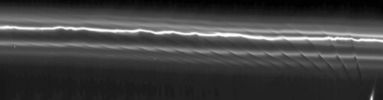
The Rings-PIA07750.jpgSurfing the waves of the F-Ring (from 1,1 MKM)54 visiteOriginal caption:"This mosaic of 15 Cassini images of Saturn's F-Ring shows how the moon Prometheus creates a gore in the Ring once every 14 h and 42', as it approaches and recedes from the F-Ring on its eccentric orbit. The individual images have been processed to make the Ring appear as if it has been straightened, making it easier to see the Ring's structure. The mosaic shows a Region 147.000 Km (about 91.000 miles) along the Ring (horizontal direction in the image); this represents about 60° of Longitude around the Ring. The Region seen here is about 1500 Km (900 miles) across (vertical direction). The first and last images in the mosaic were taken approximately 2,5 hours apart.
Each dark channel, or "gore," is clearly visible across more than 1,000 kilometers (600 miles) of the ring and is due to the gravitational effect of Prometheus (102 kilometers, or 63 miles across), even though the moon does not enter the F ring. The channels have different tilts because the ring particles closer to Prometheus (overexposed, stretched, and just visible at the bottom right of the image) move slower with respect to the moon than those farther away. This causes the channels to shear with time, their slopes becoming greater, and gives the overall visual impression of drapes of ring material. The channels at the right are the youngest and have near-vertical slopes, while those at the left are the oldest and have near-horizontal slopes. This phenomenon has not previously been detected in any other planetary ring system, but computer simulations of the system prove that the disturbance is caused by a simple gravitational interaction. The eccentric orbit of Prometheus is gradually moving so that the moon will eventually come even closer in its closest approach to the eccentric F ring. Scientists calculate that its perturbations of the F ring will reach a maximum in December 2009".05/09/09 at 16:59MareKromium: Le "gravitational waves" partono tutte d...
|
|
The Rings-PIA07750.jpgSurfing the waves of the F-Ring (from 1,1 MKM)54 visiteOriginal caption:"This mosaic of 15 Cassini images of Saturn's F-Ring shows how the moon Prometheus creates a gore in the Ring once every 14 h and 42', as it approaches and recedes from the F-Ring on its eccentric orbit. The individual images have been processed to make the Ring appear as if it has been straightened, making it easier to see the Ring's structure. The mosaic shows a Region 147.000 Km (about 91.000 miles) along the Ring (horizontal direction in the image); this represents about 60° of Longitude around the Ring. The Region seen here is about 1500 Km (900 miles) across (vertical direction). The first and last images in the mosaic were taken approximately 2,5 hours apart.
Each dark channel, or "gore," is clearly visible across more than 1,000 kilometers (600 miles) of the ring and is due to the gravitational effect of Prometheus (102 kilometers, or 63 miles across), even though the moon does not enter the F ring. The channels have different tilts because the ring particles closer to Prometheus (overexposed, stretched, and just visible at the bottom right of the image) move slower with respect to the moon than those farther away. This causes the channels to shear with time, their slopes becoming greater, and gives the overall visual impression of drapes of ring material. The channels at the right are the youngest and have near-vertical slopes, while those at the left are the oldest and have near-horizontal slopes. This phenomenon has not previously been detected in any other planetary ring system, but computer simulations of the system prove that the disturbance is caused by a simple gravitational interaction. The eccentric orbit of Prometheus is gradually moving so that the moon will eventually come even closer in its closest approach to the eccentric F ring. Scientists calculate that its perturbations of the F ring will reach a maximum in December 2009".05/09/09 at 12:36aeritel: Strano, i Fronti d'onda sembrano avere una zon...
|
|
| 920 immagini su 77 pagina(e) |
 |
|
|
|
|
61 | |
|
|
|
|





