| |

| Ultimi commenti - Curiosity and the Exploration of Gale Crater |
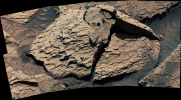
SOL4887-PIA26724.pngAtacama - Sol 4877 (Credits: NASA/JPL-Caltech)122 visiteNASA’s Curiosity Mars rover used its Mast Camera, or Mastcam, to capture this view of a rock nicknamed “Atacama” on May 6, 2026, the 4,877th Martian day, or sol, of the mission. The rock had gotten stuck to the drill on the end of Curiosity’s robotic arm on April 25. Engineers spent several days repositioning the arm and vibrating the drill to try and get the rock loose, finally detaching the rock on May 1.
Atacama is estimated to be 1.5 feet in diameter at its base and 6 inches thick. It would weigh roughly 28.6 pounds (13 kilograms) on Earth (and about a third of that on Mars). The circular hole produced by Curiosity’s drill is visible in the rock.
This mosaic is made up of eight images that were stitched together after being sent back to Earth. The color has been approximately white-balanced to resemble how the scene would appear under daytime lighting conditions on Earth.
Curiosity was built by NASA’s Jet Propulsion Laboratory, which is managed by Caltech in Pasadena, California. JPL leads the mission on behalf of NASA’s Science Mission Directorate in Washington as part of NASA’s Mars Exploration Program portfolio. Malin Space Science Systems in San Diego built and operates Mastcam.MareKromium05/20/26 at 21:57Paolo C. Fienga: Infatti, se lo fosse (piena/totalmente compatta), ...
|
|
SOL4887-PIA26724.pngAtacama - Sol 4877 (Credits: NASA/JPL-Caltech)122 visiteNASA’s Curiosity Mars rover used its Mast Camera, or Mastcam, to capture this view of a rock nicknamed “Atacama” on May 6, 2026, the 4,877th Martian day, or sol, of the mission. The rock had gotten stuck to the drill on the end of Curiosity’s robotic arm on April 25. Engineers spent several days repositioning the arm and vibrating the drill to try and get the rock loose, finally detaching the rock on May 1.
Atacama is estimated to be 1.5 feet in diameter at its base and 6 inches thick. It would weigh roughly 28.6 pounds (13 kilograms) on Earth (and about a third of that on Mars). The circular hole produced by Curiosity’s drill is visible in the rock.
This mosaic is made up of eight images that were stitched together after being sent back to Earth. The color has been approximately white-balanced to resemble how the scene would appear under daytime lighting conditions on Earth.
Curiosity was built by NASA’s Jet Propulsion Laboratory, which is managed by Caltech in Pasadena, California. JPL leads the mission on behalf of NASA’s Science Mission Directorate in Washington as part of NASA’s Mars Exploration Program portfolio. Malin Space Science Systems in San Diego built and operates Mastcam.MareKromium05/12/26 at 15:31MareKromium: La roccia si è pluri-fratturata durante la sua per...
|
|

SOL3075_-_Don_Davis.jpgClouds over Curiosity (Credits: NASA/JPL; Credits for the additional process. and color: Don Davis)139 visiteL'immagine, in sè, potrebbe anche essere carina. Ma questo tipo di colorizzazione non esiste. Nemmeno su Marte. Evidentemente anche il "Grande " Don Davis - di cui ho apprezzato molto il lavoro negli anni, sta invecchiando o si è piegato alle logiche cromatiche NASA.
Decidete Voi.MareKromium04/13/26 at 17:48Paolo C. Fienga: Mamma mia come ci siamo ridotti...
|
|

SOL3724-27338_PIA25740-web.jpgIcy Feather - Sol 3724148 visiteNASA’s Curiosity Mars rover captured this feather-shaped iridescent cloud just after sunset on Jan. 27, 2023, the 3,724th Martian day, or sol, of the mission. Studying the colors in iridescent clouds tells scientists something about particle size within the clouds and how they grow over time.
These clouds were captured as part of a follow-on imaging campaign to study noctilucent, or "night-shining" clouds, which started in 2021. While most Martian clouds hover no more than 37 miles (60 kilometers) above the ground and are composed of water ice, these clouds appear to be higher in elevation, where it’s very cold. That suggests these clouds are made of carbon dioxide, or dry ice.
This scene is made up of 28 individual images captured by the rover’s Mast Camera, or Mastcam. The images have been processed to emphasize the highlights.MareKromium06/30/23 at 12:51Paolo C. Fienga: Osservo a mi chiedo come si possa "non amare&...
|
|

SOL0738-1581_PIA25821-web.gif153 visiteNASA’s Perseverance Mars rover used one of its navigation cameras to take a series of images of drifting clouds just before sunrise on March 18, 2023, the 738th Martian day, or sol, of the mission.
Scientists on both the Perseverance mission and NASA's Curiosity rover mission are studying the formation process of Martian clouds.
A key objective for Perseverance's mission on Mars is astrobiology, including the search for signs of ancient microbial life. The rover will characterize the planet's geology and past climate, pave the way for human exploration of the Red Planet, and be the first mission to collect and cache Martian rock and regolith (broken rock and dust).
Subsequent NASA missions, in cooperation with ESA (European Space Agency), would send spacecraft to Mars to collect these sealed samples from the surface and return them to Earth for in-depth analysis.
The Mars 2020 Perseverance mission is part of NASA's Moon to Mars exploration approach, which includes Artemis missions to the Moon that will help prepare for human exploration of the Red Planet.MareKromium06/30/23 at 12:50Paolo C. Fienga: Nuvole "Nottilucenti". Cosa non darei pe...
|
|
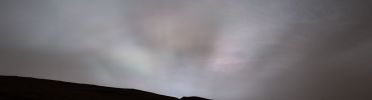
SOL3730-27337_PIA25739-web.jpgMartian Twilight - Sol 3730147 visiteNASA’s Curiosity Mars Rover captured these "Sun Rays" shining through clouds at sunset on Feb. 2, 2023, the 3,730th Martian Day, or Sol, of the mission. It was the first time that sun rays, also known as crepuscular rays, have been viewed so clearly on Mars. Crepuscular is taken from the Latin word for “Twilight,� as these rays appear near Sunset or Sunrise.
These clouds were captured as part of a follow-on imaging campaign to study noctilucent, or "night-shining" clouds, which started in 2021. While most Martian clouds hover no more than 37 miles (60 kilometers) above the ground and are composed of water-ice, these clouds appear to be higher in elevation, where it’s very cold. That suggests these clouds are made of carbon dioxide, or dry ice.
This scene made up of 28 individual images captured by the rover’s Mast Camera, or MastCam. The images have been processed to emphasize the highlights.MareKromium06/30/23 at 12:49Paolo C. Fienga: Stupenda!!!
|
|

SOL3423-PIA25176-8192x2276.jpg"(Alli)Gator Back" Rocks on "Greenheugh" - Sol 3423182 visiteNASA’s Curiosity Mars rover used its Mast Camera, or MastCam, to take this 360° panorama on March 23, 2022, the 3.423th Martian Day, or Sol, of the Mission. The team has informally described the wind-sharpened rocks seen here as “gator-back” rocks because of their scaly appearance.
Wind-sharpened rocks like these are called ventifacts, and are responsible for chewing up Curiosity’s wheels earlier in the mission. Since then, rover engineers have found ways to slow wheel wear, including a traction control algorithm. They also plan rover routes that avoid driving over such rocks, including these latest ventifacts, which are made of sandstone – the hardest type of rock Curiosity has encountered on Mars.
These rocks form the Surface of the “Greenheugh Pediment,” a broad, sloping plain in the foothills of Mount Sharp. The floor of Gale Crater is visible along the edges of the mosaic. When Curiosity’s team saw the gator-back rocks, they ultimately decided to turn the rover around and take an alternative path to continue climbing Mount Sharp, a 3,4-mile-tall (approx. 5,5-Km-tall) mountain that Curiosity has been ascending since 2014. As it climbs, Curiosity is able to study different sedimentary layers shaped by water billions of years ago. These layers help scientists understand whether microscopic life could have survived in the ancient Martian Environment.MareKromium04/09/23 at 18:01Paolo C. Fienga: Si piange non solo di Dolore, ma anche di Gioia. L...
|
|
SOL3423-PIA25176-8192x2276.jpg"(Alli)Gator Back" Rocks on "Greenheugh" - Sol 3423182 visiteNASA’s Curiosity Mars rover used its Mast Camera, or MastCam, to take this 360° panorama on March 23, 2022, the 3.423th Martian Day, or Sol, of the Mission. The team has informally described the wind-sharpened rocks seen here as “gator-back” rocks because of their scaly appearance.
Wind-sharpened rocks like these are called ventifacts, and are responsible for chewing up Curiosity’s wheels earlier in the mission. Since then, rover engineers have found ways to slow wheel wear, including a traction control algorithm. They also plan rover routes that avoid driving over such rocks, including these latest ventifacts, which are made of sandstone – the hardest type of rock Curiosity has encountered on Mars.
These rocks form the Surface of the “Greenheugh Pediment,” a broad, sloping plain in the foothills of Mount Sharp. The floor of Gale Crater is visible along the edges of the mosaic. When Curiosity’s team saw the gator-back rocks, they ultimately decided to turn the rover around and take an alternative path to continue climbing Mount Sharp, a 3,4-mile-tall (approx. 5,5-Km-tall) mountain that Curiosity has been ascending since 2014. As it climbs, Curiosity is able to study different sedimentary layers shaped by water billions of years ago. These layers help scientists understand whether microscopic life could have survived in the ancient Martian Environment.MareKromium04/09/23 at 09:32Anakin: In India piangon latte. Ma vabnb?. Mare hai visto ...
|
|

SOL3690-mars_nasa_gov_msl-raw-images_proj_msl_redops_ods_surface_sol_03690_opgs_edr_ncam_NRB_725065045EDR_S0990000NCAM00594M_.JPGFunny-shaped "Mounds" - Sol 3690101 visiteHo un dubbio: si tratta di "Mounds" o (piccole) "Buttes"?MareKromium04/08/23 at 16:41MareKromium: Grazie Walt e ben trovato. Ovviamente, Ti quoto.
|
|
SOL3423-PIA25176-8192x2276.jpg"(Alli)Gator Back" Rocks on "Greenheugh" - Sol 3423182 visiteNASA’s Curiosity Mars rover used its Mast Camera, or MastCam, to take this 360° panorama on March 23, 2022, the 3.423th Martian Day, or Sol, of the Mission. The team has informally described the wind-sharpened rocks seen here as “gator-back” rocks because of their scaly appearance.
Wind-sharpened rocks like these are called ventifacts, and are responsible for chewing up Curiosity’s wheels earlier in the mission. Since then, rover engineers have found ways to slow wheel wear, including a traction control algorithm. They also plan rover routes that avoid driving over such rocks, including these latest ventifacts, which are made of sandstone – the hardest type of rock Curiosity has encountered on Mars.
These rocks form the Surface of the “Greenheugh Pediment,” a broad, sloping plain in the foothills of Mount Sharp. The floor of Gale Crater is visible along the edges of the mosaic. When Curiosity’s team saw the gator-back rocks, they ultimately decided to turn the rover around and take an alternative path to continue climbing Mount Sharp, a 3,4-mile-tall (approx. 5,5-Km-tall) mountain that Curiosity has been ascending since 2014. As it climbs, Curiosity is able to study different sedimentary layers shaped by water billions of years ago. These layers help scientists understand whether microscopic life could have survived in the ancient Martian Environment.MareKromium04/08/23 at 16:40MareKromium: In effetti, di Miracoli fatti dal Profeta, ne ho s...
|
|
SOL3423-PIA25176-8192x2276.jpg"(Alli)Gator Back" Rocks on "Greenheugh" - Sol 3423182 visiteNASA’s Curiosity Mars rover used its Mast Camera, or MastCam, to take this 360° panorama on March 23, 2022, the 3.423th Martian Day, or Sol, of the Mission. The team has informally described the wind-sharpened rocks seen here as “gator-back” rocks because of their scaly appearance.
Wind-sharpened rocks like these are called ventifacts, and are responsible for chewing up Curiosity’s wheels earlier in the mission. Since then, rover engineers have found ways to slow wheel wear, including a traction control algorithm. They also plan rover routes that avoid driving over such rocks, including these latest ventifacts, which are made of sandstone – the hardest type of rock Curiosity has encountered on Mars.
These rocks form the Surface of the “Greenheugh Pediment,” a broad, sloping plain in the foothills of Mount Sharp. The floor of Gale Crater is visible along the edges of the mosaic. When Curiosity’s team saw the gator-back rocks, they ultimately decided to turn the rover around and take an alternative path to continue climbing Mount Sharp, a 3,4-mile-tall (approx. 5,5-Km-tall) mountain that Curiosity has been ascending since 2014. As it climbs, Curiosity is able to study different sedimentary layers shaped by water billions of years ago. These layers help scientists understand whether microscopic life could have survived in the ancient Martian Environment.MareKromium04/08/23 at 13:17Ufologo: Anakin. l'ho cestinata! Mi sono accorto dopo c...
|
|
SOL3690-mars_nasa_gov_msl-raw-images_proj_msl_redops_ods_surface_sol_03690_opgs_edr_ncam_NRB_725065045EDR_S0990000NCAM00594M_.JPGFunny-shaped "Mounds" - Sol 3690101 visiteHo un dubbio: si tratta di "Mounds" o (piccole) "Buttes"?MareKromium04/07/23 at 19:50walthari: splendido esempio di erosione selettiva in rilievi...
|
|
| 1143 immagini su 96 pagina(e) |
1 |
|
|
|
|
|
|
|
|
|
|
|
|








