| |

| Ultimi commenti - Titan: The "Foggy" Moon |

Titan-N00067442.jpgShort "light-streak" in the space of Titan58 visiteCaption NASA:"N00067442.jpg was taken on October 10, 2006 and received on Earth on the same day. The camera was pointing toward Titan that, at the time, was approximately 168.568 Km away.
This image was taken using the CL1 and CB3 filters and it has not been validated or calibrated". 07/17/23 at 16:40Paolo C. Fienga: No Cosmic Ray, no artifact.
|
|
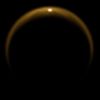
Titan-Lakes-Unnamed_North_Polar_Lake-PIA12481.jpgReflection of Sunlight off a Titanian Northern Lake (Natural Colors; credits: NASA/JPL/University of Arizona/DLR)173 visiteThis image shows the first flash of sunlight reflected off a lake on Saturn's moon Titan. The glint off a mirror-like surface is known as a specular reflection. This kind of glint was detected by the visual and infrared mapping spectrometer (VIMS) on NASA's Cassini spacecraft on July 8, 2009. It confirmed the presence of liquid in the moon's northern hemisphere, where lakes are more numerous and larger than those in the southern hemisphere. Scientists using VIMS had confirmed the presence of liquid in Ontario Lacus, the largest lake in the southern hemisphere, in 2008.
The northern hemisphere was shrouded in darkness for nearly 15 years, but the sun began to illuminate the area again as it approached its spring equinox in August 2009. VIMS was able to detect the glint as the viewing geometry changed. Titan's hazy atmosphere also scatters and absorbs many wavelengths of light, including most of the visible light spectrum. But the VIMS instrument enabled scientists to look for the glint in infrared wavelengths that were able to penetrate through the moon's atmosphere. This image was created using wavelengths of light in the 5 micron range.
By comparing the new image to radar and near-infrared light images acquired from 2006 to 2008, Cassini scientists were able to correlate the reflection to the southern shoreline of a Titan lake called Kraken Mare. The sprawling Kraken Mare covers about 400,000 square kilometers (150,000 square miles). The reflection appeared to come from a part of the lake around 71 degrees north latitude and 337 degrees west latitude.
It was taken on Cassini's 59th flyby of Titan on July 8, 2009, at a distance of about 200,000 kilometers (120,000 miles). The image resolution was about 100 kilometers (60 miles) per pixel. Image processing was done at the German Aerospace Center in Berlin and the University of Arizona in Tucson.
MareKromium03/16/22 at 15:59Paolo C. Fienga: ,,,penso Forme di Vita "esotiche", compl...
|
|
Titan-Lakes-Unnamed_North_Polar_Lake-PIA12481.jpgReflection of Sunlight off a Titanian Northern Lake (Natural Colors; credits: NASA/JPL/University of Arizona/DLR)173 visiteThis image shows the first flash of sunlight reflected off a lake on Saturn's moon Titan. The glint off a mirror-like surface is known as a specular reflection. This kind of glint was detected by the visual and infrared mapping spectrometer (VIMS) on NASA's Cassini spacecraft on July 8, 2009. It confirmed the presence of liquid in the moon's northern hemisphere, where lakes are more numerous and larger than those in the southern hemisphere. Scientists using VIMS had confirmed the presence of liquid in Ontario Lacus, the largest lake in the southern hemisphere, in 2008.
The northern hemisphere was shrouded in darkness for nearly 15 years, but the sun began to illuminate the area again as it approached its spring equinox in August 2009. VIMS was able to detect the glint as the viewing geometry changed. Titan's hazy atmosphere also scatters and absorbs many wavelengths of light, including most of the visible light spectrum. But the VIMS instrument enabled scientists to look for the glint in infrared wavelengths that were able to penetrate through the moon's atmosphere. This image was created using wavelengths of light in the 5 micron range.
By comparing the new image to radar and near-infrared light images acquired from 2006 to 2008, Cassini scientists were able to correlate the reflection to the southern shoreline of a Titan lake called Kraken Mare. The sprawling Kraken Mare covers about 400,000 square kilometers (150,000 square miles). The reflection appeared to come from a part of the lake around 71 degrees north latitude and 337 degrees west latitude.
It was taken on Cassini's 59th flyby of Titan on July 8, 2009, at a distance of about 200,000 kilometers (120,000 miles). The image resolution was about 100 kilometers (60 miles) per pixel. Image processing was done at the German Aerospace Center in Berlin and the University of Arizona in Tucson.
MareKromium03/12/22 at 18:59walthari: Titano ? veramente un mondo interessante sotto mol...
|
|
Titan-Lakes-Unnamed_North_Polar_Lake-PIA12481.jpgReflection of Sunlight off a Titanian Northern Lake (Natural Colors; credits: NASA/JPL/University of Arizona/DLR)173 visiteThis image shows the first flash of sunlight reflected off a lake on Saturn's moon Titan. The glint off a mirror-like surface is known as a specular reflection. This kind of glint was detected by the visual and infrared mapping spectrometer (VIMS) on NASA's Cassini spacecraft on July 8, 2009. It confirmed the presence of liquid in the moon's northern hemisphere, where lakes are more numerous and larger than those in the southern hemisphere. Scientists using VIMS had confirmed the presence of liquid in Ontario Lacus, the largest lake in the southern hemisphere, in 2008.
The northern hemisphere was shrouded in darkness for nearly 15 years, but the sun began to illuminate the area again as it approached its spring equinox in August 2009. VIMS was able to detect the glint as the viewing geometry changed. Titan's hazy atmosphere also scatters and absorbs many wavelengths of light, including most of the visible light spectrum. But the VIMS instrument enabled scientists to look for the glint in infrared wavelengths that were able to penetrate through the moon's atmosphere. This image was created using wavelengths of light in the 5 micron range.
By comparing the new image to radar and near-infrared light images acquired from 2006 to 2008, Cassini scientists were able to correlate the reflection to the southern shoreline of a Titan lake called Kraken Mare. The sprawling Kraken Mare covers about 400,000 square kilometers (150,000 square miles). The reflection appeared to come from a part of the lake around 71 degrees north latitude and 337 degrees west latitude.
It was taken on Cassini's 59th flyby of Titan on July 8, 2009, at a distance of about 200,000 kilometers (120,000 miles). The image resolution was about 100 kilometers (60 miles) per pixel. Image processing was done at the German Aerospace Center in Berlin and the University of Arizona in Tucson.
MareKromium03/09/22 at 17:56Paolo C. Fienga: Che Meraviglia, e quanto Mistero. E noi, poveri st...
|
|

Titan-PIA12320.jpgCrescent Titan (Natural Colors; credits: NASA/JPL/Space Science Institute & Lunexit)103 visiteCaption NASA:"Titan's golden, smog-like atmosphere and complex layered hazes appear to Cassini as a luminous ring around the planet-sized moon. The world beneath that haze has become slightly less mysterious under the gaze of Cassini and its Huygens probe, but many new discoveries await.
This mosaic view of Titan represents "Target 3" in the fall 2009 edition of the Cassini Scientist for a Day contest. (See http://saturn.jpl.nasa.gov/education/scientistforaday8thedition/.) The contest is designed to give students a taste of life as a scientist by challenging them to write an essay describing the value of one target choice among three for Cassini to image.
Images taken using red, blue and green spectral filters were combined to create this color view. Six images -- two sets of three colors -- were combined to create the mosaic. The images were acquired with the Cassini wide-angle camera on Oct. 12, 2009 at a distance of approx. 145.000 Km (such as about 90.000 miles) from Titan".MareKromium01/14/21 at 18:06MareKromium: Gaudeamus Igitur (dedicata a Tutti Coloro che aman...
|
|

Titan-Atmosphere-PIA06236.jpgThe Atmosphere of Titan58 visiteCaption NASA originale:"This natural color image shows Titan's upper atmosphere: an active place where methane molecules are being broken apart by solar ultraviolet light and the byproducts combine to form compounds like ethane and acetylene. The haze preferentially scatters blue and ultraviolet wavelengths of light, making its complex layered structure more easily visible at the shorter wavelengths used in this image. Lower down in the atmosphere, the haze turns into a globe-enshrouding smog of complex organic molecules. This thick, orange-colored haze absorbs visible sunlight, allowing only perhaps 10% of the light to reach the surface. The thick haze is also inefficient at holding in and then re-radiating infrared (thermal) energy back down to the surface. Thus, despite the fact that Titan has a thicker atmosphere than Earth, the thick global haze causes the greenhouse effect there to be somewhat weaker than it is on Earth". 11/06/20 at 10:34MareKromium: Titano ? sempre affascinante: in immagine ed in &q...
|
|

00-Titan.JPGTitan in possible True Colors (credits: NASA)63 visiteAttraverso l’oculare di un (anche) modesto telescopio, Titano, il più grande satellite naturale del pianeta Saturno, appare come un corpo puntiforme che splende debolmente di un delicato color giallo-pallido.
Si tratta di un oggetto celeste reso affascinante dalla sua posizione – apparentemente assai prossima – rispetto al Gigante Anellato (la sua distanza angolare da Saturno non supera mai i 20 raggi saturniani), ma certo non si può dire che Titano, in sé, riesca a suggerire particolari interessi e curiosità visive, anzi: nessun rilievo superficiale di questo Mondo, infatti, risulta discernibile nelle osservazioni effettuate da Terra (nemmeno usando le più sofisticate ed avanzate tecniche fotografiche) e, come abbiamo appreso grazie alle immagini ottenute dalle Sonde Voyager prima e dall’Orbiter Cassini poi, anche da distanza (relativamente) ravvicinata questo mondo risulta alquanto indecifrabile (anche se occorre dire che, già dalla metà degli Anni ’70, l’effettuazione di una serie di osservazioni ripetute di Titano – effettuate usando i più grandi telescopi terrestri al tempo disponibili – aveva, peraltro correttamente, suggerito agli Astronomi una sostanziale NON uniformità, in termini di albedo, della sua superficie la quale venne ben interpretata, sin d’allora, come indice della possibile presenza di aree superficiali sensibilmente disomogenee ed equiparabili a continenti).
MareKromium11/02/20 at 15:55MareKromium: Lo far?, occhi permettendo (posso stare davanti ad...
|
|
00-Titan.JPGTitan in possible True Colors (credits: NASA)63 visiteAttraverso l’oculare di un (anche) modesto telescopio, Titano, il più grande satellite naturale del pianeta Saturno, appare come un corpo puntiforme che splende debolmente di un delicato color giallo-pallido.
Si tratta di un oggetto celeste reso affascinante dalla sua posizione – apparentemente assai prossima – rispetto al Gigante Anellato (la sua distanza angolare da Saturno non supera mai i 20 raggi saturniani), ma certo non si può dire che Titano, in sé, riesca a suggerire particolari interessi e curiosità visive, anzi: nessun rilievo superficiale di questo Mondo, infatti, risulta discernibile nelle osservazioni effettuate da Terra (nemmeno usando le più sofisticate ed avanzate tecniche fotografiche) e, come abbiamo appreso grazie alle immagini ottenute dalle Sonde Voyager prima e dall’Orbiter Cassini poi, anche da distanza (relativamente) ravvicinata questo mondo risulta alquanto indecifrabile (anche se occorre dire che, già dalla metà degli Anni ’70, l’effettuazione di una serie di osservazioni ripetute di Titano – effettuate usando i più grandi telescopi terrestri al tempo disponibili – aveva, peraltro correttamente, suggerito agli Astronomi una sostanziale NON uniformità, in termini di albedo, della sua superficie la quale venne ben interpretata, sin d’allora, come indice della possibile presenza di aree superficiali sensibilmente disomogenee ed equiparabili a continenti).
MareKromium11/02/20 at 14:54walthari: ? uno degli episodi pi? iconici dell'intera sa...
|
|
00-Titan.JPGTitan in possible True Colors (credits: NASA)63 visiteAttraverso l’oculare di un (anche) modesto telescopio, Titano, il più grande satellite naturale del pianeta Saturno, appare come un corpo puntiforme che splende debolmente di un delicato color giallo-pallido.
Si tratta di un oggetto celeste reso affascinante dalla sua posizione – apparentemente assai prossima – rispetto al Gigante Anellato (la sua distanza angolare da Saturno non supera mai i 20 raggi saturniani), ma certo non si può dire che Titano, in sé, riesca a suggerire particolari interessi e curiosità visive, anzi: nessun rilievo superficiale di questo Mondo, infatti, risulta discernibile nelle osservazioni effettuate da Terra (nemmeno usando le più sofisticate ed avanzate tecniche fotografiche) e, come abbiamo appreso grazie alle immagini ottenute dalle Sonde Voyager prima e dall’Orbiter Cassini poi, anche da distanza (relativamente) ravvicinata questo mondo risulta alquanto indecifrabile (anche se occorre dire che, già dalla metà degli Anni ’70, l’effettuazione di una serie di osservazioni ripetute di Titano – effettuate usando i più grandi telescopi terrestri al tempo disponibili – aveva, peraltro correttamente, suggerito agli Astronomi una sostanziale NON uniformità, in termini di albedo, della sua superficie la quale venne ben interpretata, sin d’allora, come indice della possibile presenza di aree superficiali sensibilmente disomogenee ed equiparabili a continenti).
MareKromium11/01/20 at 18:58MareKromium: ...non l'ho visto. Provo a cercarlo. Comunque,...
|
|
00-Titan.JPGTitan in possible True Colors (credits: NASA)63 visiteAttraverso l’oculare di un (anche) modesto telescopio, Titano, il più grande satellite naturale del pianeta Saturno, appare come un corpo puntiforme che splende debolmente di un delicato color giallo-pallido.
Si tratta di un oggetto celeste reso affascinante dalla sua posizione – apparentemente assai prossima – rispetto al Gigante Anellato (la sua distanza angolare da Saturno non supera mai i 20 raggi saturniani), ma certo non si può dire che Titano, in sé, riesca a suggerire particolari interessi e curiosità visive, anzi: nessun rilievo superficiale di questo Mondo, infatti, risulta discernibile nelle osservazioni effettuate da Terra (nemmeno usando le più sofisticate ed avanzate tecniche fotografiche) e, come abbiamo appreso grazie alle immagini ottenute dalle Sonde Voyager prima e dall’Orbiter Cassini poi, anche da distanza (relativamente) ravvicinata questo mondo risulta alquanto indecifrabile (anche se occorre dire che, già dalla metà degli Anni ’70, l’effettuazione di una serie di osservazioni ripetute di Titano – effettuate usando i più grandi telescopi terrestri al tempo disponibili – aveva, peraltro correttamente, suggerito agli Astronomi una sostanziale NON uniformità, in termini di albedo, della sua superficie la quale venne ben interpretata, sin d’allora, come indice della possibile presenza di aree superficiali sensibilmente disomogenee ed equiparabili a continenti).
MareKromium11/01/20 at 07:15walthari: continua a venirmi in mente la creatura malvagia d...
|
|

Titan-Regions-Aztlan,_Fensal_and_Senkyo_Region-PIA12655-PCF-LXTT2.jpgAztlan, Fensal and Senkyo Region (Natural Colors; credits: Dr Paolo C. Fienga - Lunexit Team)68 visiteNota Lunexit: questa colorizzazione è stata INTEGRALMENTE ottenuta mediante l'impiego di Illuminazione Virtuale.MareKromium10/31/20 at 15:43MareKromium: ...forse non sono capace di cercarla n?, a maggior...
|
|
Titan-Regions-Aztlan,_Fensal_and_Senkyo_Region-PIA12655-PCF-LXTT2.jpgAztlan, Fensal and Senkyo Region (Natural Colors; credits: Dr Paolo C. Fienga - Lunexit Team)68 visiteNota Lunexit: questa colorizzazione è stata INTEGRALMENTE ottenuta mediante l'impiego di Illuminazione Virtuale.MareKromium10/31/20 at 13:08Ufologo: Tieni in mente una cosa: La Fede la trova chi ... ...
|
|
| 229 immagini su 20 pagina(e) |
1 |
|
|
|
|
|
|
|
|
|
|
|
|





