| Ultimi commenti - Phobos: the "Doomed" Moon |
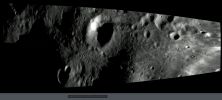
Phobos-MF.jpgPhobos, from MGS (an Image-Mosaic by Dr M. Faccin - Lunexit Team)113 visitenessun commentoMareKromium03/14/10 at 12:14walthari: Buongiorno Paolo, hai proprio ragione certi attegg...
|
|
Phobos-MF.jpgPhobos, from MGS (an Image-Mosaic by Dr M. Faccin - Lunexit Team)113 visitenessun commentoMareKromium03/14/10 at 11:42george_p: Buona Paolo, lo scriverei in quei forum dove gli i...
|
|
Phobos-MF.jpgPhobos, from MGS (an Image-Mosaic by Dr M. Faccin - Lunexit Team)113 visitenessun commentoMareKromium03/14/10 at 10:52MareKromium: Cari Amici,
un piccolo "messaggio della do...
|
|
Phobos-MF.jpgPhobos, from MGS (an Image-Mosaic by Dr M. Faccin - Lunexit Team)113 visitenessun commentoMareKromium03/14/10 at 09:06george_p: Mah, io dico che la NASA riesce bene a in una cosa...
|
|
Phobos-MF.jpgPhobos, from MGS (an Image-Mosaic by Dr M. Faccin - Lunexit Team)113 visitenessun commentoMareKromium03/13/10 at 22:29gurosao: Spetta spetta! :))) Visto come sono buffi quei sas...
|
|
Phobos-MF.jpgPhobos, from MGS (an Image-Mosaic by Dr M. Faccin - Lunexit Team)113 visitenessun commentoMareKromium03/13/10 at 21:53MareKromium: ...Ancora aspetto che sia la NASA a fare (per il P...
|
|
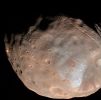
PSP_007769_9015_IRB.jpgPhobos (Natural Colors; credits: NASA)69 visitePhobos, and the second Martian moon, Deimos, are interesting for several reasons. Both objects are small, with average diameters of just 22 and 12 Km, respectively.
At this size, their gravity is insufficient (less than 1/1000th of Earth) to pull them into spherical shapes, in contrast to the larger moons and planets in the Solar System.
Both moons are tidally locked to Mars, meaning, like our own moon relative to Earth, they present the same side to Mars all the time. The small size and composition (determined from spectroscopy) of Phobos and Deimos make them very similar to some asteroids.
Most asteroids are located in a belt between Mars and Jupiter, with others having orbits that cross that of Mars. Therefore, it is possible that Phobos and Deimos are captured asteroids.
Other hypotheses are that they formed with Mars in the early Solar System, or are composed of material blasted off of Mars by impacts.MareKromium07/18/08 at 11:30charlie64: Ciao Mare. Viste le, modeste, dimensioni di Phobos...
|
|
PSP_007769_9015_IRB.jpgPhobos (Natural Colors; credits: NASA)69 visitePhobos, and the second Martian moon, Deimos, are interesting for several reasons. Both objects are small, with average diameters of just 22 and 12 Km, respectively.
At this size, their gravity is insufficient (less than 1/1000th of Earth) to pull them into spherical shapes, in contrast to the larger moons and planets in the Solar System.
Both moons are tidally locked to Mars, meaning, like our own moon relative to Earth, they present the same side to Mars all the time. The small size and composition (determined from spectroscopy) of Phobos and Deimos make them very similar to some asteroids.
Most asteroids are located in a belt between Mars and Jupiter, with others having orbits that cross that of Mars. Therefore, it is possible that Phobos and Deimos are captured asteroids.
Other hypotheses are that they formed with Mars in the early Solar System, or are composed of material blasted off of Mars by impacts.MareKromium07/18/08 at 11:08MareKromium: ...GRANDISSIMA NOTIZIA!!! Non so che darei per far...
|
|
PSP_007769_9015_IRB.jpgPhobos (Natural Colors; credits: NASA)69 visitePhobos, and the second Martian moon, Deimos, are interesting for several reasons. Both objects are small, with average diameters of just 22 and 12 Km, respectively.
At this size, their gravity is insufficient (less than 1/1000th of Earth) to pull them into spherical shapes, in contrast to the larger moons and planets in the Solar System.
Both moons are tidally locked to Mars, meaning, like our own moon relative to Earth, they present the same side to Mars all the time. The small size and composition (determined from spectroscopy) of Phobos and Deimos make them very similar to some asteroids.
Most asteroids are located in a belt between Mars and Jupiter, with others having orbits that cross that of Mars. Therefore, it is possible that Phobos and Deimos are captured asteroids.
Other hypotheses are that they formed with Mars in the early Solar System, or are composed of material blasted off of Mars by impacts.MareKromium07/18/08 at 10:55charlie64: (ANSA) - ANSA, 18 LUG - Scienziati ed ingegneri de...
|
|
PSP_007769_9015_IRB.jpgPhobos (Natural Colors; credits: NASA)69 visitePhobos, and the second Martian moon, Deimos, are interesting for several reasons. Both objects are small, with average diameters of just 22 and 12 Km, respectively.
At this size, their gravity is insufficient (less than 1/1000th of Earth) to pull them into spherical shapes, in contrast to the larger moons and planets in the Solar System.
Both moons are tidally locked to Mars, meaning, like our own moon relative to Earth, they present the same side to Mars all the time. The small size and composition (determined from spectroscopy) of Phobos and Deimos make them very similar to some asteroids.
Most asteroids are located in a belt between Mars and Jupiter, with others having orbits that cross that of Mars. Therefore, it is possible that Phobos and Deimos are captured asteroids.
Other hypotheses are that they formed with Mars in the early Solar System, or are composed of material blasted off of Mars by impacts.MareKromium07/17/08 at 21:24titanio44: /* Time when power to the CPMM units was applied. ...
|
|
|
|
| 106 immagini su 9 pagina(e) |
 |
|
|
|
|
|
9 |
|








