| |

| Ultimi commenti - 433-Eros: Pictures, Facts and Legends |
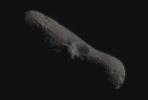
20000217a-PCF-LXTT-IPF.jpgOrbiting 433-Eros (Absolute Natural Colors; credits for the additional process. and color: Dr Paolo C. Fienga/Lunar Explorer Italia/Italian Planetary Foundation)148 visiteCaption NASA:"This picture of 433-Eros, the first of an Asteroid taken from an orbiting spacecraft, is a mosaic of 4 images obtained by NEAR on February 14, 2000, immediately after the Spacecraft's insertion into orbit. We are looking down over the North Pole of Eros at one of the largest craters on the surface, which measures 4 miles (about 6 Km) across. Inside the crater walls are subtle variations in brightness that hint at some layering of the rock in which the crater formed. Narrow grooves that run parallel to the long axis of Eros cut through the South-Eastern part of the crater rim. A house-sized boulder is present near the floor of the crater; it appears to have rolled down the bowl-shaped crater wall. A large number of boulders is also present on other parts of the Asteroid's surface. The surface of the Asteroid is heavily cratered, indicating that 433-Eros is relatively old.
(Mosaic of images 0125956839, 0125957025, 0125957087, 0125957273)MareKromium10/28/20 at 12:41Anakin: Intanto rispondo velocemente a Max. Lo stesso prob...
|
|
20000217a-PCF-LXTT-IPF.jpgOrbiting 433-Eros (Absolute Natural Colors; credits for the additional process. and color: Dr Paolo C. Fienga/Lunar Explorer Italia/Italian Planetary Foundation)148 visiteCaption NASA:"This picture of 433-Eros, the first of an Asteroid taken from an orbiting spacecraft, is a mosaic of 4 images obtained by NEAR on February 14, 2000, immediately after the Spacecraft's insertion into orbit. We are looking down over the North Pole of Eros at one of the largest craters on the surface, which measures 4 miles (about 6 Km) across. Inside the crater walls are subtle variations in brightness that hint at some layering of the rock in which the crater formed. Narrow grooves that run parallel to the long axis of Eros cut through the South-Eastern part of the crater rim. A house-sized boulder is present near the floor of the crater; it appears to have rolled down the bowl-shaped crater wall. A large number of boulders is also present on other parts of the Asteroid's surface. The surface of the Asteroid is heavily cratered, indicating that 433-Eros is relatively old.
(Mosaic of images 0125956839, 0125957025, 0125957087, 0125957273)MareKromium10/28/20 at 11:02MareKromium: Allora: per Walt.
La Tecnologia si sviluppa a ...
|
|
20000217a-PCF-LXTT-IPF.jpgOrbiting 433-Eros (Absolute Natural Colors; credits for the additional process. and color: Dr Paolo C. Fienga/Lunar Explorer Italia/Italian Planetary Foundation)148 visiteCaption NASA:"This picture of 433-Eros, the first of an Asteroid taken from an orbiting spacecraft, is a mosaic of 4 images obtained by NEAR on February 14, 2000, immediately after the Spacecraft's insertion into orbit. We are looking down over the North Pole of Eros at one of the largest craters on the surface, which measures 4 miles (about 6 Km) across. Inside the crater walls are subtle variations in brightness that hint at some layering of the rock in which the crater formed. Narrow grooves that run parallel to the long axis of Eros cut through the South-Eastern part of the crater rim. A house-sized boulder is present near the floor of the crater; it appears to have rolled down the bowl-shaped crater wall. A large number of boulders is also present on other parts of the Asteroid's surface. The surface of the Asteroid is heavily cratered, indicating that 433-Eros is relatively old.
(Mosaic of images 0125956839, 0125957025, 0125957087, 0125957273)MareKromium10/28/20 at 09:21Ufologo: Una questione che mi pongo .. da sempre: fin da ra...
|
|
20000217a-PCF-LXTT-IPF.jpgOrbiting 433-Eros (Absolute Natural Colors; credits for the additional process. and color: Dr Paolo C. Fienga/Lunar Explorer Italia/Italian Planetary Foundation)148 visiteCaption NASA:"This picture of 433-Eros, the first of an Asteroid taken from an orbiting spacecraft, is a mosaic of 4 images obtained by NEAR on February 14, 2000, immediately after the Spacecraft's insertion into orbit. We are looking down over the North Pole of Eros at one of the largest craters on the surface, which measures 4 miles (about 6 Km) across. Inside the crater walls are subtle variations in brightness that hint at some layering of the rock in which the crater formed. Narrow grooves that run parallel to the long axis of Eros cut through the South-Eastern part of the crater rim. A house-sized boulder is present near the floor of the crater; it appears to have rolled down the bowl-shaped crater wall. A large number of boulders is also present on other parts of the Asteroid's surface. The surface of the Asteroid is heavily cratered, indicating that 433-Eros is relatively old.
(Mosaic of images 0125956839, 0125957025, 0125957087, 0125957273)MareKromium10/27/20 at 15:10walthari: sono d'accordo ufologo sulla tecnologia, ma va...
|
|
20000217a-PCF-LXTT-IPF.jpgOrbiting 433-Eros (Absolute Natural Colors; credits for the additional process. and color: Dr Paolo C. Fienga/Lunar Explorer Italia/Italian Planetary Foundation)148 visiteCaption NASA:"This picture of 433-Eros, the first of an Asteroid taken from an orbiting spacecraft, is a mosaic of 4 images obtained by NEAR on February 14, 2000, immediately after the Spacecraft's insertion into orbit. We are looking down over the North Pole of Eros at one of the largest craters on the surface, which measures 4 miles (about 6 Km) across. Inside the crater walls are subtle variations in brightness that hint at some layering of the rock in which the crater formed. Narrow grooves that run parallel to the long axis of Eros cut through the South-Eastern part of the crater rim. A house-sized boulder is present near the floor of the crater; it appears to have rolled down the bowl-shaped crater wall. A large number of boulders is also present on other parts of the Asteroid's surface. The surface of the Asteroid is heavily cratered, indicating that 433-Eros is relatively old.
(Mosaic of images 0125956839, 0125957025, 0125957087, 0125957273)MareKromium10/27/20 at 09:30Anakin: Se accettiamo l'idea di popolazioni estraterre...
|
|
20000217a-PCF-LXTT-IPF.jpgOrbiting 433-Eros (Absolute Natural Colors; credits for the additional process. and color: Dr Paolo C. Fienga/Lunar Explorer Italia/Italian Planetary Foundation)148 visiteCaption NASA:"This picture of 433-Eros, the first of an Asteroid taken from an orbiting spacecraft, is a mosaic of 4 images obtained by NEAR on February 14, 2000, immediately after the Spacecraft's insertion into orbit. We are looking down over the North Pole of Eros at one of the largest craters on the surface, which measures 4 miles (about 6 Km) across. Inside the crater walls are subtle variations in brightness that hint at some layering of the rock in which the crater formed. Narrow grooves that run parallel to the long axis of Eros cut through the South-Eastern part of the crater rim. A house-sized boulder is present near the floor of the crater; it appears to have rolled down the bowl-shaped crater wall. A large number of boulders is also present on other parts of the Asteroid's surface. The surface of the Asteroid is heavily cratered, indicating that 433-Eros is relatively old.
(Mosaic of images 0125956839, 0125957025, 0125957087, 0125957273)MareKromium10/25/20 at 11:51Ufologo: ... Per?, se prendiamo in considerazione chi affer...
|
|
20000217a-PCF-LXTT-IPF.jpgOrbiting 433-Eros (Absolute Natural Colors; credits for the additional process. and color: Dr Paolo C. Fienga/Lunar Explorer Italia/Italian Planetary Foundation)148 visiteCaption NASA:"This picture of 433-Eros, the first of an Asteroid taken from an orbiting spacecraft, is a mosaic of 4 images obtained by NEAR on February 14, 2000, immediately after the Spacecraft's insertion into orbit. We are looking down over the North Pole of Eros at one of the largest craters on the surface, which measures 4 miles (about 6 Km) across. Inside the crater walls are subtle variations in brightness that hint at some layering of the rock in which the crater formed. Narrow grooves that run parallel to the long axis of Eros cut through the South-Eastern part of the crater rim. A house-sized boulder is present near the floor of the crater; it appears to have rolled down the bowl-shaped crater wall. A large number of boulders is also present on other parts of the Asteroid's surface. The surface of the Asteroid is heavily cratered, indicating that 433-Eros is relatively old.
(Mosaic of images 0125956839, 0125957025, 0125957087, 0125957273)MareKromium10/25/20 at 09:04MareKromium: Io penso di si. In maniere e forme che sfuggono al...
|
|
20000217a-PCF-LXTT-IPF.jpgOrbiting 433-Eros (Absolute Natural Colors; credits for the additional process. and color: Dr Paolo C. Fienga/Lunar Explorer Italia/Italian Planetary Foundation)148 visiteCaption NASA:"This picture of 433-Eros, the first of an Asteroid taken from an orbiting spacecraft, is a mosaic of 4 images obtained by NEAR on February 14, 2000, immediately after the Spacecraft's insertion into orbit. We are looking down over the North Pole of Eros at one of the largest craters on the surface, which measures 4 miles (about 6 Km) across. Inside the crater walls are subtle variations in brightness that hint at some layering of the rock in which the crater formed. Narrow grooves that run parallel to the long axis of Eros cut through the South-Eastern part of the crater rim. A house-sized boulder is present near the floor of the crater; it appears to have rolled down the bowl-shaped crater wall. A large number of boulders is also present on other parts of the Asteroid's surface. The surface of the Asteroid is heavily cratered, indicating that 433-Eros is relatively old.
(Mosaic of images 0125956839, 0125957025, 0125957087, 0125957273)MareKromium10/24/20 at 19:08walthari: viaggi interstellari, stati di coscienza, che sian...
|
|
20000217a-PCF-LXTT-IPF.jpgOrbiting 433-Eros (Absolute Natural Colors; credits for the additional process. and color: Dr Paolo C. Fienga/Lunar Explorer Italia/Italian Planetary Foundation)148 visiteCaption NASA:"This picture of 433-Eros, the first of an Asteroid taken from an orbiting spacecraft, is a mosaic of 4 images obtained by NEAR on February 14, 2000, immediately after the Spacecraft's insertion into orbit. We are looking down over the North Pole of Eros at one of the largest craters on the surface, which measures 4 miles (about 6 Km) across. Inside the crater walls are subtle variations in brightness that hint at some layering of the rock in which the crater formed. Narrow grooves that run parallel to the long axis of Eros cut through the South-Eastern part of the crater rim. A house-sized boulder is present near the floor of the crater; it appears to have rolled down the bowl-shaped crater wall. A large number of boulders is also present on other parts of the Asteroid's surface. The surface of the Asteroid is heavily cratered, indicating that 433-Eros is relatively old.
(Mosaic of images 0125956839, 0125957025, 0125957087, 0125957273)MareKromium10/24/20 at 16:25MareKromium: Per Ivana: quando puoi e vuoi, i Tuoi commenti e c...
|
|
20000217a-PCF-LXTT-IPF.jpgOrbiting 433-Eros (Absolute Natural Colors; credits for the additional process. and color: Dr Paolo C. Fienga/Lunar Explorer Italia/Italian Planetary Foundation)148 visiteCaption NASA:"This picture of 433-Eros, the first of an Asteroid taken from an orbiting spacecraft, is a mosaic of 4 images obtained by NEAR on February 14, 2000, immediately after the Spacecraft's insertion into orbit. We are looking down over the North Pole of Eros at one of the largest craters on the surface, which measures 4 miles (about 6 Km) across. Inside the crater walls are subtle variations in brightness that hint at some layering of the rock in which the crater formed. Narrow grooves that run parallel to the long axis of Eros cut through the South-Eastern part of the crater rim. A house-sized boulder is present near the floor of the crater; it appears to have rolled down the bowl-shaped crater wall. A large number of boulders is also present on other parts of the Asteroid's surface. The surface of the Asteroid is heavily cratered, indicating that 433-Eros is relatively old.
(Mosaic of images 0125956839, 0125957025, 0125957087, 0125957273)MareKromium10/24/20 at 11:44Ufologo: " Vi fu un'Epoca in cui i sovrani d'E...
|
|
20000217a-PCF-LXTT-IPF.jpgOrbiting 433-Eros (Absolute Natural Colors; credits for the additional process. and color: Dr Paolo C. Fienga/Lunar Explorer Italia/Italian Planetary Foundation)148 visiteCaption NASA:"This picture of 433-Eros, the first of an Asteroid taken from an orbiting spacecraft, is a mosaic of 4 images obtained by NEAR on February 14, 2000, immediately after the Spacecraft's insertion into orbit. We are looking down over the North Pole of Eros at one of the largest craters on the surface, which measures 4 miles (about 6 Km) across. Inside the crater walls are subtle variations in brightness that hint at some layering of the rock in which the crater formed. Narrow grooves that run parallel to the long axis of Eros cut through the South-Eastern part of the crater rim. A house-sized boulder is present near the floor of the crater; it appears to have rolled down the bowl-shaped crater wall. A large number of boulders is also present on other parts of the Asteroid's surface. The surface of the Asteroid is heavily cratered, indicating that 433-Eros is relatively old.
(Mosaic of images 0125956839, 0125957025, 0125957087, 0125957273)MareKromium10/23/20 at 21:24Ivana: Mi collego ora dopo un mese, il mio provider wi-fi...
|
|
20000217a-PCF-LXTT-IPF.jpgOrbiting 433-Eros (Absolute Natural Colors; credits for the additional process. and color: Dr Paolo C. Fienga/Lunar Explorer Italia/Italian Planetary Foundation)148 visiteCaption NASA:"This picture of 433-Eros, the first of an Asteroid taken from an orbiting spacecraft, is a mosaic of 4 images obtained by NEAR on February 14, 2000, immediately after the Spacecraft's insertion into orbit. We are looking down over the North Pole of Eros at one of the largest craters on the surface, which measures 4 miles (about 6 Km) across. Inside the crater walls are subtle variations in brightness that hint at some layering of the rock in which the crater formed. Narrow grooves that run parallel to the long axis of Eros cut through the South-Eastern part of the crater rim. A house-sized boulder is present near the floor of the crater; it appears to have rolled down the bowl-shaped crater wall. A large number of boulders is also present on other parts of the Asteroid's surface. The surface of the Asteroid is heavily cratered, indicating that 433-Eros is relatively old.
(Mosaic of images 0125956839, 0125957025, 0125957087, 0125957273)MareKromium10/23/20 at 12:58MareKromium: La Fisica Quantistica - per come l'ho capita i...
|
|
| 134 immagini su 12 pagina(e) |
2 | |
|
|
|
|
|
|
|
|
|
|
|





