| |

| Ultimi commenti - Mars, Deimos and Phobos: Maps |

030-Mars-17-PIA09225_fig1.jpgThe "Lower Boundary" of the Icy Layers Covering Mars' South Polar Region (Map 2)71 visiteThis map shows the topography of the South Polar Region of Mars, including topography buried by thick deposits of icy material. The map is a combination of surface elevation data acquired by the Mars Orbiter Laser Altimeter aboard NASA's Mars Global Surveyor orbiter, and subsurface elevation data acquired by the Mars Advanced Radar for Subsurface and Ionospheric Sounding (MARSIS) aboard the European Space Agency's Mars Express orbiter.
The black line shows the boundary of the South Polar Layered Deposits, an ice-rich geologic unit that was probed by MARSIS. Elevation values within the black outline, as measured by MARSIS, show the topography at the boundary between the layered deposits and the underlying material, an interface known as the "bed" of the deposits. The elevation of the terrain is shown by colors, with purple and blue representing the lowest areas, and orange and red the highest. The total range of elevation shown is about 5 Km.
The radar data reveal previously undetected features of topography of the bed, including depressions as deep as 1 Km (0,6 miles) shown in purple in the near-polar region.
The boundary of the layered deposits was mapped by scientists from the U.S. Geological Survey. The dark circle in the upper center is the area poleward of 87° South Latitude, where MARSIS data cannot be collected.
The map covers an area of 1670 by 1800 Km (about 1035 by 1115 miles). 07/31/22 at 15:31Paolo C. Fienga: Si. Per creare "Mistero", dove "Mis...
|
|
030-Mars-17-PIA09225_fig1.jpgThe "Lower Boundary" of the Icy Layers Covering Mars' South Polar Region (Map 2)71 visiteThis map shows the topography of the South Polar Region of Mars, including topography buried by thick deposits of icy material. The map is a combination of surface elevation data acquired by the Mars Orbiter Laser Altimeter aboard NASA's Mars Global Surveyor orbiter, and subsurface elevation data acquired by the Mars Advanced Radar for Subsurface and Ionospheric Sounding (MARSIS) aboard the European Space Agency's Mars Express orbiter.
The black line shows the boundary of the South Polar Layered Deposits, an ice-rich geologic unit that was probed by MARSIS. Elevation values within the black outline, as measured by MARSIS, show the topography at the boundary between the layered deposits and the underlying material, an interface known as the "bed" of the deposits. The elevation of the terrain is shown by colors, with purple and blue representing the lowest areas, and orange and red the highest. The total range of elevation shown is about 5 Km.
The radar data reveal previously undetected features of topography of the bed, including depressions as deep as 1 Km (0,6 miles) shown in purple in the near-polar region.
The boundary of the layered deposits was mapped by scientists from the U.S. Geological Survey. The dark circle in the upper center is the area poleward of 87° South Latitude, where MARSIS data cannot be collected.
The map covers an area of 1670 by 1800 Km (about 1035 by 1115 miles). 07/31/22 at 14:46Anakin: Bufala per aver inventato un'anomalia a tavoli...
|
|
030-Mars-17-PIA09225_fig1.jpgThe "Lower Boundary" of the Icy Layers Covering Mars' South Polar Region (Map 2)71 visiteThis map shows the topography of the South Polar Region of Mars, including topography buried by thick deposits of icy material. The map is a combination of surface elevation data acquired by the Mars Orbiter Laser Altimeter aboard NASA's Mars Global Surveyor orbiter, and subsurface elevation data acquired by the Mars Advanced Radar for Subsurface and Ionospheric Sounding (MARSIS) aboard the European Space Agency's Mars Express orbiter.
The black line shows the boundary of the South Polar Layered Deposits, an ice-rich geologic unit that was probed by MARSIS. Elevation values within the black outline, as measured by MARSIS, show the topography at the boundary between the layered deposits and the underlying material, an interface known as the "bed" of the deposits. The elevation of the terrain is shown by colors, with purple and blue representing the lowest areas, and orange and red the highest. The total range of elevation shown is about 5 Km.
The radar data reveal previously undetected features of topography of the bed, including depressions as deep as 1 Km (0,6 miles) shown in purple in the near-polar region.
The boundary of the layered deposits was mapped by scientists from the U.S. Geological Survey. The dark circle in the upper center is the area poleward of 87° South Latitude, where MARSIS data cannot be collected.
The map covers an area of 1670 by 1800 Km (about 1035 by 1115 miles). 07/30/22 at 16:51Paolo C. Fienga: Non ? un fenomeno naturale: beccate le foto, che p...
|
|
030-Mars-17-PIA09225_fig1.jpgThe "Lower Boundary" of the Icy Layers Covering Mars' South Polar Region (Map 2)71 visiteThis map shows the topography of the South Polar Region of Mars, including topography buried by thick deposits of icy material. The map is a combination of surface elevation data acquired by the Mars Orbiter Laser Altimeter aboard NASA's Mars Global Surveyor orbiter, and subsurface elevation data acquired by the Mars Advanced Radar for Subsurface and Ionospheric Sounding (MARSIS) aboard the European Space Agency's Mars Express orbiter.
The black line shows the boundary of the South Polar Layered Deposits, an ice-rich geologic unit that was probed by MARSIS. Elevation values within the black outline, as measured by MARSIS, show the topography at the boundary between the layered deposits and the underlying material, an interface known as the "bed" of the deposits. The elevation of the terrain is shown by colors, with purple and blue representing the lowest areas, and orange and red the highest. The total range of elevation shown is about 5 Km.
The radar data reveal previously undetected features of topography of the bed, including depressions as deep as 1 Km (0,6 miles) shown in purple in the near-polar region.
The boundary of the layered deposits was mapped by scientists from the U.S. Geological Survey. The dark circle in the upper center is the area poleward of 87° South Latitude, where MARSIS data cannot be collected.
The map covers an area of 1670 by 1800 Km (about 1035 by 1115 miles). 07/30/22 at 08:05Anakin: Paolo e Walt, qui c'? pane per i vostri denti
...
|
|
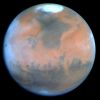
000-Mars.jpgMars: the Red Planet with "Blue Limbs"...265 visiteMars Data and Statistics
Mass (kg) = 6.421e+23
Mass (Earth = 1) = 1.0745e-01
Equatorial radius = 3.397,2 Km
Equatorial radius (Earth = 1) = 5.3264e-01
Mean density (gm/cm^3) = 3,94
Mean distance from the Sun = 227.940.000 Km
Mean distance from the Sun (Earth = 1) = 1,5237
Rotational period (hours) = 24,6229
Rotational period (days) = 1,025957
Orbital period (days) = 686,98
Mean orbital velocity = 24,13 Km per second
Tilt of axis = 25,19°
Orbital inclination = 1,850°
Equatorial surface gravity (m/sec^2) = 3,72
Equatorial escape velocity = 5,02 Km per second
Magnitude (Vo) = - 2.01
Minimum surface temperature = - 140°C
Mean surface temperature = - 63°C
Maximum surface temperature = + 35°C
Atmospheric pressure (bars) = 0,007
Atmospheric composition: Carbon Dioxide (C02) 95,2%; Nitrogen 2,7%; Argon 1,6%; Oxygen 0,13%; Carbon Monoxide 0,07%; Water 0,03%; Neon 0,00025%; Krypton 0,00003%06/12/14 at 17:54KKK: Non ? un "fake", tecnicamente, ma Google...
|
|
000-Mars.jpgMars: the Red Planet with "Blue Limbs"...265 visiteMars Data and Statistics
Mass (kg) = 6.421e+23
Mass (Earth = 1) = 1.0745e-01
Equatorial radius = 3.397,2 Km
Equatorial radius (Earth = 1) = 5.3264e-01
Mean density (gm/cm^3) = 3,94
Mean distance from the Sun = 227.940.000 Km
Mean distance from the Sun (Earth = 1) = 1,5237
Rotational period (hours) = 24,6229
Rotational period (days) = 1,025957
Orbital period (days) = 686,98
Mean orbital velocity = 24,13 Km per second
Tilt of axis = 25,19°
Orbital inclination = 1,850°
Equatorial surface gravity (m/sec^2) = 3,72
Equatorial escape velocity = 5,02 Km per second
Magnitude (Vo) = - 2.01
Minimum surface temperature = - 140°C
Mean surface temperature = - 63°C
Maximum surface temperature = + 35°C
Atmospheric pressure (bars) = 0,007
Atmospheric composition: Carbon Dioxide (C02) 95,2%; Nitrogen 2,7%; Argon 1,6%; Oxygen 0,13%; Carbon Monoxide 0,07%; Water 0,03%; Neon 0,00025%; Krypton 0,00003%06/12/14 at 15:40Anakin: http : // www . youtube . com / watch?v=LKDS0Cvgz5...
|
|

Mars-013.jpgMars: Yesterday and Today264 visiteDoes Mars have canals? A hot debate topic of the late 1800s, several prominent astronomers including Percival Lowell not only claimed to see an extensive system of long straight canals on Mars, but used them to indicate that intelligent life exists there. The relatively close opposition of 1894 was used to make drawings like the one digitally re-scaled on the above left. The above map was originally prepared by Eugene Antoniadi and redrawn by Lowell Hess for the book Exploring Mars, by Roy A. Gallant. In more modern times, the latest Mars opposition has allowed the Hubble Space Telescope to capture a picture of similar orientation. Comparison of the two images shows that large features were impressively recorded, but that an extensive system of long and straight canals just does not exist. Satellites orbiting Mars have now shown conclusively that the red planet does indeed have surface features similar to canals, but that these are usually smaller, curved, and less extensive than that previously claimed. Real canyon systems like Noctis Labyrinthus are most likely cracks caused by surface stress.
05/18/14 at 13:04KKK: I do too, of course!...
|
|
Mars-013.jpgMars: Yesterday and Today264 visiteDoes Mars have canals? A hot debate topic of the late 1800s, several prominent astronomers including Percival Lowell not only claimed to see an extensive system of long straight canals on Mars, but used them to indicate that intelligent life exists there. The relatively close opposition of 1894 was used to make drawings like the one digitally re-scaled on the above left. The above map was originally prepared by Eugene Antoniadi and redrawn by Lowell Hess for the book Exploring Mars, by Roy A. Gallant. In more modern times, the latest Mars opposition has allowed the Hubble Space Telescope to capture a picture of similar orientation. Comparison of the two images shows that large features were impressively recorded, but that an extensive system of long and straight canals just does not exist. Satellites orbiting Mars have now shown conclusively that the red planet does indeed have surface features similar to canals, but that these are usually smaller, curved, and less extensive than that previously claimed. Real canyon systems like Noctis Labyrinthus are most likely cracks caused by surface stress.
05/18/14 at 09:26walthari: "i believe!"
|
|
Mars-013.jpgMars: Yesterday and Today264 visiteDoes Mars have canals? A hot debate topic of the late 1800s, several prominent astronomers including Percival Lowell not only claimed to see an extensive system of long straight canals on Mars, but used them to indicate that intelligent life exists there. The relatively close opposition of 1894 was used to make drawings like the one digitally re-scaled on the above left. The above map was originally prepared by Eugene Antoniadi and redrawn by Lowell Hess for the book Exploring Mars, by Roy A. Gallant. In more modern times, the latest Mars opposition has allowed the Hubble Space Telescope to capture a picture of similar orientation. Comparison of the two images shows that large features were impressively recorded, but that an extensive system of long and straight canals just does not exist. Satellites orbiting Mars have now shown conclusively that the red planet does indeed have surface features similar to canals, but that these are usually smaller, curved, and less extensive than that previously claimed. Real canyon systems like Noctis Labyrinthus are most likely cracks caused by surface stress.
05/04/14 at 12:57KKK: Condivido l'approccio pragmatico di Cicas65, m...
|
|
Mars-013.jpgMars: Yesterday and Today264 visiteDoes Mars have canals? A hot debate topic of the late 1800s, several prominent astronomers including Percival Lowell not only claimed to see an extensive system of long straight canals on Mars, but used them to indicate that intelligent life exists there. The relatively close opposition of 1894 was used to make drawings like the one digitally re-scaled on the above left. The above map was originally prepared by Eugene Antoniadi and redrawn by Lowell Hess for the book Exploring Mars, by Roy A. Gallant. In more modern times, the latest Mars opposition has allowed the Hubble Space Telescope to capture a picture of similar orientation. Comparison of the two images shows that large features were impressively recorded, but that an extensive system of long and straight canals just does not exist. Satellites orbiting Mars have now shown conclusively that the red planet does indeed have surface features similar to canals, but that these are usually smaller, curved, and less extensive than that previously claimed. Real canyon systems like Noctis Labyrinthus are most likely cracks caused by surface stress.
05/03/14 at 18:29Ufologo: Se non vedrai tu stesso, quelle non le avrai .. ma...
|
|
Mars-013.jpgMars: Yesterday and Today264 visiteDoes Mars have canals? A hot debate topic of the late 1800s, several prominent astronomers including Percival Lowell not only claimed to see an extensive system of long straight canals on Mars, but used them to indicate that intelligent life exists there. The relatively close opposition of 1894 was used to make drawings like the one digitally re-scaled on the above left. The above map was originally prepared by Eugene Antoniadi and redrawn by Lowell Hess for the book Exploring Mars, by Roy A. Gallant. In more modern times, the latest Mars opposition has allowed the Hubble Space Telescope to capture a picture of similar orientation. Comparison of the two images shows that large features were impressively recorded, but that an extensive system of long and straight canals just does not exist. Satellites orbiting Mars have now shown conclusively that the red planet does indeed have surface features similar to canals, but that these are usually smaller, curved, and less extensive than that previously claimed. Real canyon systems like Noctis Labyrinthus are most likely cracks caused by surface stress.
05/03/14 at 11:37cicas65: Sono pronto a cambiare idea, ma ci vogliono prove ...
|
|
Mars-013.jpgMars: Yesterday and Today264 visiteDoes Mars have canals? A hot debate topic of the late 1800s, several prominent astronomers including Percival Lowell not only claimed to see an extensive system of long straight canals on Mars, but used them to indicate that intelligent life exists there. The relatively close opposition of 1894 was used to make drawings like the one digitally re-scaled on the above left. The above map was originally prepared by Eugene Antoniadi and redrawn by Lowell Hess for the book Exploring Mars, by Roy A. Gallant. In more modern times, the latest Mars opposition has allowed the Hubble Space Telescope to capture a picture of similar orientation. Comparison of the two images shows that large features were impressively recorded, but that an extensive system of long and straight canals just does not exist. Satellites orbiting Mars have now shown conclusively that the red planet does indeed have surface features similar to canals, but that these are usually smaller, curved, and less extensive than that previously claimed. Real canyon systems like Noctis Labyrinthus are most likely cracks caused by surface stress.
05/03/14 at 10:14Ufologo: .. e se uno Lo vedesse? (Il sottoscritto) e ne ave...
|
|
| 174 immagini su 15 pagina(e) |
|
3 | |
|
|
|
|
|
|
|
|
|
|








