| |

| Ultimi commenti - Mars in JPEG2000 |

PSP_009342_1725_RED_abrowse-06.jpgExtremely Unusual Surface Feature: "The Worm" (EDM n. 2; credits: Dr M. Faccin)4656 visiteNon è nostra intenzione assolutizzare il "potere" delle immagini poichè, come sappiamo tutti, le immagini, spesso, sono ingannevoli.
Ma non ci è possibile neppure ignorare gli elementi che sono ricavabili dall'analisi visuale di un frame, sebbene questi elementi, a volte (come questa volta!) sembrano schiudere le porte ad una realtà tanto oggettiva, quanto - come detto - "esotica ed inquietante".
Il rilievo superficiale a forma di "verme", infatti, è di color grigio-azzurro pallido (come ben si vede nel perspective detail mgnf che trovate a Dx del frame, ben colorizzato in Colori Naturali), in nettissimo contrasto rispetto al resto del paesaggio, che è bianco-giallastro (diremmo una "Dominante Ocra"): il tipico colore della polvere Marziana.
Il nostro "dettaglio controverso", inoltre, mostra di possedere una texture che è completamente diversa/incongrua rispetto alla texture del suolo che lo circonda e sembra anche mostrare un'albedo leggermente superiore.
Il fatto, poi, che la sua forma assecondi l'apparente conformazione e configurazione del suolo circostante e che esso sembri altresì "scivolare" fuori da quella sorta di tana/tunnel che potrebbe ancora contenerne una porzione dimensionalmente assai significativa, sono elementi ulteriori di analisi i quali, anche volendo assecondare un approccio severo e distaccato, unito ad una Contestualizzazione rigida e pragmatica, restano - a nostro parere ed almeno per adesso - senza una risposta valida.
Conclusioni (interlocutorie): si tratta di una Feature indefinibile la quale concreta e si sostanzia in una fattispecie tipica di Anomalìa Superficiale. Se possedessimo altre immagini del medesimo dettaglio, potremmo - forse - provare a sbilanciarci un pò sulla effettiva origine del rilievo, muovendoci dallo scenario più razionale per arrivare ad ipotesi esotiche (ergo: potremmo partire dall'estrusione di "fanghi" colorati, passando dal possibile manufatto alieno e poi arrivare sino alla Forma Vitale Indigena).
Una sola cosa ci sembra certa e difficilmente questionabile: il Dettaglio Controverso NON CONDIVIDE AFFATTO le caratteristiche superficiali del paesaggio al quale esso accede: nè per texture, nè per colore e nè per albedo.
E questo, Cari Amici, è già un complesso di fattori ed elementi che DEVE FARCI RIFLETTERE.
Che cosa stiamo guardando?MareKromium12/13/23 at 14:21Paolo C. Fienga: Vedi Max? Questa e' una Verita' incontro...
|
|
PSP_009342_1725_RED_abrowse-06.jpgExtremely Unusual Surface Feature: "The Worm" (EDM n. 2; credits: Dr M. Faccin)4656 visiteNon è nostra intenzione assolutizzare il "potere" delle immagini poichè, come sappiamo tutti, le immagini, spesso, sono ingannevoli.
Ma non ci è possibile neppure ignorare gli elementi che sono ricavabili dall'analisi visuale di un frame, sebbene questi elementi, a volte (come questa volta!) sembrano schiudere le porte ad una realtà tanto oggettiva, quanto - come detto - "esotica ed inquietante".
Il rilievo superficiale a forma di "verme", infatti, è di color grigio-azzurro pallido (come ben si vede nel perspective detail mgnf che trovate a Dx del frame, ben colorizzato in Colori Naturali), in nettissimo contrasto rispetto al resto del paesaggio, che è bianco-giallastro (diremmo una "Dominante Ocra"): il tipico colore della polvere Marziana.
Il nostro "dettaglio controverso", inoltre, mostra di possedere una texture che è completamente diversa/incongrua rispetto alla texture del suolo che lo circonda e sembra anche mostrare un'albedo leggermente superiore.
Il fatto, poi, che la sua forma assecondi l'apparente conformazione e configurazione del suolo circostante e che esso sembri altresì "scivolare" fuori da quella sorta di tana/tunnel che potrebbe ancora contenerne una porzione dimensionalmente assai significativa, sono elementi ulteriori di analisi i quali, anche volendo assecondare un approccio severo e distaccato, unito ad una Contestualizzazione rigida e pragmatica, restano - a nostro parere ed almeno per adesso - senza una risposta valida.
Conclusioni (interlocutorie): si tratta di una Feature indefinibile la quale concreta e si sostanzia in una fattispecie tipica di Anomalìa Superficiale. Se possedessimo altre immagini del medesimo dettaglio, potremmo - forse - provare a sbilanciarci un pò sulla effettiva origine del rilievo, muovendoci dallo scenario più razionale per arrivare ad ipotesi esotiche (ergo: potremmo partire dall'estrusione di "fanghi" colorati, passando dal possibile manufatto alieno e poi arrivare sino alla Forma Vitale Indigena).
Una sola cosa ci sembra certa e difficilmente questionabile: il Dettaglio Controverso NON CONDIVIDE AFFATTO le caratteristiche superficiali del paesaggio al quale esso accede: nè per texture, nè per colore e nè per albedo.
E questo, Cari Amici, è già un complesso di fattori ed elementi che DEVE FARCI RIFLETTERE.
Che cosa stiamo guardando?MareKromium10/14/21 at 15:37MareKromium: Questa è spettacolare!
|
|
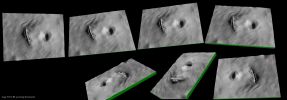
PSP_002922_1725-MF1-LXTT.jpgPossible Volcanic "Mouth", on Arsia Mons' Flank (High-Def Image Mosaic and Perspective Views - credits for the additional process.: Dr Marco Faccin)106 visitenessun commentoMareKromium05/14/21 at 10:32MareKromium: Ovviamente. ;-)
|
|
PSP_002922_1725-MF1-LXTT.jpgPossible Volcanic "Mouth", on Arsia Mons' Flank (High-Def Image Mosaic and Perspective Views - credits for the additional process.: Dr Marco Faccin)106 visitenessun commentoMareKromium05/13/21 at 12:25walthari: Ovviamente.....
|
|
PSP_002922_1725-MF1-LXTT.jpgPossible Volcanic "Mouth", on Arsia Mons' Flank (High-Def Image Mosaic and Perspective Views - credits for the additional process.: Dr Marco Faccin)106 visitenessun commentoMareKromium05/11/21 at 10:45MareKromium: Verissimo. Ma io penso, fondamentalmente, ai venti...
|
|
PSP_002922_1725-MF1-LXTT.jpgPossible Volcanic "Mouth", on Arsia Mons' Flank (High-Def Image Mosaic and Perspective Views - credits for the additional process.: Dr Marco Faccin)106 visitenessun commentoMareKromium05/11/21 at 06:53walthari: In effetti sembrerebbe molto pi? recente, anche se...
|
|
PSP_002922_1725-MF1-LXTT.jpgPossible Volcanic "Mouth", on Arsia Mons' Flank (High-Def Image Mosaic and Perspective Views - credits for the additional process.: Dr Marco Faccin)106 visitenessun commentoMareKromium05/10/21 at 17:47MareKromium: ...Ma questa "fenditura", Amici, Vi pare...
|
|

ESP_014342_0930-05.jpgSouth Polar Residual Cap Intraseasonal Change Monitoring (EDM n.5 - Natural Colors; credits: Lunexit)71 visitenessun commentoMareKromium03/02/20 at 18:05MareKromium: La Geometria Frattale ? - forse - l'in s? dell...
|
|

ESP_023024_1010-GB-PCF-LXTT-IPF-Possible_Paleo-Lake-02.jpgPossible Paleo-Lake near the South Pole of Mars (an Image-Mosaic in Absolute Natural Colors; credits for the Research, additional process. and color.: Drr Gianluigi Barca and Paolo C. Fienga/Lunar Explorer Italia/Italian Planetary Foundation)128 visiteIn this image-mosaic showing the "Smooth South Polar Region", as NASA defined this Surface Feature, we wish to draw to your attention the extremely linear and, in a way, unusually-looking Chain of "oblong-shaped" Impact Craters that can easily be seen on the East Side (better yet: East Wall) of the Feature, from its upper right (Dx) corner and then down, for about 1/4 (one fourth) of its full length. This Chain of Craters litterally "follows" the Eastern Margin of the Lake-like Feature, then it suddenly stops (or, perhaps, quite a few of the Craters forming the Chain were simply "erased" by the occurrence of some Geological and/or Atmospherical - or both, probably - Events, still unknown at this point), and then it starts again, still remaining sharp and linear, but with a lesser Craters' Density.
Furthermore, on the left (Sx) side of the Craters forming the Chain, the Surface appears to be characterized by the presence of Gullies (---> remember that a so-called "Gully" is a landform created by running water, eroding sharply into the Soil. Gullies may resemble to large ditches or small valleys, but they can be a few meters, to tens of meters, deep and wide. When the Gully Formation is in process, the Water Flow Rate can be substantial, and this fact causes a significant deep cutting action into the Soil). So, one - perhaps remote, but, in any case, extremely intriguing - possibility, is that the Chain of Craters (or whatever those "oblong-shaped holes in the ground" may be) was the actual "passageway" through which a more than significant amount of running water once flew and, in the end (an end that occurred, very likely, in a distant past), filled up the whole Surface Depression and formed a true South Polar Lake. Then the water froze, and the Surface of this Martian Lake got slowly covered by Dust and Ashes but, in any case, it remained very smooth, like the still waters that once must have been there and that, in our opinion, froze very quickly.
All that said, we humbly believe, as IPF, that this whole Surface Feature has too quickly (and superficially) been called "Smooth South Polar Region", and then (at least as far as we know) forgotten by the many Spacecrafts that we still have orbiting around the Red Planet. In other words, if we had the chance, we would strongly suggest NASA (and ESA) to send the Mars Reconnaissance Orbiter and the Mars Express Spacecraft over this Region, and then take a new and better look at was lies down below, on the Surface. And this because, as they should know very well, "Science is always full of surprises"!...
Your opinions and insights about this topic are and shall always be appreciated.
Mars Local Time: 14:56 (Early Afternoon)
Coord. (centered): 78,638° South Lat. and 68,111° East Long.
Spacecraft altitude: 248,0 Km (such as about 154,008 miles)
Original image scale range: 49,6 cm/pixel (with 2 x 2 binning) so objects ~ 1 mt and 49 cm across are resolved
Map projected scale: 50 cm/pixel
Map projection: POLAR STEREOGRAPHIC
Emission Angle: 4,5°
Sun-Martian Surface-MRO Spacecraft (or Phase) Angle: 67,9°
Solar Incidence Angle: 65° (meaning that the Sun was about 25° above the Local Horizon at the time the picture was taken)
Solar Longitude: 317,2° (Northern Winter - Southern Summer)
Credits: NASA/JPL/University of Arizona
Additional process. and coloring: Lunar Explorer Italia
This picture (which is a cropped and NON-Map Projected NASA - Original Mars Reconnaissance Orbiter CTX b/w frame, identified by the serial n. ESP_023024_1010) has been additionally processed and then colorized in Absolute Natural Colors (such as the colors that a human eye would actually perceive if someone were onboard the NASA - Mars Reconnaissance Orbiter and then looked down, towards the Surface of Mars), by using an original technique created - and, in time, dramatically improved - by the Lunar Explorer Italia Team.MareKromium03/02/20 at 18:04MareKromium: Concordo.
|
|
ESP_023024_1010-GB-PCF-LXTT-IPF-Possible_Paleo-Lake-02.jpgPossible Paleo-Lake near the South Pole of Mars (an Image-Mosaic in Absolute Natural Colors; credits for the Research, additional process. and color.: Drr Gianluigi Barca and Paolo C. Fienga/Lunar Explorer Italia/Italian Planetary Foundation)128 visiteIn this image-mosaic showing the "Smooth South Polar Region", as NASA defined this Surface Feature, we wish to draw to your attention the extremely linear and, in a way, unusually-looking Chain of "oblong-shaped" Impact Craters that can easily be seen on the East Side (better yet: East Wall) of the Feature, from its upper right (Dx) corner and then down, for about 1/4 (one fourth) of its full length. This Chain of Craters litterally "follows" the Eastern Margin of the Lake-like Feature, then it suddenly stops (or, perhaps, quite a few of the Craters forming the Chain were simply "erased" by the occurrence of some Geological and/or Atmospherical - or both, probably - Events, still unknown at this point), and then it starts again, still remaining sharp and linear, but with a lesser Craters' Density.
Furthermore, on the left (Sx) side of the Craters forming the Chain, the Surface appears to be characterized by the presence of Gullies (---> remember that a so-called "Gully" is a landform created by running water, eroding sharply into the Soil. Gullies may resemble to large ditches or small valleys, but they can be a few meters, to tens of meters, deep and wide. When the Gully Formation is in process, the Water Flow Rate can be substantial, and this fact causes a significant deep cutting action into the Soil). So, one - perhaps remote, but, in any case, extremely intriguing - possibility, is that the Chain of Craters (or whatever those "oblong-shaped holes in the ground" may be) was the actual "passageway" through which a more than significant amount of running water once flew and, in the end (an end that occurred, very likely, in a distant past), filled up the whole Surface Depression and formed a true South Polar Lake. Then the water froze, and the Surface of this Martian Lake got slowly covered by Dust and Ashes but, in any case, it remained very smooth, like the still waters that once must have been there and that, in our opinion, froze very quickly.
All that said, we humbly believe, as IPF, that this whole Surface Feature has too quickly (and superficially) been called "Smooth South Polar Region", and then (at least as far as we know) forgotten by the many Spacecrafts that we still have orbiting around the Red Planet. In other words, if we had the chance, we would strongly suggest NASA (and ESA) to send the Mars Reconnaissance Orbiter and the Mars Express Spacecraft over this Region, and then take a new and better look at was lies down below, on the Surface. And this because, as they should know very well, "Science is always full of surprises"!...
Your opinions and insights about this topic are and shall always be appreciated.
Mars Local Time: 14:56 (Early Afternoon)
Coord. (centered): 78,638° South Lat. and 68,111° East Long.
Spacecraft altitude: 248,0 Km (such as about 154,008 miles)
Original image scale range: 49,6 cm/pixel (with 2 x 2 binning) so objects ~ 1 mt and 49 cm across are resolved
Map projected scale: 50 cm/pixel
Map projection: POLAR STEREOGRAPHIC
Emission Angle: 4,5°
Sun-Martian Surface-MRO Spacecraft (or Phase) Angle: 67,9°
Solar Incidence Angle: 65° (meaning that the Sun was about 25° above the Local Horizon at the time the picture was taken)
Solar Longitude: 317,2° (Northern Winter - Southern Summer)
Credits: NASA/JPL/University of Arizona
Additional process. and coloring: Lunar Explorer Italia
This picture (which is a cropped and NON-Map Projected NASA - Original Mars Reconnaissance Orbiter CTX b/w frame, identified by the serial n. ESP_023024_1010) has been additionally processed and then colorized in Absolute Natural Colors (such as the colors that a human eye would actually perceive if someone were onboard the NASA - Mars Reconnaissance Orbiter and then looked down, towards the Surface of Mars), by using an original technique created - and, in time, dramatically improved - by the Lunar Explorer Italia Team.MareKromium03/01/20 at 12:26walthari: la logica ci impone di pensare questo lago in form...
|
|
ESP_014342_0930-05.jpgSouth Polar Residual Cap Intraseasonal Change Monitoring (EDM n.5 - Natural Colors; credits: Lunexit)71 visitenessun commentoMareKromium03/01/20 at 12:23walthari: essi, mi ricordano la geometria frattale...
|
|
ESP_014342_0930-05.jpgSouth Polar Residual Cap Intraseasonal Change Monitoring (EDM n.5 - Natural Colors; credits: Lunexit)71 visitenessun commentoMareKromium02/28/20 at 17:18MareKromium: Forme bizzarre, non credete?!?
|
|
| 672 immagini su 56 pagina(e) |
1 |
|
|
|
|
|
|
|
|
|
|
|
|








