Original NASA Frames - Jupiter and the "Jupiter System" through Voyager 1 and 2
|
|
|
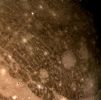
505-PIA00356.jpgGanymede (Enhanced Natural Colors and HR; credits: NASA/JPL)55 visiteCaption NASA originale:"This color reconstruction of part of the Northern Hemisphere of Ganymede was made from pictures taken from a range of about 313.000 Km (approx. 194.000 miles).
The scene is approx. 1.300 Km (about 806 miles) across and it shows part of dark, densely cratered block which is bound on the south by lighter and less cratered, grooved terrain.
The dark blocks are believed to be the oldest parts of Ganymede's surface. Numerous craters are visible, many with central peaks. The large bright circular features have little relief and are probably the remnants of old, large craters that have been annealed by flow of the icy near-surface material.
The closely-spaced arcuate, linear features are probably analogous to similar features on Ganymede which surround a large impact basin.
The linear features here may indicate the former presence of a large impact basin to the South-West".
|
|

505-PIA00357.jpgGanymede (Enhanced Natural Colors and HR; credits: NASA/JPL)56 visiteCaption NASA originale:"This color picture of Ganymede is relevant to a Region located at 30° South Lat. and 180° West Long. It shows features as small as 6 Km (about 3,7 miles) across. Notice here a bright halo impact crater that shows the fresh material thrown out of the crater. In the background it can be seen a bright grooved terrain that may be the result of the shearing of the surface materials along fault planes.
The dark background material is the ancient heavily cratered terrain -- probably the oldest material preserved on the surface of Ganymede".
|
|

507-PIA01517.jpgThe equatorial Region of Ganymede57 visiteCaption NASA originale:"This picture is relevant to a Regione near the Equator of Ganymede, and has relatively subdued colors in the visible part of the spectrum. The most striking features are the bright ray craters which have a distinctly bluer color, appearing white against the redder background.
Ganymede's surface is known to contain large amounts of surface ice and it appears that these relatively young craters have spread bright fresh ice materials over the surface.
Likewise, the lighter color and reflectivity of the grooved areas suggest that here, too, there is cleaner ice. We see ray craters with all sizes of ray patterns, ranging from extensive systems, down to craters which have only faint remnants of bright ejecta patterns.
This variation suggests that, as on the Moon, there are processes which act to darken ray material - probably the so-called "gardening", by micrometeoroid impacts".
|
|
|
| 39 immagini su 4 pagina(e) |
 |
4 |
|





