|
|

040-Vesta-PIA14122.jpgApproaching 4-Vesta82 visitenessun commentoMareKromium
|
|

049-Vesta-PIA14124.jpg4-Vesta in Spectrometer View (Visible Light and IR)76 visiteCaption NASA:"On June 8, 2011, the Visible and InfraRed Mapping Spectrometer aboard NASA's Dawn Spacecraft captured the instrument's first images of 4-Vesta that are larger than a few pixels, from a distance of about 218.000 miles (approx. 351.000 Km). The images were taken for calibration purposes.
Images obtained in the Visible part of the light Spectrum, at about 0,55 microns in wavelength, appear on the left. Images obtained in the InfraRed Spectrum, at around 3 microns in wavelength, appear on the right. The spatial resolution of these images is about 60 miles (approx. 90 Km) per pixel.
The Visible and InfraRed mapping spectrometer will be able to provide images of 4-Vesta in 432 wavelengths, which will help scientists determine the basic composition of the Asteroid".MareKromium
|
|

050-Vesta-HR_Video.gif4-Vesta: Full Rotation (a GIF-Movie by NASA / JPL / UCLA / MPS / DLR / PSI)106 visiteAs Dawn continued its approach to 4-Vesta on June 20, 2011, it occasionally quit thrusting and turned to the spinning Asteroid to perform a "rotation characterization," seeing all longitudes as 4-Vesta rotated beneath the Spacecraft.MareKromium
|
|

051-569825main_dawn-image-070111-43_946-710.jpgApproaching 4-Vesta79 visitenessun commentoMareKromium
|
|

052-569814main_dawn-image-062411-43_946-710.jpgApproaching 4-Vesta72 visitenessun commentoMareKromium
|
|

053-Vesta-PIA14312.jpgFeatures of 4- Vesta (Saturated Absolute Natural Colors; credits for the additional process. and color: Dr Paolo C. Fienga - Lunexit Team)212 visiteCaption NASA:"NASA's Dawn Spacecraft obtained this image of the giant Asteroid 4-Vesta with its framing camera on July, 9, 2011. It was taken from a distance of about 26.000 miles (approx. 41.000 Km). 4-Vesta is also considered a "protoplanet" because it is a large body that almost became a planet. Each pixel in the image corresponds to roughly 2,4 miles (about 3,8 Km).
The Dawn mission to 4-Vesta and 1-Ceres is managed by the Jet Propulsion Laboratory, for NASA's Science Mission Directorate, Washington, D.C. It is a project of the Discovery Program managed by NASA's Marshall Space Flight Center, Huntsville, Ala. UCLA, is responsible for overall Dawn mission science. Orbital Sciences Corporation of Dulles, Va., designed and built the Dawn Spacecraft!".
MareKromium
|
|

054-Vesta-571329-PCF-LXTT.jpgApproaching 4-Vesta (Natural Colors; credits for the additional process. and color.: Dr Paolo C. Fienga - Lunar Explorer Italia)133 visiteCaption NASA:"NASA's Dawn Spacecraft obtained this image with its framing camera on July 17, 2011. It was taken from a distance of about 9500 miles (approx. 15.000 Km) away from the Protoplanet 4-Vesta. Each pixel in the image corresponds to roughly 0,88 miles (about 1,4 Km)".MareKromium
|
|
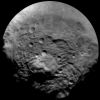
055-Vesta-PIA14315.jpgThe South Pole of 4-Vesta111 visiteCaption NASA:"This image, taken by the framing camera instrument aboard NASA's Dawn Spacecraft, shows the South Polar Region of 4-Vesta, which has a diameter of about 330 miles (approx. 530 Km). The image was taken through the clear filter on July, 9th, 2011, as part of a rotation characterization sequence, and it has a scale of about 2,2 miles (approx. 3,5 Km) per pixel.
To enhance details, the resolution was enlarged to .6 miles (roughly 1 Km) per pixel.
This Region is characterized by rough topography, a large Mountain, Impact Craters, Grooves and steep Scarps. The original image was map-projected, centered at 55°
South Latitude and 210° East Longitude".MareKromium
|
|

056-Vesta-3D-PIA14314.jpgThe South Pole of 4-Vesta in 3D107 visiteCaption NASA:"This anaglyph image of the South Polar Region of the Asteroid 4-Vesta was put together from two clear filter images, taken on July, 9th, 2011 by the framing camera instrument aboard NASA's Dawn Spacecraft. Each pixel in this image corresponds to roughly 2,2 miles (about 3,5 Km)".MareKromium
|
|
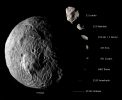
060-Vesta_and_Friends-PIA14316.jpg4-Vesta and "Friends"...88 visiteCaption NASA:"This composite image shows the comparative sizes of 8 (eight) Asteroids. Up until now, Lutetia, with a diameter of about 81 miles (approx. 130 Km), was the largest Asteroid visited by a Spacecraft.
Vesta, which is also considered a protoplanet because it's a large body that almost became a planet, dwarfs all other small bodies in this image, with its diameter sizing up at approximately 330 miles (about 530 Km)".
MareKromium
|
|

062-Vesta-071811-PCF-LXTT.jpgFeatures of 4-Vesta (Natural Colors; credits for the additional process. and color.: Dr Paolo C. Fienga - Lunar Explorer Italia)135 visiteCaption NASA:"NASA's Dawn Spacecraft obtained this image with its framing camera on July 18, 2011. It was taken from a distance of about 6500 miles (approx. 10.500 Km) away from the Protoplanet 4-Vesta. The smallest detail visible is about 1,2 miles across (approx. 2 Km).MareKromium
|
|

063-Vesta-Dawn-image-072311-PCF-LXTT.jpgFeatures of 4-Vesta (Natural Colors; credits for the additional process. and color.: Dr Paolo C. Fienga - Lunar Explorer Italia)179 visiteCaption NASA:"NASA's Dawn spacecraft obtained this image with its framing camera on July 23, 2011. It was taken from a distance of about 3200 miles (approx. 5200 Km) away from the giant Asteroid 4-Vesta".MareKromium
|
|
| 55 immagini su 5 pagina(e) |
 |
3 | |
|





