The Best Frames from Viking Orbiter 1 and 2
|
|
|

vo1-PIA00300_modest.jpgOlympus Mons (False Colors; credits: NASA)94 visiteShown here is a digital mosaic of Olympus Mons, the largest known volcano in the Solar System. It is 27 Km high, over 600 Km at the base, and is surrounded by a well-defined scarp (scarp--->"scarpata") that is up to 6 Km high. Lava flows (lava flow--->"colata lavica") drape over the scarp in places. Much of the plains surrounding the volcano are covered by the ridged (to ridge--->verb.:"increspare"; ridge--->sost.:"crinali") and grooved (to groove--->verb.:"scanalare" o "incavare"; groove--->sost.:"solco" o "scanalatura") 'aureole' of Olympus Mons.
|
|
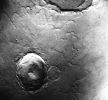
vo1_003a07.jpgMars: according to Viking 1 Orbiter56 visiteUna carrellata su alcuni bellissimi (e dimenticati) frames Viking 1 e Viking 2 i quali hanno il compito fondamentale (se non unico) di rammentarci che la tecnologia fotografica (e non solo), sin dalla metà degli Anni '70 (siamo nel 1975 per Viking 1 e nel 1976 per Viking 2), era già più che eccellente. Su Marte, e questo è il "messaggio" che vorremmo far passare - mentre guardate questi splendidi panorami orbitali - è che su Marte non siamo ancora andati (con Uomini) NON perchè non è possibile, o sicuro, o - magari - "profitable", come dicono in America.
Su Marte, oggi, AD 2006, non abbiamo ancora messo piede solo perchè - ... - non vogliamo.
Il resto (tutto il resto) è soltanto disinformazione, controinformazione e chiacchiere da bar.
|
|

vo1_010a56.jpgMars: according to Viking 1 Orbiter59 visiteNASA's Viking Mission to Mars was composed of 2 spacecrafts: Viking 1 and Viking 2, each consisting of an Orbiter and a Lander.
The primary mission objectives were to obtain HR images of the Martian surface, characterize the structure and composition of the atmosphere and surface, and search for evidence of life. Viking 1 was launched on August 20, 1975 and arrived at Mars on June 19, 1976. The first month of orbit was devoted to imaging the surface to find appropriate landing sites for the Viking Landers. On July 20, 1976 the Viking 1 Lander separated from the Orbiter and touched down at Chryse Planitia (22,48° N, 49,97° W planetographic, 1,5 Km below the datum - 0 elevation). Viking 2 was launched September 9, 1975 and entered Mars orbit on August 7, 1976. The Viking 2 Lander touched down at Utopia Planitia (47,97° N, 225,74° W, 3 Km below the datum) on September 3, 1976. The Orbiters imaged the entire surface of Mars at a resolution of 150 to 300 meters.
|
|

vo1_020a62.jpgMars: according to Viking 1 Orbiter54 visiteThe results from the Viking experiments give our most complete view of Mars to date. Volcanoes, lava plains, immense canyons, cratered areas, wind-formed features and evidence of surface water are apparent in the Orbiter images. The Planet appears to be divisible into two main regions: Northern Low Plains and Southern Cratered Highlands. Superimposed on these Regions are the Tharsis and Elysium bulges - high-standing volcanic areas - and Valles Marineris, a system of giant canyons near the Equator.
The surface material at both landing sites can best be characterized as iron-rich clay. Measured temperatures at the landing sites ranged from 150 to 250 K, with a variation over a given day of 35 to 50 K. Seasonal dust storms, pressure changes, and transport of atmospheric gases between the polar caps were observed.
The biology experiment produced no evidence of life at either landing site.
|
|

vo1_022a54.jpgMars: according to Viking 1 Orbiter58 visiteFurther information on the spacecraft, experiments, and data returned from the Viking missions can be found in the September 30, 1977 issue of the Journal of Geophysical Research, "Scientific Results of the Viking Project", vol. 82, no. 28.
ATTENZIONE: se avete letto con attenzione la caption NASA originale, si dice, senza enfasi e quasi "con nonchalance", che gli affioramenti di H2O sono evidenti e conclamati "...evidence of surface water are apparent in the Orbiter images...". Certo, si potrebbe obbiettare che la caption sta facendo riferimento ad "antichi" affioramenti ma...Noi leggiamo il testo e non lo interpretiamo: il testo dice che "...evidenze di acque superficiali sono palesi nelle immagini degli Orbiter...".
Parola della NASA, e se lo dicono loro...
|
|

vo1_032a18.jpgMars: according to Viking 1 Orbiter54 visitenessun commento
|
|

vo1_035a64.jpgMars: according to Viking 1 Orbiter58 visitenessun commento
|
|

vo1_038a02.jpgMars: according to Viking 1 Orbiter54 visitenessun commento
|
|

vo1_043a04.jpgMars: according to Viking 1 Orbiter54 visitenessun commento
|
|

vo1_056a12.jpgMars: according to Viking 1 Orbiter58 visitenessun commento
|
|

vo1_057a45.jpgMars: according to Viking 1 Orbiter71 visitenessun commento
|
|

vo1_058a02.jpgVery thin and bright "Water-Ice" Clouds62 visitenessun commento
|
|
| 78 immagini su 7 pagina(e) |
2 |  |
|
|
|
|





