Mars Reconnaissance Orbiter (MRO)
|
|
|
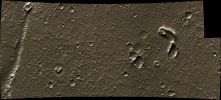
PSP_001578_2000-MF-LXT.jpgFaulting in Amazonis Planitia (Natural Colors; credits: Dr M. Faccin & Lunexit)63 visiteThis HiRISE image is centered on a long "Strike-Slip Fault" on the Young Plains of the Amazonis Planitai Region.
The most famous example of a Strike-Slip Fault on Planet Earth is probably the San Andreas Fault in California.
The Plains of Amazonis, as seen here, show only a few large and medium-sized craters, indicating that the Surface has been "remodeled" relatively recently.
The fact that the Fault visible here has cut the Plains, indicates that tectonic processes (as well as Marsquakes) have occurred even more recently (whereas that the word "recently", on Mars, is a relative term - since it is likely that both the Surface and the Fault are more than a billion years old.
Other interesting features that can be seen in this frame are "Moats" (---> fossi e fossati) - visible around Knobs (---> colline a ceppo) - and a few Impact Craters.MareKromium
|
|
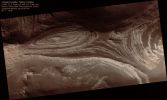
PSP_001596_1525_RED_browse-01-PCF-LXTT.jpgLayering inside Terby Crater (Absolute Natural Colors; credits: Dr Paolo C. Fienga - Lunexit Team)268 visiteImage PSP_001596_1525 shows a sequence of predominantly light-toned, layered, sedimentary rocks exposed by erosion on the floor of Terby Crater. Terby Crater is ~165 Km (~100 miles) in diameter. It's located on the northern rim of the Hellas impact basin in the Southern Hemisphere of Mars.
The layered sequence is ~2 Km (~1,2 miles) thick and consists of many repetitive, relatively horizontal beds. The beds appear to be laterally continuous, which means you can identify a given layer in many locations across the area.
Details in the layering seen in this HiRISE image reveal variations in the brightness of the layers and may indicate differing mineralogies. Based on the ease with which wind appears to erode these layers, they are believed to be composed mostly of fine-grained sediments.
However, one or more of the beds is weathering to form meter(yard)-scale boulders that have accumulated downslope in fans of debris.
These larger boulders indicate the material in the layers may be stronger than just fine-grained sediments.
It's not clear how these layers formed, but it may have involved deposition by wind or volcanic activity. Another theory involves all or part of the Hellas basin being filled with ice-covered lakes at one time in the past. The layers we see may have formed as material that was suspended in the water dropped down to the bottom of the lake. MareKromium
|
|

PSP_001602_1700_red-00~0.jpgThe "Central Uplift" of Oudemans Crater (CTX Frame - possible Natural Colors; credits: Lunexit)63 visiteBased on estimates of the depth of excavation for a crater the size of Oudemans, these Layers originated from just as deep as those exposed in Valles Marineris and possibly deeper.
A comparison of the Layers in Valles Marineris and in the Oudemans Central Uplift may prove that they are similar rock types that share the same mode of origin. The fact that these Layers are so well intact gives planetary scientists specific clues regarding the Subsurface and history of the general area.
Additionly, three other craters, Martin (21,2° S and 290,7° E), Mazamba (27,3° S and 290,2° E) and a yet unnamed crater (28,4° S and 305° E) also possess finely Layered Materials in their Central Uplift features and lie within the circum-Tharsis Region.
The preservation of the layering and geographical occurrence of these 4 craters suggests that they could be ash layers deposited from numerous episodes from the Tharsis Volcanoes.
Voluminous volcanic episodes could have produced large volumes of Layered Rock that could have been rapidly buried and protected from cratering.MareKromium
|
|

PSP_001602_1700_red_01~0.jpgThe "Central Uplift" of Oudemans Crater (EDM - possible Natural Colors; credits: Lunexit)64 visiteThis HiRISE image covers a portion of the Central Uplift of the 120-Km diameter Oudemans Crater.
Oudemans is located at the Western end of Valles Marineris and just South of the Great Canyon System by the Noctis Labyrinthus.
Images from the Mars Orbital Camera (MOC) were the first to reveal that this large impact crater exposed Layered Rock in its Central Uplift Feature.
Such beautifully preserved Layered Rocks, although rare, are no surprise to planetary scientists.
First, Layered Rocks exposed in the Central Uplifts are common in terrestrial impact structures. Secondly, there is abundant layering exposed in the nearby Valles Marineris Canyon System — a gash that exposes layering down to 7 Km beneath the mean Surface.
This suggests that Layered Materials exist to great depths in the Subsurface, which is supported by the Oudemans Central Uplift observation. MareKromium
|
|
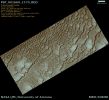
PSP_001660_2570_RED_abrowse.jpgFrost-covered Dunes (Natural Colors; credits: Dr Paolo C. Fienga - Lunexit Team)75 visiteThis image shows Dunes on the Northern Plains of Mars, and appears similar to images taken when the Surface was covered by Frost.
However, CRISM spectra taken at the same time do not show evidence for either water or CO2 frost here. Possibly, and consistent with the CRISM spectra, this area is covered by Dust, obscuring the dark material that is typically present in Dunes of this type.
The orientation of the Dunes indicates that they were formed by winds blowing generally from upper right to lower left. Ripples on the Dunes show that the wind patterns that formed them are more complex, with the dune shapes affecting the wind direction.
It is not known whether these Dunes are currently active (such as if thy're being moved by wind still today) or have been in this location for a very long time; however, if they are indeed covered by Dust, the they cannot have been recently active.
Between the Dunes, the underlying Surface of the Northern Plains can be seen. In places, it has been fractured into polygonal blocks, suggesting that water ice is or was present below the Surface. Meter-size blocks are also seen in places in this image and elsewhere on the Northern Plains.
The origin of these blocks is not known, but they may be remnants of erosion of material that once covered this Region.MareKromium
|
|
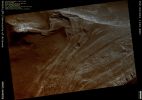
PSP_001662_1520_RED_abrowse.jpgLayered Deposits in Terby Crater (Natural - but enhanced - Colors; credits: Dr Paolo C. Fienga - Lunexit Team)108 visiteTerby Crater is a large (approximately 165 Km), Noachian-aged crater located on the Northern Rim of the Hellas Impact Basin.
Terby hosts a very impressive sequence of predominantly light-toned Layered Deposits, up to 2,5 Km thick that are banked along its Northern Rim and extend toward the center of the Crater.
The full image shows this stack of layered rocks as they are exposed Westward facing scarp. The layered sequence consists of many beds that are repetitive, relatively horizontal and laterally continuous on a kilometer scale. Many beds are strongly jointed and fractured and exhibit evidence of small-scale wind scour.
The light-toned layers are typically at least partially covered with dark mantling material that obscures the layers as well as debris and numerous, meter-scale boulders that have cascaded down slope. The processes responsible for formation of these layers remain a mystery, but could include deposition in water, by the wind, or even volcanic activity.
This HiRISE image is a proposed landing site for the Mars Science Laboratory (MSL) in Terby Crater.MareKromium
|
|

PSP_001666_1530_RED.jpgHolden Crater (Natural Colors; credits: Lunexit)68 visitenessun commentoMareKromium
|
|
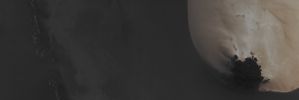
PSP_001700_2505-PCF-LXTT-IPF-01.jpgLouth Crater (CTX Frame - Absolute Natural Colors; credits for the additional process. and color.: Dr Paolo C. Fienga - Lunexit Team)105 visiteThis observation shows a persistent Frost Patch located on a Mound which is inside Louth Crater. The Frost Patch has remained largely stable at least since the Viking era (such as the late 1970s). The bright Frosty Region is bounded by a Dunefield on the North/East and the so-called "Size Classes" of several of the Features forming the Dunefield probably represent generations of Dunes that were created under a variety of Dominant Wind Conditions. The Frost is largely absent over the Dunes, but it is way more stable on the Ground that does not possess Dune-shaped Landforms.
Mars Local Time: 15:14 (Early Afternoon)
Coord. (centered): 70,377° North Lat. and 103,397° East Long.
Spacecraft altitude: 317,5 Km (such as about 198,4 miles)
Original image scale range: 63,5 cm/pixel (with 2 x 2 binning) so objects ~ 1 mt and 91 cm across are resolved
Map projected scale: 50 cm/pixel
Map projection: POLAR STEREOGRAPHIC
Emission Angle: 9,3°
Sun - Mars - MRO (or "Phase") Angle: 56,1°
Solar Incidence Angle: 64° (meaning that the Sun is about 26° above the Local Horizon)
Solar Longitude: 146,4° (Northern Summer - Southern Winter)
Credits: NASA/JPL/University of Arizona
Additional process. and coloring: Lunar Explorer ItaliaMareKromium
|
|

PSP_001700_2505-PCF-LXTT-IPF-02.jpgLouth Crater (EDM - Absolute Natural Colors; credits for the additional process. and color.: Dr Paolo C. Fienga - Lunexit Team)115 visiteThis observation shows a persistent Frost Patch located on a Mound which is inside Louth Crater. The Frost Patch has remained largely stable at least since the Viking era (such as the late 1970s). The bright Frosty Region is bounded by a Dunefield on the North/East and the so-called "Size Classes" of several of the Features forming the Dunefield probably represent generations of Dunes that were created under a variety of Dominant Wind Conditions. The Frost is largely absent over the Dunes, but it is way more stable on the Ground that does not possess Dune-shaped Landforms.
Mars Local Time: 15:14 (Early Afternoon)
Coord. (centered): 70,377° North Lat. and 103,397° East Long.
Spacecraft altitude: 317,5 Km (such as about 198,4 miles)
Original image scale range: 63,5 cm/pixel (with 2 x 2 binning) so objects ~ 1 mt and 91 cm across are resolved
Map projected scale: 50 cm/pixel
Map projection: POLAR STEREOGRAPHIC
Emission Angle: 9,3°
Sun - Mars - MRO (or "Phase") Angle: 56,1°
Solar Incidence Angle: 64° (meaning that the Sun is about 26° above the Local Horizon)
Solar Longitude: 146,4° (Northern Summer - Southern Winter)
Credits: NASA/JPL/University of Arizona
Additional process. and coloring: Lunar Explorer ItaliaMareKromium
|
|

PSP_001700_2505_RED_abrowse-00.jpgThe "Frozen pseudo-Lake" of Vastitas Borealis (CTX Frame - Natural Colors; credits: Dr Paolo C. Fienga - Lunexit Team)89 visiteThe right side (Dx) of this observation shows a portion of a "Frost Patch" on a mound inside a Northern Hemisphere Crater. This is the same frosted mound shown in this image. The Frost Patch has remained largely stable at least since the Viking era (late 1970s).
The bright frost region is bounded by a Dunefield on the N/E. Several sizes of Dunes are visible. The size classes probably represent generations of dunes that formed under a variety of dominant wind conditions.
The EDM shows the Dunes and Frost Boundary up-close. The Frost is largely absent over the Dunes and is more stable over the ground that does not have dune-shaped landforms.
Note Lunexit: il Cratere, che la NASA stessa si affrettò a battezzare "Louth" (nonostante fosse ancora pending l'approvazione del nome da parte dell'International Astronomical Union (IAU) - un'Entità tanto enorme e pesante quanto, nei fatti, inutile...), è tornato ad essere un Cratere senza Nome dell'Emisfero Nord.
Il "presunto" Lago ghiacciato è diventato un "Frost Patch" (lett.: una "chiazza di brina") e le sue caratterizzazioni - ed implicazioni, come a suo tempo espresse dall'ESA - sono...sparite! Nelle pagine NASA (ed ESA, recenti) non vi è traccia di investigazioni o analisi più approfondite su questo - comunque intrigante - Rilievo Superficiale. Nulla.
Il possibile Laghetto del Cratere Louth, Regione di Vastitas Borealis - Marte -, di fatto non solo non esiste (e su questo potremmo anche essere d'accordo, sebbene a malincuore), ma non è MAI esistito (e su questo modo di pensare e di agire, invece, NON SIAMO ASSOLUTAMENTE D'ACCORDO: perchè è scorretto, intrinsecamente contraddittorio, nonchè scientificamente e logicamente viziato).
Curioso, quindi, (e "curioso" è un puro eufemismo) il modo in cui tutta questa storia è stata (mal)trattata dalle "Potenze Spaziali"... Veramente curioso.MareKromium
|
|

PSP_001700_2505_RED_abrowse-01.jpgThe "Frozen pseudo-Lake" of Vastitas Borealis (EDM - Natural Colors; credits: Dr Paolo C. Fienga - Lunexit Team)73 visiteLa parte realmente "interessante" del frame è proprio nella texture della porzione più chiara e profonda del "Frost Patch", perchè è in quel punto della Surface Feature che, volendo, si riesce a vedere qualcosa di significativo e quindi si può anche provare a ragionare e ad osservare con estrema attenzione eppure...eppure la NASA ci mostra le dunette (fangose?) che lo delimitano ed ignora il resto.
Beh, vorrà dire che l'Analisi sulla porzione più "bianca e profonda" del Frost Patch la faremo noi, con calma.
E che i Signori di Pasadena ci scusino tanto per aver osato dubitare della correttezza del loro (pseudo) "Metodo Scientifico"!MareKromium
|
|
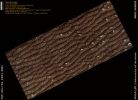
PSP_001736_2605_RED_abrowse.jpgOlympia Undae (Natural Colors; credits for the additional process. and color.: Dr Paolo C. Fienga - Lunexit Team)80 visiteThis observation shows Dark Dunes and light Polygonal Terrain in Olympia Undae, also known as the North Polar Erg.
Two sets of Dunes are obvious. The major set trends North-South, indicating winds from the East or West. Between the crests of these Dunes is a second set oriented mostly East-West.
Zooming in on the Dunes, a rippled texture is apparent, probably due to redistribution of sand at the scale of meters and less. Near the crests of some Dunes are Channel-like features, with some branching downslope. The origin of these Channels is unknown, but they may result from the flow and displacement of sand that was fluidized by sublimating CO2 or water frost.
Bright patches of ground are found in some inter-dune areas, with many having a polygonal texture.
Polygons on Earth form from contraction induced by stresses from dehydration, cooling and other processes, so these features may have a similar origin. The CRISM instrument on MRO and OMEGA on Mars Express indicates that many dunes in Olympia Undae are rich in the mineral Gypsum (---> gesso).MareKromium
|
|
| 2236 immagini su 187 pagina(e) |
 |
|
|
|
|
98 | |
|
|
|
|








