Mars Reconnaissance Orbiter (MRO)
|
|
|

PSP_001501_2280_RED_abrowse-01.jpgThe Viking Lander 2 Landing Site - Gerald Soffen Memorial Station (edm - Natural Colors; credits: Lunar Explorer Italia)68 visiteM.L.T.: 15:14 (early afternoon)
Latitude (centered): 47,7° North and Longitude 134,3° East
Range to target site: 310 Km (approx. 193,8 miles)
Original image scale range: 31 cm/pixel (with 1 x 1 binning) so objects ~93 cm across are resolved
Map projected scale: 25 cm/pixel and North is up
Map projection: EQUIRECTANGULAR
Emission angle: 11,7°
Phase angle: 62,1°
Solar Incidence Angle: 51°, with the Sun about 39° above the Local Horizon
Solar Longitude: 138,7° (Northern Summer) MareKromium
|
|

PSP_001503_1645_RED_abrowse-00.jpgEroding Layers in an Unnamed Southern Crater (CTX Frame - Natural Colors; credits: Dr Paolo C. Fienga - Lunexit Team)65 visiteThis image shows a stack of Rocky Layers on the Floor of an Unnamed Impact Crater, roughly 30 Km across. Many of the layers appear to be extremely thin, and barely resolved.
In broad view, it is clear that the deposit is eroding into a series of Ridges, likely due to the wind.
Below the Ridges, additional dark-toned Layered Deposits crop out. These exhibit a variety of textures, some of which may be due to transport of material.
The light Ridges are often capped by thin Dark Layers, and similar Layers are exposed on the Flanks of the Ridges. These Layers are likely harder than the rest of the material, and so armor the surface against erosion. They are shedding boulders which roll down the slope, as shown in the following EDM.
Although these Cap Layers are relatively resistant, the boulders do not seem to accumulate at the base of the slope, so it is likely that they also disintegrate relatively quickly. MareKromium
|
|

PSP_001503_1645_RED_abrowse-01.jpgEroding Layers in an Unnamed Southern Crater (EDM - Natural Colors; credits: Dr Paolo C. Fienga - Lunexit Team)65 visiteThis EDM is approx. 250 meters wide.
Boulders are visible on the Slopes of the Ridges along with thin Dark Layers including the Cap Layer, but they are absent on the Spurs, where the resistant cover has been eroded.
This demonstrates that the Boulders come only from the Dark Layers, and are not embedded in the rest of the Deposit.MareKromium
|
|

PSP_001507_1400_RED_browse.jpgMantling Material (Natural Colors; credits for the additional process. and color.: Dr Paolo C. Fienga - Lunexit Team)69 visitenessun commentoMareKromium
|
|

PSP_001510_2195_RED_abrowse.jpgAlba Patera (Natural Colors; credits: Lunexit)63 visiteThis HiRISE image shows a small portion of the Rim of the Caldera at the top of the Volcano Alba Patera. This Volcano has shallower slopes than most of the other large Volcanoes on Mars. Unfortunately, this image is not able to help us understand what is unique about Alba Patera because of the thick Dust Cover that covers almost every surface detail but, instead, it shows that the Dust has been carved into streamlined shapes by the wind, cut by small Landslides.
Interestingly, there are some isolated patches that appear smooth and undisturbed by the wind.MareKromium
|
|

PSP_001513_1655_RED_abrowse-00.jpgThe MER Spirit Landing Site (ctx frame - Natural Colors; credits: Lunar Explorer Italia)64 visiteThis HiRISE image shows the Landing Site of the Mars Exploration Rover Spirit. The impact crater in the upper left-hand portion of the image is "Bonneville Crater", which was investigated by Spirit shortly after landing. In the lower right-hand portion of the image is "Husband Hill", a large hill that Spirit climbed and where it spent much of its now nearly five-year mission.
M.L.T.: 15:29 (early afternoon)
Latitude (centered): 14,6° South and Longitude 175,5° East
Range to target site: 270,7 Km (approx. 169,2 miles)
Original image scale range: 27,1 cm/pixel (with 1 x 1 binning) so objects ~81 cm across are resolved
Map projected scale: 25 cm/pixel and North is up
Map projection: EQUIRECTANGULAR
Emission angle: 15,8°
Phase angle: 73,6°
Solar Incidence Angle: 60°, with the Sun about 30° above the Local Horizon
Solar Longitude: 139,1° (Northern Summer)MareKromium
|
|

PSP_001513_1655_RED_abrowse-01.jpgThe MER Spirit Landing Site (edm - Natural Colors; credits: Lunar Explorer Italia)88 visiteThe bright irregularly-shaped feature in area "A" of the image is Spirit's parachute, now lying on the Martian surface. Near the parachute is the cone-shaped "backshell" that helped protect Spirit's lander during its seven-month journey to Mars. The backshell appears relatively undamaged by its impact with the martian surface. Wrinkles and folds in the parachute fabric are clearly visible.
Area "B" of the image shows Spirit's lander. The crater in the upper left-hand portion of the image, just to the northwest of the lander, is the one that the Mars Exploration Rover team named "Sleepy Hollow".
Area "C" shows the damaged remnant of the heat shield that protected the vehicle during the high-speed entry through the Martian atmosphere. The heat shield impacted the surface after being separated from the vehicle during the final stages of the descent.
Area "D" of the image shows the current location of Spirit. Toward the top of the image is "Home Plate", a plateau of layered rocks that Spirit explored during the early part of its third year on Mars. Spirit itself is clearly seen just to the southeast of Home Plate. Also visible are the tracks made by the rover before it arrived at its current location.MareKromium
|
|
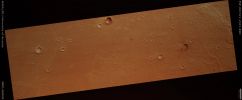
PSP_001521_2025_RED_abrowse-00.jpgThe Viking Lander 1 Landing Site - Thomas Mutch Memorial Station (ctx frame - Natural Colors; credits: Lunar Explorer Italia)64 visiteViking Lander 1 (VL1) touched down in Western Chryse Planitia on July 20, 1976.
The Lander, which has a diameter of about 3 meters, has been precisely located in the HiRISE orbital image, and likely locations have been found for the Heat-Shield, Backshell and Parachute attached to the Backshell.
The Lander location has been confirmed by overlaying the lander-derived topographic contours on the HiRISE image, which provides an excellent match. VL1 was one element of an ambitious mission to study Mars, with a 4-spacecraft flotilla consisting of 2 Orbiters and 2 Landers.MareKromium
|
|
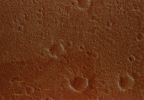
PSP_001521_2025_RED_abrowse-01.jpgThe Viking Lander 1 Landing Site - Thomas Mutch Memorial Station (edm - Natural Colors; credits: Lunar Explorer Italia)75 visiteM.L.T.: 15:20 (early afternoon)
Latitude (centered): 22,3° North and Longitude 312,1° East
Range to target site: 303,3 Km (approx. 189,5 miles)
Original image scale range: 30,3 cm/pixel (with 1 x 1 binning) so objects ~91 cm across are resolved
Map projected scale: 25 cm/pixel and North is up
Map projection: EQUIRECTANGULAR
Emission angle: 21,2°
Phase angle: 68,5°
Solar Incidence Angle: 48°, with the Sun about 42° above the Local Horizon
Solar Longitude: 139,4° (Northern Summer)MareKromium
|
|

PSP_001552_1410_RED_abrowse-02.jpgFrost Covered Gullies in Terra Sirenum (CTX Frame + EDM - Absolute Natural Colors; credits: Dr Paolo C. Fienga - Lunexit Team) 93 visitePSP_001552_1410 shows Gullies in a Unnamed Crater located in Terra Sirenum (Southern Hemisphere of Mars).
This image was acquired during the Winter, which explains the abundant frost (the bright material) seen throughout the image. The frost is likely water frost, as opposed to CO2, because temperatures at this latitude probably do not get cold enough for Carbon Dioxide to condense.
The formation mechanism of Gullies is much debated. Several theories support erosion by liquid water, while others favor dry debris flows or Carbon Dioxide. A major unknown is, if the Gullies are formed by liquid water, does the water originate from the Surface or Subsurface?
Also interesting about this scene is the fact that the Gullies occur at multiple elevations along the same Crater Wall. This is uncommon on Mars. Gullies, whether or not they are found in conjunction with an obvious horizontal layer, usually form at the same elevation on a given slope. It is unknown what caused these Gullies to form at multiple elevations. Their locations are suggestive of a distributed water source, which also favors a Surface, rather than a confined Subsurface origin of water, such as an Aquifer.
Acquisition Date: November, 25th, 2006
Mars Local Time (M.L.T.): 15:40 (Middle Afternoon)
Latitude (centered): 38,9° South
Longitude (East): 195,9 °
Range to Target Site (or Spacecraft Altitude as to the pictured area): 250,5 Km (such as approx. 156,6 miles)
Original Image Scale Range: 50,1 cm/pixel (with 2 x 2 binning) so objects ~150 cm across are resolved
Map Projected Scale: 50 cm/pixel and North is up
Map projection: EQUIRECTANGULAR
Emission Angle: 2,4°
Phase Angle: 76,9°
Solar Incidence Angle: 75° (with the Sun about 15° above the Local Horizon)
Solar Longitude: 140,6° (Northern Summer)MareKromium
|
|

PSP_001558_1325_RED_abrowse.jpgSouthern Dunefield (Natural Colors; credits: Lunexit)64 visitenessun commentoMareKromium
|
|

PSP_001578_1425_RED_abrowse.jpgSouthern Crater with Gullies and a small Landslide (Natural Colors; credits: Lunexit)64 visitenessun commentoMareKromium
|
|
| 2236 immagini su 187 pagina(e) |
 |
|
|
|
|
97 | |
|
|
|
|








