Mars Reconnaissance Orbiter (MRO)
|
|
|

Juventae_Chasma_12m-02.jpgFeatures of Juventae Chasma (3)64 visitenessun commento
|
|
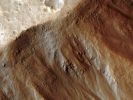
Kasei_Valles-PIA13265.jpgFeatures of Kasei Valles (EDM - Saturated Natural Colors; credits for the additional process. and color.: Dr Paolo C. Fienga - Lunexit Team)65 visiteThis observation from NASA's Mars Reconnaissance Orbiter (MRO) shows the very steep side of a Plateau, part of the Northern Limit of the Kasei Valles System, which is one of the largest Outflow Channel Systems on Mars. The difference in elevation here between the mostly flat Channel's Floor (bottom right) and the top of the Plateau (top left) is over 1300 meters (about 0,8 miles), comparable in height to the Grand Canyon Walls. The Kasei Valles System is much wider than the Grand Canyon, though, getting to be in places approx. 500 Km (such as about 300 miles) wide. (The Grand Canyon's maximum width is approx. 30 Km, or about 18 miles).
This EDM shows numerous paths with the appearance of dotted lines, criss-crossing the steep side of the Plateau. The carving agents can be found at the end of some of these paths: rocky blocks such as the ones in this subset, up to 2 meters (2,2 yards) across (4 meters or 4,4 yards across elsewhere in the image). Some of these blocks traveled downhill several hundred meters (yards) as they rolled and bounced leaving behind a trail of indentations or poke marks in the surface's fine-grained, light-toned soils. The raised borders in some of these poke marks indicate they are relatively recent features, unaffected by wind erosion, or that this soil has cohesive properties, such as if it was cemented.
The sound of these blocks falling did not travel very far, though. According to computer simulations sound in Mars travels only 1,5% (per-cent) the distance it would travel on Earth. (No Martian sound has ever been officially recorded) Hence, the same sound which would travel one Km (0,6 miles) on Earth, would travel only 15 meters (16 yards) on Mars. This is due to the lower Martian Atmospheric Pressure, which is approximately 1% of that of the Earth.MareKromium
|
|

Kunowsky_Crater_-_Sand_Dunes-StripedDunes_HiRISE_1182.jpgStriped Sand Dunes136 visiteCaption NASA:"Why are these sand dunes on Mars striped?
No one is sure.
The featured image shows striped dunes in Kunowsky Crater on Mars, photographed recently with the Mars Reconnaissance Orbiter’s HiRISE Camera.
Many Martian dunes are known to be covered unevenly with carbon dioxide (dry ice) frost, creating patterns of light and dark areas. Carbon dioxide doesn’t melt, but sublimates, turning directly into a gas. Carbon dioxide is also a greenhouse material even as a solid, so it can trap heat under the ice and sublimate from the bottom up, causing geyser-like eruptions. During Martian spring, these eruptions can cause a pattern of dark defrosting spots, where the darker sand is exposed.
The featured image, though, was taken during Martian Autumn, when the weather is getting colder – making these stripes particularly puzzling. One hypothesis is that they are caused by cracks in the ice that form from weaker eruptions or thermal stress as part of the day-night cycle, but research continues.
Watching these dunes and others through more Martian seasons may give us more clues to solve this mystery".MareKromium
|
|
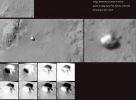
Mars3-MF.jpgIs this "CCCP-Mapc 3" or just a Boulder? (an Image-Mosaic by Dr Marco Faccin)97 visitenessun commentoMareKromium
|
|

MartianTerminator-TRA_000841_1300_RED.jpgHalf in the light and half in the darkness... (possible True Colors; credis: Lunar Explorer Italia)69 visiteCaption NASA originale:"Image TRA_000841_1300 was taken by the High Resolution Imaging Science Experiment (HiRISE) camera onboard the Mars Reconnaissance Orbiter spacecraft on October 1, 2006. The complete image is centered at 49,7° South Lat. and 154,2° East Long. The range to the target site was 248,4 Km (such as about 155,3 miles).
At this distance the image scale is 99,4 cm/pixel (with 4 x 4 binning) so objects ~298 cm across are resolved. The image shown here has been map-projected to 100 cm/pixel and North is up. The image was taken at a MLT of 15:39 and the scene is illuminated from the West with a solar incidence angle of 87°, thus the Sun was about 3° above the horizon.
At a Solar Longitude of 114,2°, the season on Mars is Northern Summer". MareKromium
|
|
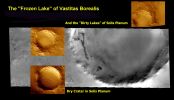
Martian_Lakes_in_Vastitas_Borealis_and_Solis_Planum.jpgWet Craters and Dry Craters: a Visual Comparison64 visitenessun commento
|
|

Mawrth_Vallis-PIA01924-PCF-LXTT.jpgMineral Diversity in Mawrth Vallis (Absolute Natural Colors; credits for the additional process. and color.: Dr Paolo C. Fienga - Lunexit Team)352 visitenessun commentoMareKromium
|
|
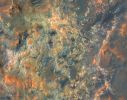
Mawrth_Vallis-PIA01924.jpgThe colors of Mawrth Vallis (False Colors; credits: NASA/JPL-Caltech/Univ. of Arizona)67 visiteCaption NASA originale:"This view shows diverse materials and morphologies in the region south of Mawrth Vallis on Mars. The color is composed of infrared, red, and blue-green color images, and has been enhanced to accentuate the color differences. The bright material may be rich in clays and date back to a time when Mars had a wetter environment. This is a sub-image of a larger view imaged by the High Resolution Imaging Science Experiment (HiRISE) on NASA's Mars Reconnaissance Orbiter on Oct. 1, 2006. The resolution is 25 centimeters (10 inches) per pixel, and the scene is 352 meters (385 yards) wide".
|
|

Mawrth_Vallis-The_Pyramid-GIF.gifZooming on a "Pseudo-Pyramid" - Mawrth Vallis (GIF-Movie, by Carlo Contu)95 visiteAcquisition date: January, 05, 2007
Local Mars Time: 15:32
Latitude: 22,5° North
Longitude: 341,8° East
Range to target site: 286,8 Km
Original image scale range: 28,7 cm/pixel (with 1 x 1 binning) so objects ~86 cm across are resolved
Emission angle: 6,3 °
Phase angle: 59,4 °
Solar incidence angle: 53°, with the Sun about 37° above the horizon MareKromium
|
|
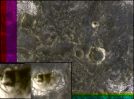
Mawrth_Vallis-The_Pyramid-HSol.jpgThe "Pseudo-Pyramid" of Mawrth Vallis (credits: Dr M. Faccin)122 visiteEd ecco qui, in versione a colori naturali ed extra-magnificata, la pseudo-piramide di Mawrth Vallis.
Opera della Natura? Opera "Artificiale"? Secondo noi, si tratta di un rilievo assolutamente particolare, questo è certo, e quindi da studiare. Ma il fatto di scendere ulteriormente in dettaglio e parlare di "artificialità", visti gli elementi (scarsissimi!) che abbiamo a disposizione, a nostro - onesto - parere, sembra eccessivo (e l'idea di restare colpiti anche noi dalla "Sindrome di' Hoagland", sinceramente, non ci riempie di gioia...).
Sempre complimenti al Dr Faccin per l'elaborazione ed all'ottimo Carlo Contu, per l'individuazione del rilievo.MareKromium
|
|

Mawrth_Vallis-The_Waterfall-CC.gifZooming on the "Waterfall" - Mawrth Vallis (GIF-Movie, by Carlo Contu)78 visiteAcquisition date: January, 04, 2008
Local Mars Time: 14:19
Latitude: 23,0° North
Longitude: 341,6° East
Range to target site: 309,9 Km
Original image scale range: 31 cm/pixel (with 1 x 1 binning) so objects ~93 cm across are resolved
Map projected scale: 25 cm/pixel and North is up
Map projection: EQUIRECTANGULAR
Emission angle: 22,7°
Phase angle: 60,1°
Solar incidence angle: 38°, with the Sun about 52° above the horizonMareKromium
|
|
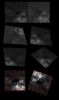
Mawrth_Vallis.jpgExtremely unusually-looking Surface Feature in Mawrth Vallis (an Image-Mosaic by Dr Marco Faccin - Lunexit Team)118 visitenessun commentoMareKromium
|
|
| 2236 immagini su 187 pagina(e) |
 |
|
|
|
|
89 | |
|
|
|
|








