Mars Reconnaissance Orbiter (MRO)
|
|
|

ESP_020893_1615_RED_abrowse.jpgAlmost "Invisible": Unnamed Craters in Solis Planum (Natural Colors; credits for the additional process. and color.: Dr Paolo C. Fienga - Lunexit Team)188 visitenessun commentoMareKromium
|
|
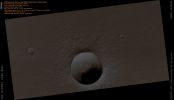
ESP_020897_2040_RED_abrowse.jpgUnnamed Crater on the Distal Eastern Flank of Elysium Mons (Absolute Natural Colors; credits for the additional process. and color.: Dr Paolo C. Fienga - Lunexit Team)215 visitenessun commentoMareKromium
|
|

ESP_020904_1595_RED_abrowse.jpgSouthern Margaritifer Terra (Natural Colors; credits for the additional process. and color.: Dr Paolo C. Fienga - Lunexit Team)187 visitenessun commentoMareKromium
|
|

ESP_020904_2005_RED_abrowse-PCF-LXTT.jpgHamelin Crater and Unnamed "Companion" (Absolute Natural Colors; credits for the additional process. and color.: Dr Paolo C. Fienga - Lunexit Team)229 visitenessun commentoMareKromium
|
|

ESP_020916_1695_RED_abrowse-PCF-LXTT.jpgUnnamed Crater within Madler Crater (Absolute Natural Colors; credits for the additional process. and color.: Dr Paolo C. Fienga - Lunexit Team)188 visitenessun commentoMareKromium
|
|

ESP_020917_2075_RED_abrowse-PCF-LXTT.jpgUnnamed Craters in Acidalia Planitia (Absolute Natural Colors; credits for the additional process. and color.: Dr Paolo C. Fienga - Lunexit Team)256 visitenessun commentoMareKromium
|
|

ESP_020918_1400_RED_abrowse.jpgOutcrops in the Southern Latitudes (Natural Colors; credits for the additional process. and color.: Dr Paolo C. Fienga - Lunexit Team)333 visitenessun commentoMareKromium
|
|

ESP_020919_1525_RED_abrowse.jpgUnnamed Crater and possible "Olivine" Deposits in Solis Planum (Absolute Natural Colors; credits for the additional process. and coloring: Dr Paolo C. Fienga - Lunexit Team)211 visitenessun commentoMareKromium
|
|

ESP_020922_1635_RED_abrowse.jpgProximities of Gratteri Crater (Absolute Natural Colors; credits: Dr Paolo C. Fienga - Lunexit Team)277 visiteCaption NASA:"Gratteri Crater, located about 150 Km to the South-East, ejected rocks that created millions of Secondary Craters over a Region at least 500 Km wide.
Many of these Secondary Craters are concentrated in "Rays", or lines extending radially from the Primary Impact Area (such as the "Gratteri Crater" Area).
Crater Rays on the Moon are typically bright at visible wavelengths, but on Mars they are often best seen in the Thermal InfraRed wavelengths, from temperature contrasts. This image confirms that this Ray contains many Secondary Craters (they are the small, sharp-rimmed Craters). Since millions of Secondary Craters form at once, they all have the same age and same degree of modification over time. Understanding the distribution of secondary craters provides information about impact processes, including escape of rocks that could become Martian meteorites on Earth".MareKromium
|
|

ESP_020924_1455_RED_abrowse.jpgTriple (Simultaneous) Impact (Absolute Natural Colors; credits for the additional process. and color.: Dr Paolo C. Fienga - Lunexit Team)601 visitenessun commentoMareKromium
|
|

ESP_020926_1815_RED_abrowse-PCF-LXTT.jpgLibya Montes (Absolute Natural Colors; credits: Dr Paolo C. Fienga - Lunexit Team)324 visitenessun commentoMareKromium
|
|

ESP_020929_1360_RED_abrowse.jpgUplifted Bedrock (Absolute Natural Colors; credits for the additional process. and color.: Dr Paolo C. Fienga - Lunexit Team)352 visiteCaption NASA:"Large Impact Craters expose deep Bedrock. After the transient cavity forms, the Crater Floor rebounds and creates a permanent structural Uplift, typically equivalent to about 10% of the Crater diameter.
A Crater approx. 70 Km (43,47 miles) wide like this one, can raise up and expose Bedrock that was approx. 7 Km (4,34 miles) lower in elevation prior to the Impact.
Deeper rocks are usually older, and on Mars the oldest rocks are interesting because they are more likely to have been altered by water and provide clues to ancient environments and processes. This image reveals good Bedrock exposures with diverse rock types (as indicated by colors and textures)".MareKromium
|
|
| 2236 immagini su 187 pagina(e) |
 |
|
|
|
|
46 | |
|
|
|
|








