| |

Mars Reconnaissance Orbiter (MRO)
|
|
|

Craters-Rabe_Crater-PIA13728-PCF-LXTT-1.jpgInside Rabe Crater - Summertime (Absolute Natural Colors; credits for the additional process. and color.: Dr Paolo C. Fienga - Lunexit Team)102 visitenessun commentoMareKromium
|
|

Craters-Rabe_Crater-PIA13728-PCF-LXTT-2.jpgInside Rabe Crater - Springtime (Absolute Natural Colors; credits for the additional process. and color.: Dr Paolo C. Fienga - Lunexit Team)98 visitenessun commentoMareKromium
|
|

Craters-Rabe_Crater-PIA13728-PCF-LXTT-3.jpgInside Rabe Crater - Wintertime (Absolute Natural Colors; credits for the additional process. and color.: Dr Paolo C. Fienga - Lunexit Team)108 visitenessun commentoMareKromium
|
|
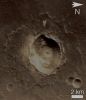
Craters-Unnamed_Crater-Arabia_Terra-1.jpgMartian "Love" (EDM - Absolute Natural Colors; credits for the additional process. and color.: Dr Paolo C. Fienga - Lunexit Team)104 visiteis picture of a "heart-shaped" feature in Arabia Terra on Mars was taken on May 23, 2010, by the Context Camera (CTX) on NASA's Mars Reconnaissance Orbiter. A small Impact Crater near the tip of the heart is responsible for the formation of the bright, heart-shaped feature. When the impact occurred, darker material on the Surface was blown away while brighter material beneath it was revealed.
Some of this brighter material appears to have flowed further downslope to form the heart, as the small impact occurred on the Ejecta Blanket of a much larger Impact Crater.
The heart-shaped feature is about 1 Km (0,6 mile) long and is centered at 21,9° North Lat. and 12,7° West Long.
These pictures are subframes of the full CTX image B21_017910_2002_XI_20N012W, taken just at the start of Northern Summer on Mars. North is to the right, and illumination is from the upper right.MareKromium
|
|

Craters-Unnamed_Crater-Arabia_Terra-2.jpgMartian "Love" (EDM - Absolute Natural Colors; credits for the additional process. and color.: Dr Paolo C. Fienga - Lunexit Team)111 visiteThis picture of a "heart-shaped" feature in Arabia Terra on Mars was taken on May 23, 2010, by the Context Camera (CTX) on NASA's Mars Reconnaissance Orbiter. A small Impact Crater near the tip of the heart is responsible for the formation of the bright, heart-shaped feature. When the impact occurred, darker material on the Surface was blown away while brighter material beneath it was revealed.
Some of this brighter material appears to have flowed further downslope to form the heart, as the small impact occurred on the Ejecta Blanket of a much larger Impact Crater.
The heart-shaped feature is about 1 Km (0,6 mile) long and is centered at 21,9° North Lat. and 12,7° West Long.
These pictures are subframes of the full CTX image B21_017910_2002_XI_20N012W, taken just at the start of northern summer on Mars. North is to the right, and illumination is from the upper right.MareKromium
|
|

Craters-Unnamed_Crater-ESP_017975_1705-PCF-LXTT-IPF.jpgUnnamed Crater with Ridges (Absolute Natural Colors; credits for the additional process. and color.: Dr Paolo C. Fienga/Lunar Explorer Italia/Italian Planetary Foundation)85 visiteMars Local Time: 15:20 (Early Afternoon)
Coord. (centered): 9,515° South Lat. and 16,433° East Long.
Spacecraft altitude: 261,3 Km (such as about 162,267 miles)
Original image scale range: 52,3 cm/pixel (with 2 x 2 binning) so objects ~ 1 mt and 57 cm across are resolved
Map projected scale: 50 cm/pixel
Map projection: EQUIRECTANGULAR
Emission Angle: 0,7°
Phase Angle: 60,4°
Solar Incidence Angle: 60° (meaning that the Sun was about 30° above the Local Horizon at the time the picture was taken)
Solar Longitude: 96,6° (Northern Summer - Southern Winter)
Credits: NASA/JPL/University of Arizona
Additional process. and coloring: Lunar Explorer Italia
This picture (which is a NASA - Original Mars Reconnaissance Orbiter NON-Map Projected CTX b/w frame identified by the serial n. ESP_025557_1705) has been additionally processed and then colorized in Absolute Natural Colors (such as the colors that a human eye would actually perceive if someone were onboard the NASA - Mars Reconnaissance Orbiter and then looked down, towards the Surface of Mars), by using an original technique created - and, in time, dramatically improved - by the Lunar Explorer Italia Team.MareKromium
|
|

Craters-Unnamed_Crater_in_Terra_Sirenum_12m-00.jpgCrater in Terra Sirenum (1)66 visiteThe largest number of gullies on Mars occur on the walls of southern hemisphere craters. During southern winter, many of the gullied walls are in shadow. It has been known for many years from Mars Global Surveyor Mars Orbiter Camera images that frost forms on these shadowed slopes and that differences in the amount or nature of the frost deposits highlight the gully floors and deposits. Such differences may occur because the materials are of different particle sizes, or have other differing attributes that affect their thermophysical properties. To investigate this phenomenon, CTX acquired this image of a crater at 39.3°S, 136.5°W, where gullies were known to display frost during winter. To see the gullies, download the image and view it in an image processing program, as they are nearly invisible in the normal contrast image.
|
|

Craters-Unnamed_Crater_in_Terra_Sirenum_12m-01.jpgCrater in Terra Sirenum (2) - natural colors79 visiteDuring its first week of observations from low orbit, NASA's newest Mars spacecraft is already revealing new clues about both recent and ancient environments on the red planet.
Scientists hope the Mars Reconnaissance Orbiter will answer questions about the history and distribution of Mars' water by combining data from the orbiter's high-resolution camera, imaging spectrometer, context camera, ground-penetrating radar, atmospheric sounder, global color camera, radio and accelerometers.
Between Sept. 29 and Oct. 6, science instruments on the spacecraft viewed dozens of sites that reflect different episodes in Mars' history. The diverse sites provide a good test for the capabilities of the spacecraft instruments. The orbiter will begin its primary science mission phase in early November when Mars re-emerges from passing nearly behind the sun.
The instruments are seeing details in the shapes and icy composition of geologically young layering near the Martian north pole. Other views offer details of a mid-latitude valley whose upper layers have been eroded away, revealing an underlying clay layer that formed a few billion years ago, when wet conditions produced the clay. Observations of a southern-hemisphere crater show fine-scale details of more recent gullies, adding evidence that they were carved by flowing water.
"In this opening phase we have tested the instruments, and they are working perfectly," said Dr. Steve Saunders, Mars Reconnaissance Orbiter program scientist at NASA Headquarters, Washington. "The teams are getting amazing science data. They are ready to fulfill the mission's science objectives and to support other Mars missions. One image is already helping the Mars Exploration Rover team choose a route to explore Victoria Crater. Others will help guide the selection of a safe site for the future Phoenix Mars Lander."
In Chasma Boreale, a vast valley that juts into the north polar ice cap, the orbiter's spectrometer sees layers that vary in soil composition and in how much ice is mixed with the soil. A dark underlying layer contains little ice, but just beneath it lies ice-rich material resembling higher layers. The spectrometer takes pictures both in visible-light and infrared wavelengths useful for identifying what a target is made of.
"You see more-ice-rich and less-ice-rich layers, which tells you that conditions changed from the time one layer was deposited to the time another layer was deposited," said Dr. Scott Murchie of Johns Hopkins University Applied Physics Laboratory, Laurel, Md. Murchie is the principal investigator for the spectrometer on the spacecraft. "These layers are geologically young -- on the order of thousands or millions of years -- and may hold clues about climate cycles."
A lower-latitude target was Mawrth Vallis. The European Mars Express spacecraft previously discovered ancient deposits of clay minerals that could form only if water were present for a long time at Mawrth Vallis. The Mars Reconnaissance Orbiter's spectrometer has resolved smaller-scale compositional features and detected differing clay mineral content. The clay-rich areas show some of the best evidence for conditions possibly favorable for life on ancient Mars, Murchie said.
The mission's High Resolution Imaging Science Experiment camera has shown unprecedented detail in orbital images of Mars. An example was released recently showing the Opportunity rover at Victoria Crater. The camera imaged 64 areas on Mars during the testing week. "These images are truly beautiful, and since they resolve features the size of people, you can visualize yourself hiking around in these diverse terrains," said the camera's principal investigator, Dr. Alfred McEwen of the University of Arizona, Tucson.
The high-resolution camera, the imaging spectrometer and the orbiter's wider-looking Context Camera all observed Mawrth Vallis. Details visible in the new observations, such as small channels, are consistent with past wet conditions, McEwen said.
Another observation of an unnamed southern crater shows relatively young gullies, like those seen in many Mars locations viewed by NASA's Mars Global Surveyor orbiter. Braided channels characteristic of sediment-rich streams are visible in the new observations. This reinforces the interpretation that these geologically young gullies formed at least in part from erosion by flowing water. Original discovery of the many geologically young gullies on Martian slopes was by Dr. Michael Malin of Malin Space Science Systems, San Diego.
The Mars Reconnaissance Orbiter is managed by the Jet Propulsion Laboratory, Pasadena, Calif., for NASA's Science Mission Directorate, Washington.
|
|

Craters-Unnamed_Crater_with_Gullies.jpgGullies, from MRO65 visitenessun commentoMareKromium
|
|

Craters-Unnamed_Craters-ESP_031292_1295-PCF-LXTT-IPF.jpgUnnamed Craters in Hellas Planitia (Absolute Natural Colors; credits for the additional process. and color.: Dr Paolo C. Fienga/Lunar Explorer Italia/Italian Planetary Foundation)85 visiteIn this frame, taken by the NASA - Mars Reconnaissance Orbiter on March, 30, 2013 and showing us a small portion of the Southern Martian Region known as Hellas Planitia, we can see - litterally lost in a "Sea" of Sand that has also been heavily marked by the passage of a countless number of Dust Devils - two relatively small Unnamed Impact Craters which are going through two very different (and very distant, in terms of time) moments of their evolution.
Barely visible, on the left (Sx) side of the picture, there is an extremely old and now almost completely "Buried Impact Crater", whose Rim, however, can still be discerned from the surrounding landscape; on the right (Dx) side of the frame, instead, a way more recent Unnamed Impact Crater that shows a very well defined (and therefore - of course, always relatively speaking - "fresh") Rim, with signs of a Landslide, that has occurred on its Inner Southern Slope, and also with what appears to be just a hint of a light-colored Windstreak on its Northern Outer Rim. Also a few Gullies can be spotted in several locations of the Inner Slopes of the Crater (particularly on its North-facing Inner Rim and Slope).
Mars Local Time: 14:37 (Early Afternoon)
Coord. (centered): 50,284° South Lat. and 54,671° East Long.
Spacecraft altitude: 255,9 Km (such as about 158,913 miles)
Original image scale range: 51,2 cm/pixel (with 2 x 2 binning) so objects ~ 1 mt and 54 cm across are resolved
Map projected scale: 50 cm/pixel
Map projection: EQUIRECTANGULAR
Emission Angle: 1,6°
Phase Angle: 42,2°
Solar Incidence Angle: 41° (meaning that the Sun was about 49° above the Local Horizon at the time the picture was taken)
Solar Longitude: 292,3° (Northern Winter - Southern Summer)
Credits: NASA/JPL/University of Arizona
Additional process. and coloring: Lunar Explorer Italia
This picture (which has been cropped from a NASA - Original Mars Reconnaissance Orbiter NON-Map Projected CTX b/w frame identified by the serial n. ESP_031292_1295) has also been additionally processed and then colorized in Absolute Natural Colors (such as the colors that a human eye would actually perceive if someone were onboard the NASA - Mars Reconnaissance Orbiter and then looked down, towards the Surface of Mars - Region of Hellas Planitia), by using an original technique created - and, in time, dramatically improved - by the Lunar Explorer Italia Team.MareKromium
|
|

Craters-Unnamed_Southern_Impact_Crater_with_colorful_Layers-ESP_028693_1535-CTX-EDM-PCF-LXTT-IPF-1.jpgUnnamed Southern Impact Crater with Colorful Layers (Absolute Natural Colors; credits for the additional process. and color.: Dr Paolo C. Fienga - Lunar Explorer Italia/Italian Planetary Foundation)127 visiteThis image, obtained by the NASA - Mars Reconnaissance Orbiter (HiRISE Camera), shows us a wide portion of a relatively recent (geologically speaking, of course...) Impact Crater, located in the Southern Hemisphere of the Red Planet, and which is about 7 Km wide. Partway down from (but still quite close to) the Crater Rim, there is a prominent bright Layer of Bedrock. The full-resolution color data shows three distinct Bedrock colors: a pale yellow, a light greenish-gray and a very dark blue (almost black, in Absolute Natural Colors). These Layers should reasonably correspond to different types of Rock that, in time, were deposited as nearly flat-lying sheets; nobody can be sure, but - perhaps - this "colorful" Layering is a combination of Lava Flows and Sediments. The relatively blue and dark blue colors visible in the HiRISE InfraRed Color Frame (not shown here and which, in the Absolute Natural Colors' EDM - inset -, appear as greenish-gray and extremely dark blue to almost black) might correspond to Minerals like Olivine and Pyroxene, which can easily be found, among others, in some specific types of Lava.
Mars Local Time: 15:39 (Middle Afternoon)
Coord. (centered): 26,092° South Lat. and 88,942° East Long.
Spacecraft altitude: 257,7 Km (such as about 161,0 miles)
Original image scale range: 51,6 cm/pixel (with 2 x 2 binning) so objects ~ 1 mt and 55 cm across are resolved
Map projected scale: 50 cm/pixel
Map projection: EQUIRECTANGULAR
Emission Angle: 5,0°
Phase Angle: 66,0°
Solar Incidence Angle: 61° (meaning that the Sun was about 29° above the Local Horizon at the time the picture was taken)
Solar Longitude: 168,7° (Northern Summer - Southern Winter)
Credits: NASA/JPL/University of Arizona
Additional process. and coloring: Lunar Explorer Italia
These two pictures (which are a NASA - Original Mars Reconnaissance Orbiter CTX b/w and EDM color frames, both identified by the serial n. ESP_028693_1535) have been additionally processed and then colorized (and re-colorized, respectively) in Absolute Natural Colors (such as the colors that a human eye would actually perceive if someone were onboard the NASA - Mars Reconnaissance Orbiter and then looked down, towards the Surface of Mars), by using an original technique created - and, in time, dramatically improved - by the Lunar Explorer Italia Team.MareKromium
|
|

Craters-Victoria_Crater-PIA12167.jpgVictoria Crater (Natural Colors; credits: Lunexit)72 visiteThis image of Victoria Crater in the Meridiani Planum Region of Mars was taken by the High Resolution Imaging Science Experiment (HiRISE) camera on NASA's Mars Reconnaissance Orbiter at more of a sideways angle than earlier orbital images of this feature.
The camera pointing was 22° East of straight down, yielding a view comparable to looking at the landscape out an airplane window. East is at the top. The most interesting exposures of geological strata are in the steep walls of the Crater, difficult to see from straight overhead.
Especially prominent in this oblique view is a bright band near the top of the Crater wall.
Earlier HiRISE images of Victoria Crater supported the exploration of this Crater by NASA's Opportunity Rover and contributed to joint scientific studies. Opportunity explored the Rim and interior of this 800-meter-wide (about 0,5-mile-wide) Crater from September 2006 through August 2008.
The Rover's on-site investigations indicated that the bright band near the top of the Crater wall was formed by diagenesis (chemical and physical changes in sediments after deposition). The bright band separates bedrock from the material displaced by the impact that dug the Crater.
This view is a cutout from a HiRISE exposure taken on July 18, 2009. Some of Opportunity's Tracks are still visible to the North of the Crater (left side of this cutout).
Full-frame images from this HiRISE observation, catalogued as ESP_013954_1780, are at http://hirise.lpl.arizona.edu/ESP_013954_1780.
The full-frame image is centered at 2,1° South Latitude and 354,5° East Longitude. It was taken at 2:31 p.m. Local Mars Time. The scene is illuminated from the West with the Sun about 49° above the Local Horizon (therefore the S.I.A. was about 41°).MareKromium
|
|
| 2236 immagini su 187 pagina(e) |
|
|
4 | |
|
|
|
|
|
|
|
|
|








