Mars Reconnaissance Orbiter (MRO)
|
|
|

ESP_014436_0920_RED_abrowse-00.jpgIcy Impact (CTX Frame - Natural Colors; credits: Lunexit)77 visiteA thick (approx. 3 Km or a little less than 2 miles) sequence of ice and dust, stacked like a layer cake, covers the South Pole of Mars. Impact craters that form here experience slightly different processes of modification and degradation than those that form in rocky areas.
One example of such a process is sublimation. Most of the material that makes up an icy crater is volatile, meaning it can melt or sublimate (change directly from a solid to a gas) if heated. Sublimation is more common on Mars because of its thin and dry Atmosphere.
Crater walls facing the Sun receive more direct light than their surroundings, and are therefore more easily warmed. If the ice in the walls sublimates, the rim structure of the crater becomes degraded.MareKromium
|
|
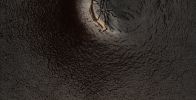
ESP_014436_0920_RED_abrowse-01.jpgIcy Impact (EDM - Natural Colors; credits: Lunexit)75 visiteThe Impact Crater in this image is roughly 900 meters (a little over 0,5 mile) across.
The remaining Raised Rim of the Crater is illuminated from the bottom right of the image, causing preferential heating of the interior of the Rim structure.
The ice appears thin here (more brown material is exposed), with an even thinner cover on the remaining exterior Rim.
This could be caused by a number of possibilities: perhaps the Exterior Wall is steeper than the Interior Wall, resulting in more direct exposure to sunlight, causing more efficient sublimation when the Sun shines on that Wall.
Once ice begins to melt, darker dustier material is exposed. The darker material absorbs more heat than white ice (just like standing in the Sun wearing a black shirt makes you warmer than wearing a white shirt, which reflects the Sun's light), causing more and more ice to sublimate near the dark material.MareKromium
|
|
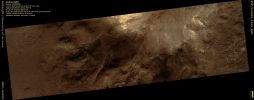
ESP_014439_1505_RED_abrowse.jpgCentral Uplift (Natural Colors; credits: Lunexit)66 visitenessun commentoMareKromium
|
|
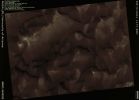
ESP_014441_1275_RED_abrowse.jpgHellespontus' Dunefield (Natural Colors; credits: Lunexit)64 visitenessun commentoMareKromium
|
|
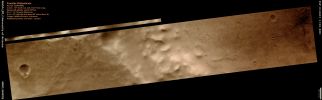
ESP_014447_1720_RED_abrowse.jpgPossible Phillosilicate (Natural Colors; credits: Lunexit)67 visitenessun commentoMareKromium
|
|
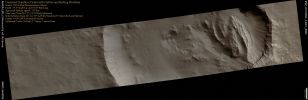
ESP_015900_1465_RED_abrowse-00-PCF-LXTT.jpgUnnamed Southern Crater with Gullies, Rolling Boulders and Dunes (CTX Frame - Absolute Natural Colors; credits for the additional process. and color.: Dr Paolo C. Fienga - Lunexit Team)335 visiteCaption NASA:"Although this image was primarily taken to study the Gullies in the Inner Walls of the Crater, it also reveals a few other interesting things.
Near the Gullies in the Northern Wall of the Crater, for instance, some Boulders have bounced down the Slope, leaving trails of Hollows along their paths (see EDM n. 1).MareKromium
|
|

ESP_015900_1465_RED_abrowse-01-PCF-LXTT.jpgUnnamed Southern Crater with Gullies, Rolling Boulders and Dunes (EDM n. 1 - Absolute Natural Colors; credits for the additional process. and color.: Dr Paolo C. Fienga - Lunexit Team)368 visitenessun commentoMareKromium
|
|

ESP_015900_1465_RED_abrowse-02-PCF-LXTT.jpgUnnamed Southern Crater with Gullies, Rolling Boulders and Dunes (EDM n. 2 - Absolute Natural Colors; credits for the additional process. and color.: Dr Paolo C. Fienga - Lunexit Team)386 visiteCaption NASA:"This image shows a nice example of different types of Dunes in close proximity to each other: North is at roughly 03:00 in this EDM.
On either side of the Mound - which is located on the Southern End of the Crater Floor - there are different types of Dunes. On the Southern side of the mound (left side of the EDM), there are "Star Dunes" (named for the Star-like Intersections of their Crests). These types of Dunes are usually formed when the wind blows in multiple directions.
On the Northern side of the Mound (the right when looking at the EDM), there are simpler Dune shapes, forming roughly straight, parallel lines. Notice that the same side of each Dune is steeper. These are called Linear Dunes, and are formed by wind blowing mainly parallel to the direction of their Crests, probably with some variation to one side or the other that causes the asymmetrical Slopes. The Linear Dunes transition to the Star Dunes near the Mound.
Since the main factor controlling which type of Dunes are formed is the (Dominant) Winds' Direction, there must have been different Wind Directions in this area (for instance, it is very likely that significant whirlpools were caused by the wind blowing around the Mound or also when they interacted with the nearby Crater Wall).MareKromium
|
|
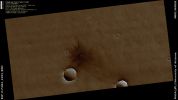
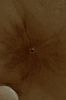
ESP_015962_1695_RED_abrowse-00.jpgRelatively fresh Impact Crater (CTX Frame - Natural Colors; credits: Dr Paolo C. Fienga - Lunexit Team)82 visiteThis image shows a very fresh-looking Impact Crater with an extensive Radial Ejecta Blanket.
The Crater was first seen in an image acquired with MRO's Context Camera (CTX). The best image of this Region prior to CTX was from one of the Viking Orbiters, and the Crater is not visible in it.
This could either mean that the Crater formed sometime between 1976 and 1999, or that there might have been more Dust on the Surface in 1976, or that maybe the air could have been hazy, thus obscuring the Crater.
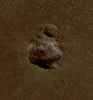
Based on the HiRISE image, we suspect that the Crater is more than several decades old, because at full resolution we see a "Textured Surface" (see EDM n.2) that is common in Dust-Mantled Regions of Mars, but absent in the youngest craters.MareKromium
|
|
ESP_015962_1695_RED_abrowse-01.jpgRelatively fresh Impact Crater (EDM n.1 - Natural Colors; credits: Dr Paolo C. Fienga - Lunexit Team)78 visitenessun commentoMareKromium
|
|
ESP_015962_1695_RED_abrowse-02.jpgRelatively fresh Impact Crater (EDM n.2 - Natural Colors; credits: Dr Paolo C. Fienga - Lunexit Team)68 visitenessun commentoMareKromium
|
|
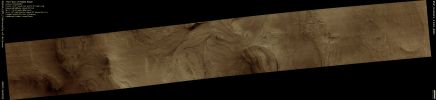
ESP_016022_1420_RED_abrowse-00.jpgThe Floor of Hellas Basin (CTX Frame - Natural Colors; credits: Dr Paolo C. Fienga - Lunexit Team)69 visiteHiRISE images are revealing some very strange landforms on the Floor of Hellas. Materials appear to have flowed in a viscous manner, like ice.
Viscous flow features are common over the Middle Latitudes of Mars, but those in Hellas are often distinctive for unknown reasons.
MareKromium
|
|
| 2236 immagini su 187 pagina(e) |
 |
|
|
|
|
29 | |
|
|
|
|








