Mars Reconnaissance Orbiter (MRO)
|
|
|

ESP_014404_1275-GB-LXT-03.jpgExtremely Unusual Surface Feature in Argyre Planitia (Natural Colors - SuperEDM n.2 - credits: Dr G. Barca & Lunexit)63 visitenessun commentoMareKromium
|
|

ESP_014404_1275-GB-LXT-04.jpgExtremely Unusual Surface Feature in Argyre Planitia (Natural Colors - SuperEDM n.3 - credits: Dr G. Barca & Lunexit)76 visiteA nostro parere, grazie a quest'ultimo EDM (ottenuto dal nostro grande Amico e Partner, Dr G. Barca), la natura della Surface Feature può essere accertata con un elevatissimo margine di sicurezza: si tratta della traccia di un impatto (sui generis).
Un impatto recentissimo, il quale ha visto la disintegrazione (probabilmente l'esplosione) del bolide negli immediati pressi del suolo (il che significa, in altre parole, che l'impatto, si, c'è stato, ma solo fra i detriti derivati dall'esplosione - con traccia della fiammata al suolo - ma SENZA una collisione vera e propria tra il bolide - che doveva essere piccolo e leggero - e la superficie).
Secondo noi, il "mistero" è risolto. Ma se Voi aveste opinioni in merito...scrivete!MareKromium
|
|
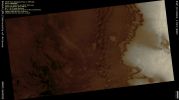
ESP_014404_1765_RED_abrowse-00.jpgUSGS Dune Database Entry Number 3076-032 (Natural Colors; credits: Lunexit)66 visitenessun commentoMareKromium
|
|
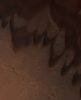
ESP_014404_1765_RED_abrowse-01.jpgEquatorial Martian Barchans (EDM - Natural Colors; credits: NASA/JPL/Univ. of Arizona)64 visiteBarchan Dunes are common on both Earth and Mars. These Dunes are very distinctive in shape, and are important because they can tell scientists about the environment in which they formed.
Barchans form in wind regimes that blow in one Dominant Direction. The ridged arcs of sand that define the Barchan Dunes end in horns that point downwind. Sand is transported up the broad, relatively shallow windward slopes and once it overtops the Dune Crest, the sand falls down a shorter steeper slope between the horns, known as the "Slip Face". Over time, the Barchans migrate downwind, following their horns.
This HiRISE image shows an example of several Barchans merging to form an even larger Barchan Dune. This can happen through a variety of circumstances, such as when smaller, faster dunes collide with larger, slower-moving dunes that absorb them, resulting in single, larger dunes. The distance between the merging horns of the large dune in this highlighted region is a little over 500 meters (about 1600 feet).
Coord.: 3,3° South Lat. and 307,6° East Long.
Spacecraft altitude: about 268 Km
M.L.T.: 14:17 (early afternoon)
S.I.A.: 36° (with the Sun about 54° abov the Local Horizon)
MareKromium
|
|
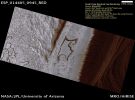
ESP_014405_0945_RED_abrowse.jpgSouth Polar Residual Cap Monitoring (Natural Colors; credits: Lunexit)70 visitenessun commentoMareKromium
|
|
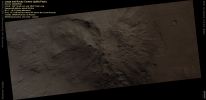
ESP_014410_1470_RED_abrowse.jpgUnnamed Crater with Rocky central Uplift (Natural Colors; credits: Lunexit)67 visitenessun commentoMareKromium
|
|
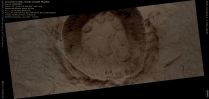
ESP_014412_1780_RED_abrowse.jpgUnnamed Crater with Deep Gullies (Absolute Natural Colors; credits for the additional process. and color.: Dr Paolo C. Fienga - Lunexit Team)265 visitenessun commentoMareKromium
|
|
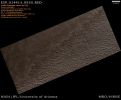
ESP_014413_0930_RED_abrowse-00.jpgRadial Channels carved by CO2 - a.k.a.: The "Spiders" (CTX Frame - Natural Colors; credits: Lunexit)75 visiteMars’ Carbon Dioxide-based Atmosphere partially condenses every Winter to form Polar Caps of Dry Ice (CO2). In the Spring, the evaporation/sublimation of the ice is a dynamic process and carves Channels into the ground as it escapes back into the Atmosphere.
Often these Channels are radial in nature and are colloquially refered to as “Spiders” although the prefered term for these radially-organized channels is “Araneiform” (which means spider-like).MareKromium
|
|
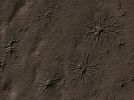
ESP_014413_0930_RED_abrowse-01.jpgRadial Channels carved by CO2 - a.k.a.: The "Spiders" (EDM - Natural Colors; credits: Lunexit)76 visiteIn this EDM we can see, now that all the seasonal frost is gone, the actual appearence of the "Spiders" and we can both use stereo images (when available) or shadows (if any) to measure the depth of the Channels carved into the ground (which, by the way, are usually 1 or 2 meters deep).MareKromium
|
|
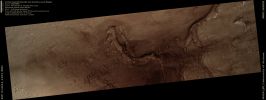
ESP_014414_2205_RED_abrowse.jpgEroded Layered Deposits near Ismenius Lacus Region (Natural Colors; credits: Lunexit)69 visitenessun commentoMareKromium
|
|

ESP_014416_0950_RED_abrowse.jpgSouth Polar Layered Deposits (Natural Colors; credits: Lunexit)77 visitenessun commentoMareKromium
|
|

ESP_014417_0940_RED_abrowse.jpgSouth Polar Residual Cap Monitoring (Natural Colors; credits: Lunexit)75 visitenessun commentoMareKromium
|
|
| 2236 immagini su 187 pagina(e) |
 |
|
|
|
|
27 | |
|
|
|
|








