Mars Reconnaissance Orbiter (MRO)
|
|
|

ESP_014181_0920_RED_abrowse.jpgThe South Polar Residual Cap (Natural Colors; credits: Lunexit)64 visitenessun commentoMareKromium
|
|

ESP_014183_1645_RED_abrowse.jpgWindstreaks (Natural Colors; credits: Lunar Explorer Italia)76 visitenessun commentoMareKromium
|
|
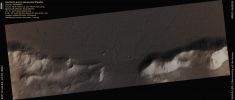
ESP_014184_2070_RED_abrowse.jpgLava Flows in Amazonis Planitia (Absolute Natural Colors; credits for the additional process. and color.: Dr Paolo C. Fienga - Lunexit Team)217 visitenessun commentoMareKromium
|
|
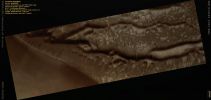
ESP_014185_1095_RED_abrowse.jpgUSGS Dune Database Entry Number 1784-704 (Natural Colors; credits: Lunexit)63 visitenessun commentoMareKromium
|
|
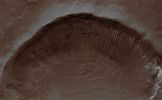
ESP_014185_1410_RED_abrowse-PCF-LXTT-1.jpgUnnamed Crater in Terra Cimmeria (Natural Colors; credits for the additional process. and color.: Dr Paolo C. Fienga - Lunexit Team)211 visiteMars Local Time: 14:18 (early afternoon)
Coord. (centered): 38,6° South Lat. and 168,8° East Long.
Spacecraft altitude: 267,7 Km (such as about 167,3 miles)
Original image scale range: 53,6 cm/pixel (with 2 x 2 binning) so objects ~ 1 mt and 61 cm across are resolved
Map projected scale: 50 cm/pixel
Map projection: EQUIRECTANGULAR
Emission Angle: 19,6°
Phase Angle: 54,8°
Solar Incidence Angle: 37° (meaning that the Sun is about 53° above the Local Horizon)
Solar Longitude: 316,2° (Northern Winter)
Credits: NASA/JPL/University of Arizona
Additional process. and coloring: Lunar Explorer ItaliaMareKromium
|
|
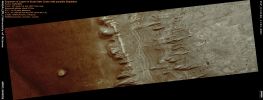
ESP_014186_1745_RED_abrowse.jpgExposures of Layers in South Gale Crater (Natural Colors; credits: Lunexit)65 visitenessun commentoMareKromium
|
|
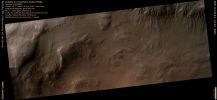
ESP_014187_2230_RED_abrowse.jpgGullies in a Northern Crater Walls (Natural Colors; credits: Lunexit)63 visitenessun commentoMareKromium
|
|

ESP_014188_1320_RED_abrowse.jpgUSGS Dune Database Entry Number 0894-475 (Natural Colors; credits: Lunexit)85 visitenessun commentoMareKromium
|
|
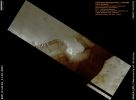
ESP_014190_1130_RED_abrowse.jpgUSGS Dune Database Entry Number 0403-669 (Natural Colors; credits: Lunexit)64 visitenessun commentoMareKromium
|
|
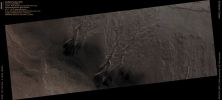
ESP_014256_1300_RED_abrowse-PCF-LXTT-1.jpgUnnamed Crater with Gullies (Absolute Natural Colors; credits for the additional process. and color.: Dr Paolo C. Fienga - Lunar Explorer Italia)146 visiteMars Local Time: 14:27 (Early Afternoon)
Coord. (centered): 49,9° South Lat. and 33,9° East Long.
Spacecraft altitude: 252,1 Km (such as about 157,5 miles)
Original image scale range: 50,4 cm/pixel (with 2 x 2 binning) so objects ~ 1 mt and 51 cm across are resolved
Map projected scale: 50 cm/pixel
Map projection: EQUIRECTANGULAR
Emission Angle: 3,1°
Sun-Mars-Spacecraft (or "Phase") Angle: 47,6°
Solar Incidence Angle: 45° (meaning that the Sun is about 45° above the Local Horizon)
Solar Longitude: 319,4° (Northern Winter)
Credits: NASA/JPL/University of Arizona
Additional process. and coloring: Dr Paolo C. Fienga - Lunar Explorer ItaliaMareKromium
|
|
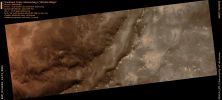
ESP_014260_1675_RED_abrowse.jpgUnnamed Crater intersecting a "Wrinkle Ridge" (Natural Colors; credits: Lunexit)104 visiteWrinkle Ridges are topographic structures produced by Subsurface faulting; they are commonly found on both the Moon and Mars.
This image shows a site where a Wrinkle Ridge intersects a Crater; the Ridge is a large feature and extends well outside this observation. The spur just inside the Crater Rim is roughly in line with the Wrinkle Ridge structure and probably represents enhanced crater collapse along the fault line.
An alternative possibility is that this spur was created by movement of the Wrinkle Ridge fault after the Crater formed, but this is unlikely because the Outer Rim of the Crater is not cut. Observations like this help constrain the relative timing of events on Mars.MareKromium
|
|

ESP_014261_0930_RED_abrowse.jpgSouth Polar Residual Cap Monitoring (Natural Colors; credits: Lunexit)77 visiteThis HiRISE image is of a portion of Mars' South Polar Residual Ice Cap. Like Earth, Mars has concentrations of water ice at both Poles.
Because Mars is so much colder, however, the seasonal ice that gets deposited at high latitudes in the Winter and is removed in the Spring (generally analogous to winter-time snow on Earth) is actually Carbon Dioxide Ice. Around the South Pole there are areas of this CO2 ice that do not disappear every Spring, but rather survive Winter after Winter. This persistent Carbon Dioxide Ice is called "South Polar Residual Cap", and is what we are looking at in this HiRISE image.
Relatively high-standing smooth material is broken up by semi-circular depressions and linear, branching troughs that make a pattern resembling those of your fingerprints. The high-standing areas are thicknesses of several meters of CO2 Ice.
The depressions and troughs are thought to be caused by the removal of Carbon Dioxide Ice by Sublimation (the change of a material from solid directly to gas). HiRISE is observing this CO2 Terrain to try to determine how these patterns develop and how fast the depressions and troughs grow.
While the South Polar Residual Cap as a whole is present every year, there are certainly changes taking place within it. With the high resolution of HiRISE, we intend to measure the amount of expansion of the depressions over multiple Mars years.
Knowing the amount of Carbon Dioxide removed can give us an idea of the atmospheric, weather, and climate conditions over the course of a year.
In addition, looking for where CO2 Ice might be being deposited on top of this terrain may help us understand if there is any net loss or accumulation of the CO2 Ice over time, which would be a good indicator of whether Mars' climate is in the process of changing, or not. (Written by: Patrick Russell)MareKromium
|
|
| 2236 immagini su 187 pagina(e) |
 |
|
|
|
|
21 | |
|
|
|
|








