Mars Reconnaissance Orbiter (MRO)
|
|
|
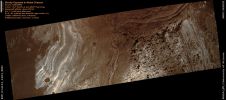
ESP_014141_1665_RED_abrowse.jpgPossible Blocky Deposits in Melas Chasma (Natural Colors; credits: Lunexit)73 visitenessun commentoMareKromium
|
|
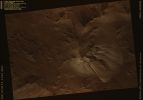
ESP_014153_1430_RED_abrowse.jpgGullies at the Edge of Hale Crater (Natural Colors; credits: Lunexit)65 visiteSeveral years ago, Gullies carved into hill-slopes and the walls of impact craters like the ones pictured here were discovered. Scientists are excited to study these features because, on Earth, they usually form through the action of liquid water - long thought to be absent on the Martian Surface.
Whether Gullies form under today's cold dry conditions is a major question that planetary scientists are trying to answer.
The Gullies pictured here are great examples of what a typical Martian Gully looks like. You can see wide V-shaped channels running downhill (from top to bottom) where the material that carved the Gully flowed. At the bottom of the channel this material empties out onto a fan-shaped mound. Several Gullies are visible here and the fans from each gully overlap one other in complicated ways.
At the tops of the channels, large amphitheater-shaped alcoves are carved in the rock. The material removed from these alcoves likely flowed downhill to the aprons through the Gullies.
Gullies at this site are especially interesting because scientists recently discovered examples at similar locations to be still active. Images separated by several years showed changes in the appearance of some of these Gullies.
Today, planetary scientists are using the HiRISE camera to examine Gullies for ongoing change and investigate what that might mean for the occurrence of liquid water on the Surface of Mars.MareKromium
|
|
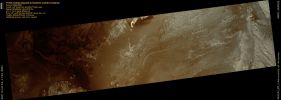
ESP_014154_1730_RED_abrowse.jpgFerric Oxide-Rich Deposit in East Candor Chasma (Natural Colors; credits: Lunexit)66 visitenessun commentoMareKromium
|
|

ESP_014159_1670_RED_abrowse-00.jpg"Worm-like" Surface Feature in the Southern Highlands (ctx frame - Natural Colors; credits: Lunexit)70 visitenessun commentoMareKromium
|
|

ESP_014159_1670_RED_abrowse-01.jpg"Worm-like" Surface Feature in the Southern Highlands (EDM - Natural Colors; credits: Lunexit)72 visitenessun commentoMareKromium
|
|

ESP_014159_1670_RED_abrowse-02.jpg"Worm-like" Surface Feature in the Southern Highlands (EDM n. 2 - False Colors; credits: Dr G. Barca)78 visiteRingraziando gli Amici di Lunexit per gli interessanti commenti, dobbiamo precisare (onde evitare l'insorgere di spiacevoli malintesi) che, a nostro parere, questa Surface Feature non possiede nulla di "Biogenico".
Si tratta, sempre a nostro modo di vedere, del letto asciutto di un antichissimo torrente (o forse anche un laghetto, le cui acque erano comunque soggette a deboli correnti).
L'apparenza - da svariate centinaia di Km di altezza - è quella di un grosso "vermone", ma la sostanza ci dice che siamo davanti ad un antico rilievo di presumibili origini fluviali, sinuoso e (ovviamente) prosciugato, sul quale si elevano delle bizzarre (e sempre affascinanti) "ripples".
Relativamente a queste ripples, da notare la loro albedo (elevata) e la loro forma a "scafo", la cui origne, con ogni probabilità, può essere fatta risalire all'azione congiunta di correnti d'aria persistenti e periodicamente contrapposte.
La loro consistenza, a nostro parere, dovrebbe rendere queste ripples simili in tutto e per tutto a quei rilievi rocciosi - ma fragili - che prendono il nome di "yardangs".MareKromium
|
|
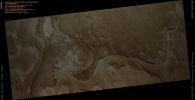
ESP_014167_1300_RED_abrowse.jpgExposures of Layered Rocks in Argyre Planitia (Natural Colors; credits: Lunexit)76 visitenessun commentoMareKromium
|
|
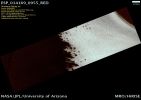
ESP_014169_0955_RED_abrowse.jpgSouthern Patchy Ice (Natural Colors; credits: Lunexit)121 visitenessun commentoMareKromium
|
|
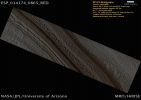
ESP_014174_0865_RED_abrowse.jpgSouth Polar Layered Deposits' (SPLD) Stratigraphy (Natural Colors; credits: Lunexit)67 visitenessun commentoMareKromium
|
|

ESP_014176_1810_RED_abrowse.jpgCentral Uplift of an Unnamed Impact Crater (Natural Colors; credits: Lunexit)72 visitenessun commentoMareKromium
|
|
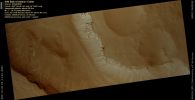
ESP_014178_1330_RED_abrowse.jpgNorth-Western Side of Asimov Crater (Natural Colors; credits: Lunexit)66 visitenessun commentoMareKromium
|
|
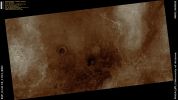
ESP_014178_1765_RED_abrowse1.jpgMeridiani Planum, Southern Boundary (Natural Colors; credits: Lunexit)65 visitenessun commentoMareKromium
|
|
| 2236 immagini su 187 pagina(e) |
 |
|
|
|
|
20 | |
|
|
|
|








