Mars Reconnaissance Orbiter (MRO)
|
|
|
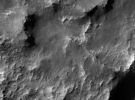
T-TRA_000853_1450_RED_AtlantisChaos_01.jpgAtlantis Chaos64 visiteThis HiRISE image covers a small area within a degraded crater adjacent to Atlantis Chaos in the Electris region of Mars. The crater and much of the surrounding region were once extensively mantled by a layer of material(s) of unknown origin and only small remnant outcrops of this material remain seen as flat topped mesas in the image sub-frame shown here. Intervening areas expose ancient uplands materials locally punctuated by narrow ridges that may represent more resistant material within the mantling deposit that were left in relief as the sediments were eroded away. Although the mesas do not appear to be comprised of finely layered materials, hints of some layering in a few locations can be seen. Large blocks of material are being shed from the mesas, but do not appear to accumulate on the mesa slopes as large talus aprons. Some wind blown dunes and ripples can be observed, but are not as widespread as in many other locations imaged with HiRISE. Collectively, these characteristics suggest that the material(s) forming the mantling deposit possess some limited strength, but are easily broken down and removed by wind over time. One possible Earth analog for these deposits may be the wind blown accumulations of very fine sediments, or silt known as loess.
|
|
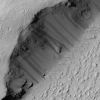
T-TRA_000853_1900_RED_MarteValles_01.jpgSeeps in Marte Vallis65 visiteMarte Vallis is a relatively young channel system on Mars that was carved by catastrophic floods of water. The HiRISE image samples just a small part of the valley system, but captures a variety of different landforms. The mesa in the eastern half of the image is a remnant of the pre-flood surface while the valley floor is covered by a surface with plates and ridges.
We highlight a piece from the southeastern portion of this HiRISE image, along the edge of the mesa. Some of the most striking features in this area are the dark streaks streaming down the cliff face. These mark locations where the layer of dust has been removed, exposing the darker surface underneath. The details of this cleaning process are not well-understood, but are thought to be driven by avalanches of dust. These avalanches appear to be more capricious than typical landslides or mudslides—they are sometimes able to surmount some large obstacles but in other cases are deflected by relatively small boulders. The darkness of the streaks vary, which suggests that they formed at different times. These streaks are expected to gradually fade as more dust will be deposited in the future. However, such fading has yet to be observed.
The role of dust is also clearly evident on the floor of the valley. The fluted mounds are characteristic of a thick dust deposit that is being gradually stripped away by wind. This extensive dust cover complicates any attempt to understand the details of the floods that carved the valley and the processes that formed the plates and ridges on the floor.
|
|
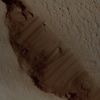
T-TRA_000853_1900_RED_MarteValles_01.jpgSeepage in Marte Vallis (Natural Colors; credits: Lunar Explorer Italia)68 visitenessun commentoMareKromium
|
|

T-TRA_000862_1710_RED_CandorChasma_01.jpgCandor Chasma75 visiteThis HiRISE sub-image shows the steep slopes along wallrock in the eastern edge of West Candor Chasma. In general, the rocks in the upper part of the canyons are interpreted to be lava flows that cover the plains surrounding Valles Marineris, whereas the deeper material along the walls could be either more lava flows or megaregolith that resulted from numerous impact craters that disrupted the Martian surface during the first billion years after formation of the planet. Resistant material is visible in portions of the sub-image and HiRISE is able to resolve 1-2 meter size boulders shedding out of these resistant wallrock units. The bright and dark lineations seen in the right of the sub-image follow the slope of the wallrock (downslope is towards the top of the sub-image) and likely represent bright dust and dark sand that are sliding downslope. The large number of small impact craters visible along the slopes indicates that there isn't a large amount of material moving downslope recently because these craters would have been destroyed or buried.
|
|
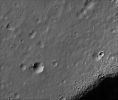
T-TRA_000866_1420_RED.jpgGorgonum Chaos76 visiteThis HiRISE image shows cratered plains along the edge of a large fracture to the south of Gorgonum Chaos. The wall of the fracture is in shadow and, at first glance, appears to reveal little detail about the geologic setting. In reality, the high quality of the HiRISE image, as shown in the stretched sub-image [below], demonstrates that considerable detail along the wall of the fracture can be discerned. A relatively dark layer extends along the upper wall of the fracture and approximately separates the exposed wall above from talus below. Some well defined talus chutes are also visible and are formed by the down slope movement of debris shed from higher along the fracture wall. The wind blown drifts of fine grained sediment accumulated along the base of the talus slope are relatively free of obvious talus. Hence, the wind likely accounts for much of the most recent modification of the scene in the sub image.
|
|

T-TRA_000866_1420_RED.jpgGorgonum Chaos (Natural Colors; credits: Lunar Explorer Italia)82 visitenessun commentoMareKromium
|
|
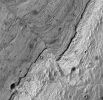
TRA_000823_1720_RED_fault.jpgFault of Jus79 visiteThe sharpness and quality of HiRISE images allows geologists to work out the detailed geometry and sequence of events that have shaped the landscape. For example, this area shows exposures of light- and dark-toned layers of rock that have been faulted and folded. These rocks formed out of sedimentary deposits that originally accumulated in thick horizontal sequences, like a layer cake.
These layers have since been tilted on-end and eroded, exposing the sequence of layers that we now see at the surface. A prominent dark layer extends through the center of the scene from the upper right to the lower left of the image. This dark layer is discontinuous and offset along a fault.
The thin grey zone that extends from the upper left to the lower right of the image delineates the fault plane. This fault was originally a thrust, or compressional fault, that formed prior to the aforementioned tilting event. Tilting of this fault and the surrounding rock reveals a series of drag folds adjacent to the fault plane. These drag folds formed as the layered rock bent in response to friction along the fault plane as the thrust fault formed, prior to the tilting event. This fault offsets the dark layer by a maximum of 70-75 m. Smaller secondary folds and faults are also visible in this scene. The smallest resolved fault offset of an individual rock layer is 1-1.5 m. Also visible in this image are numerous small 4-10-m-diameter impact craters that are surrounded by ejecta of meter-scale boulders.
|
|
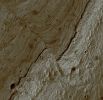
TRA_000823_1720_RED_fault.jpgFault in Jus Chasma (Natural Colors; credits: Lunar Explorer Italia)88 visitenessun commentoMareKromium
|
|

TRA_000825_2665_IRB-00.jpgNorth Polar Layers (1)86 visiteThis image of the north polar layered deposits was taken during the summer season (solar longitude of 113.6 degrees), when carbon dioxide frost had evaporated from the surface. The bright spots seen here are most likely patches of water frost, but the location of the frost patches does not appear to controlled by topography. Layers are visible at the bottom of the image, mostly due to difference in slope between them. The variations in slope are probably caused by differences in the physical properties of the layers. Thinner layers that have previously been observed in these deposits are visible, and may represent annual deposition of water ice and dust that is thought to form the polar layered deposits. These deposits are thought to record global climate variations on Mars, similar to ice ages on Earth. HiRISE images such as this should allow Mars' climate record to be inferred and compared with climate changes on Earth.
Image TRA_000825_2665 was taken by the High Resolution Imaging Science Experiment (HiRISE) camera onboard the Mars Reconnaissance Orbiter spacecraft on September 29, 2006. Shown here is the full image, centered at 86.5 degree latitude, 172.0 degrees East longitude. The image is oriented such that north is to the top. The range to the target site was 298.9 km (186.8 miles). At this distance the image scale is 59.8 cm/pixel {with 2 x 2 binning} so objects ~1.79 m across are resolved. In total the original image was 12.2 km (10024 pixels) wide and 6.1 km (5000 pixels) long. The image was taken at a local Mars time of 3:30 PM and the scene is illuminated from the southwest with a solar incidence angle of 63.5 degrees, thus the sun was about 26.5 degrees above the horizon.
|
|

TRA_000825_2665_IRB-01.jpgNorth Polar Layers (2)66 visiteNOTA:
This color images cover only the center swath of the full image, and is composed of images acquired through infrared, red, and blue-green filters. The color has been enhanced to better show the subtle color differences.
It is NOT natural color or how it would appear to normal human vision.
|
|

TRA_000825_2665_IRB.jpgNorth Polar Layered Deposits (full image & HR)69 visiteThis image of the north polar layered deposits was taken during the summer season (solar longitude of 113.6 degrees), when carbon dioxide frost had evaporated from the surface. The bright spots seen here are most likely patches of water frost, but the location of the frost patches does not appear to controlled by topography. Layers are visible at the bottom of the image, mostly due to difference in slope between them. The variations in slope are probably caused by differences in the physical properties of the layers. Thinner layers that have previously been observed in these deposits are visible, and may represent annual deposition of water ice and dust that is thought to form the polar layered deposits. These deposits are thought to record global climate variations on Mars, similar to ice ages on Earth. HiRISE images such as this should allow Mars' climate record to be inferred and compared with climate changes on Earth.
|
|

TRA_000827_1875_IRB.jpgCerberus' River75 visiteThe prominent trough in this sub-image (of HiRISE image TRA_000827_1875_IRB ) is a segment of the Cerberus Fossae rift system. In geological terminology the trough is known as a graben, or down-dropped region bounded by faults. In this location the graben is about 300 m wide and 90 m deep. Bright, dust-covered, cratered plains surround the graben, and darker sediments blanket much of its floor. Dunes that vary in size and spacing occur within the darker sediments, and their shapes suggest that the wind typically blows from east to west. Light-toned, angular boulders pepper the darker sediments. They have broken away from the rocky walls of the graben and tumbled downhill. Over time this mass wasting has caused the cliffs to retreat, widening the trough. The somewhat lighter patches of cratered terrain on the graben floor were once level with the surrounding plains, but have since been lowered by faulting. Over time they may become obscured or buried by the darker sediments. High-standing ridgesÑremnants of the former surfaceÑcast jagged shadows on the floor of the graben that reveal the rugged nature of the landscape in this region of Mars.
Image TRA_000827_1875 was taken by the High Resolution Imaging Science Experiment (HiRISE) camera onboard the Mars Reconnaissance Orbiter spacecraft on September 29, 2006. The complete image is shown below, centered at 7.4 degrees latitude, 168.5 degrees East longitude. The range to the target site was 275 km (171 miles). At this distance the image scale is 55 cm/pixel (with 2 x 2 binning) so objects ~165 cm across are resolved. The image shown below has been map-projected to 50 cm/pixel and north is up. The image was taken at a local Mars time of 3:26 PM and the scene is illuminated from the west with a solar incidence angle of 51.9 degrees, thus the sun was about 38.1 degrees above the horizon. At a solar longitude of 113.7 degrees, the season on Mars is Northern Summer / Southern Winter.
|
|
| 2236 immagini su 187 pagina(e) |
 |
|
|
|
|
|
|
184 | |
|
|








