Mars Reconnaissance Orbiter (MRO)
|
|
|
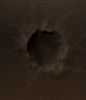
Santa_Maria_Crater-PIA13706-PCF-LXTT.jpgOrbital View of Santa Maria Crater (Absolute Natural Colors; credits for the additional process. and color.: Dr Paolo C. Fienga - Lunexit Team)136 visiteCaption NASA:"NASA's Mars Exploration Rover Opportunity approached Santa Maria Crater in December 2010. With a diameter of about 90 meters (295 feet), this Crater is slightly smaller than Endurance Crater, which Opportunity explored for about six months in 2004.
This image of Santa Maria Crater was taken by the High Resolution Imaging Science Experiment (HiRISE) camera on Mars Reconnaissance Orbiter".MareKromium
|
|

Slope_Streaks-MRO.jpgSlope Streaks (Natural Colors; credits: Dr Paolo C. Fienga - Lunexit Team)77 visitenessun commentoMareKromium
|
|

SouthPolarSpiders-PIA11857.jpgSouth Polar Fans (Natural Colors; credits: Lunar Explorer Italia)68 visiteCaption NASA:"Every Winter, Mars' Polar Region is covered with a layer of seasonal CO2 (Carbon Dioxide ice - a.k.a. "dry ice"). In the Spring, jets of gas carry dust from the ground up through openings in the ice.
The dust gets carried downwind by the prevailing wind and falls on top of the Seasonal Ice Layer in a fan-shaped deposit. Many jets appear to be active at the same time since numerous Fans are all deposited in the same direction.
This image from the High Resolution Imaging Science Experiment (HiRISE) camera on NASA's Mars Reconnaissance Orbiter appears to show several times at which jets were active. At the top of this image the Fans are oriented in one direction while at the bottom they are going in a different direction. This suggests that as the ice layer thins, a set of gas jets becomes active, they die down, then further away another set starts up at a later time with a different prevailing wind direction.
This is a reduced-resolution image from the HiRISE Observation observation catalogued as ESP_011934_0945, taken on Feb. 11, 2009. The observation is centered at 85,4° South Latitude and 104,0° East Longitude.
The image was taken at a Local Mars Time of 18:12 and the scene is illuminated from the West, with a Solar Incidence Angle of 79° (meaning that the Sun was about 11° above the Local Horizon).
At a Solar Longitude of 207,9°, the season on Mars is Northern Autumn".MareKromium
|
|

SouthPolarSpiders-PIA11858.jpgStarburst Spiders (Natural Colors; credits: Lunar Explorer Italia)80 visiteCaption NASA:"Mars' Seasonal Cap of Carbon Dioxide (CO2) ice has eroded many beautiful terrains as it sublimates (meaning that goes directly from ice to vapor) every Spring.
In the region where the High Resolution Imaging Science Experiment (HiRISE) camera on NASA's Mars Reconnaissance Orbiter took this image, we see Troughs (---> canali) that form a Starburst Pattern (---> disegno a forma di stella che esplode). In other areas these Radial Troughs have been refered to as "Spiders", simply because of their shape. In this Region the pattern looks more dendritic as channels branch out numerous times as they get further from the center.
The Troughs are believed to be formed by gas flowing beneath the seasonal ice to openings where the gas escapes, carrying along dust from the surface below. The dust falls to the surface of the ice in fan-shaped deposits.
This image, covering an area of about 1 Km (approx. 0,6 mile) across, is a portion of the HiRISE observation catalogued as ESP_011842_0980, and taken on Feb. 4, 2009.
The observation is centered at 81,8° South Latitude and 76,2° East Longitude. MLT was 16:56 and the scene is illuminated from the West with a Solar Incidence Angle of 78° (meaning that the Sun was about 12° above the Local Horizon).
At a Solar Longitude of 203,6°, the season on Mars is Northern Autumn".MareKromium
|
|

SouthPole-PIA11987.jpgThe South Pole of Mars in Spring (1)77 visitenessun commentoMareKromium
|
|

SouthPole-PIA11988.jpgThe South Pole of Mars in Spring (2)69 visitenessun commentoMareKromium
|
|

South_Polar_Feature-PIA13727.jpgBizarre-looking Surface Feature - Sol 2467 (EDM - Absolute Natural Colors; credits for the additional process. and color.: Dr Paolo C. Fienga - Lunexit Team)164 visiteThis approx. 4 Km diameter Surface Feature near the edge of the South Polar Residual Cap was recognized in Mariner 9 and Viking Orbiter images taken in the 1970s, but its origin could not be inferred. It was therefore targeted for HiRISE stereo imaging.
The bright areas in this image are covered by CO2 Frost, and the "Swiss Cheese" Terrain typical of the South Polar Residual Cap covers much of the imaged area.
The Dark Walls of the Circular Depression do not have as much Frost on them and are fractured in a Polygonal Pattern. Apparently the Surface of the Walls has been extensively modified by thermal expansion and contraction of water ice. It also appears that the "Swiss Cheese" Terrain of the Residual Cap has buried the Floor of the Circular Depression, as well as the Terrain surrounding the Feature, making it difficult to infer its origin.
Its circular symmetry is consistent with an impact origin, but there is no evidence of a Crater Rim or Ejecta Blanket (perhaps because they have been buried). The Depression may also have formed by Collapse, but there is little evidence of extensional fractures that would be expected around a Collapse Pit. Analysis of HiRISE stereo data may help the interpretation of this however really peculiar Surface Feature.MareKromium
|
|

South_Pole-PIA13985.jpgCross-Section of buried Carbon-Dioxide (CO2) Ice on Mars288 visiteCaption NASA:"This cross-section view of underground layers near Mars' South Pole is a radargram based on data from the Shallow Subsurface Radar (SHARAD) instrument on NASA's Mars Reconnaissance Orbiter. Researchers interpret the zone that is nearly free of radio-wave reflections (hence dark in the radargram) to be composed of frozen Carbon Dioxide, or "dry ice."
The newly found deposit of dry ice contains enough CO2 to dramatically increase the total amount of Atmosphere on Mars when it will vaporize, as climate models suggest it does at times when the Planet's Tilt increases. Mars' current Atmosphere is about 95% Carbon Dioxide, and this deposit contains up to about 80% as much Carbon Dioxide as the Atmosphere does.
This cross-section covers a transect about 330 Km (approx. 205 miles) long in a Region from about 86° to 87° South Latitude and 280° to 10° East Longitude. The vertical dimension of the graphic is time delay of the radar echoes. The depth of the tallest portion of the cross-section corresponds to about 20 microseconds difference in time delay, which can be converted to roughly 1,7 Km (a little more than 1 mile).
(SHARAD was provided by the Italian Space Agency. Its operations are led by Sapienza University of Rome, and its data are analyzed by a joint U.S.-Italian science team. NASA's Jet Propulsion Laboratory, a division of the California Institute of Technology in Pasadena, manages the Mars Reconnaissance Orbiter for the NASA Science Mission Directorate, Washington. Lockheed Martin Space Systems, Denver, built the Spacecraft)MareKromium
|
|

Spirit-OrbitalView-20081009-MRO.jpgGusev Crater and Spirit: Aerial View77 visiteCaption NASA:"Clear skies and low-angle sunlight are an outdoor photographer's dream. On the shortest day of Martian winter, June 24, 2008, Spirit had both. Conditions were ideal for an orbiter's shot of the Mars Rover parked on the sunlit slope of a volcanic plateau.
Shadows outlined shapes in the landscape, such as the upturned edges of the bowl-shaped plateau known as "Home Plate". Shadows also reveal nearby ridges, slopes, and large boulders. Spirit is the dark "bump", marked by a yellow arrow.
Detailed images such as this one will help scientists select a future path for Spirit. For plotting a path on Mars, a powerful orbiting camera, long shadows, and a clear sky are about as good as it gets".MareKromium
|
|

SubsurfaceIce-PIA12214.jpgSubsurface Ice is EVERYWHERE!77 visiteThis map shows five locations where fresh impact cratering has excavated water ice from just beneath the Surface of Mars (sites 1 through 5) and the Viking Lander 2 Landing Site (VL2), in the context of color coding to indicate estimated depth to ice.
The map covers an area from 40 to 60° North Latitude and from 130 to 190° East Longitude. Estimates of the depth to water-ice come from a computer model and observations of the brightness and temperature of the Surface. The model matches the ice-exposing crater observations by NASA's Mars Reconnaissance Orbiter and data from the neutron spectrometer on NASA's Mars Odyssey Orbiter.
Analysis of the observations of ice-exposing fresh craters at sites 1 through 5, reported by Byrne et al. in a Sept. 25, 2009, paper in the journal Science, leads the paper's authors to calculate that if NASA's Viking Lander 2 had been able to dig slightly deeper than the 10-to 15-centimeter-deep (4-to-6-inch-deep) trench that it excavated in 1976, it would have hit water ice.
The color coding indicates depths to the top of a water-ice-containing layer, ranging from 1 cm (about 0,5") in dark-blue coded locations to 10 meters (33 feet) in red-coded locations.MareKromium
|
|

SubsurfaceIce-PIA12216.jpgFading Fresh Craters with Subsurface Ice (Natural Colors; credits: Lunexit)63 visiteThis series of images spanning a period of 15 weeks shows a pair of fresh, middle-latitude craters on Mars in which some bright, bluish material apparent in the earliest images disappears by the later ones. Each panel is 75 meters (246 feet) across. The two craters are each about 4 meters (13 feet) in diameter and half a meter (1,5 feet) deep.
The bright material is water ice that was uncovered by the meteorite impact that excavated these small craters less than 15 weeks before the initial image of this series. Sublimation of the ice during the Martian Summer leaves behind a dust layer that gradually thickens to the point where it obscures the ice.
The High Resolution Imaging Science Experiment (HiRISE) camera on NASA's Mars Reconnaissance Orbiter took these images of this site at 46,33° North Latitude and 176,90° East Longitude. The HiRISE camera's targeting of the site was prompted by two earlier images from the Context Camera on the Mars Reconnaissance Orbiter, which showed that the impact responsible for these craters had not yet occurred by June 4, 2008, but had occurred by Aug. 10, 2008.
The dates when these six HiRISE images were taken were (left to right, top row; then left to right, bottom row): Sept. 12, 2008; Sept. 28, 2008; Oct. 9, 2008; Oct. 14, 2008; Nov. 22, 2008; and Dec. 25, 2008. The span of time corresponded to a period from mid to late Summer in Mars' Northern Hemisphere. The images are subframes of the observations made on those dates.
The full-frame images are online (same order) at http://hirise.lpl.arizona.edu/PSP_009978_2265;
http://hirise.lpl.arizona.edu/PSP_010189_2265; http://hirise.lpl.arizona.edu/PSP_010334_2265;
http://hirise.lpl.arizona.edu/PSP_010400_2265; http://hirise.lpl.arizona.edu/PSP_010901_2265; and
http://hirise.lpl.arizona.edu/ESP_011323_2265.MareKromium
|
|

SubsurfaceIce-PIA12217.jpgSubsurface Ice (Natural Colors; credits: Lunexit)67 visiteThe High Resolution Imaging Science Experiment camera on NASA's Mars Reconnaissance Orbiter took these images of a fresh, 6-meter-wide (20-foot-wide) crater on Mars on Oct. 18, 2008, (left) and on Jan. 14, 2009. Each image is about 35 meters (115 feet) across.
This crater's depth is estimated to be 1,33 meters (4,4 feet).
Images (not shown here) taken by the Thermal Emission Imaging System camera on NASA's Mars Odyssey orbiter and by the Context Camera on the Mars Reconnaissance Orbiter show that the impact that excavated this crater occurred sometime between Dec. 22, 2008 and July 5, 2008.
The impact exposed water ice from below the Surface. It is the bright material visible in this pair of images. The change in appearance from the earlier image to the later one resulted from some of the ice sublimating away during the Martian Northern-Hemisphere Summer, leaving behind dust that had been intermixed with the ice. The thickening layer of dust on top obscured the remaining ice.
This crater is at 43,28° North Latitude and 164,22° East Longitude.MareKromium
|
|
| 2236 immagini su 187 pagina(e) |
 |
|
|
|
|
182 | |
|
|
|
|








