Mars Reconnaissance Orbiter (MRO)
|
|
|

R-PIA08788-1.jpgOlympia Undae (1)76 visiteThe Compact Reconnaissance Imaging Spectrometer for Mars, a mineral mapping instrument on NASA's Mars Reconnaissance Orbiter (CRISM), began observing Mars after its lens cover was opened on Sept. 27, 2006.
This image shows one of the first regions of Mars measured after CRISM's cover was opened.
CRISM takes images in two basic formats. The first format is a "targeted image" about 10 by 10 Km (about 6 by 6 miles), at about 18 mt (60 feet) per pixel, in 544 colors covering wavelengths of 0,36 to 3,92 micrometers. The second format is a lower-resolution strip 10 Km (about 6 miles) wide and thousands of kilometers long, at 200 mt (660 feet) per pixel, in 72 colors. Many thousands of these "multispectral survey" strips are used to build a global map.
The image is part of the second multispectral survey strip, taken at 22:36 UTC (6:36 p.m. EDT) on Sept. 27, 2006. Only minimal processing of the data has been done at this early point in the MRO's Mission.
The strip crosses part of the north polar region named Olympia Undae, and stretches between 76.7 north latitude, 141.9 east longitude and 85.5 north, 115.8 east. From the top, the northern end of the image crosses layers of dusty and clean ice in the north polar cap. Moving south the image covers dusty sedimentary deposits, dark sand dunes, and outlying polar ice deposits.
|
|

R-PIA08788-2.jpgOlympia Undae (2)78 visiteThis image shows three representations of the 72 colors. The left panel is a nearly true-color composite in which the blue, green, and red planes are 0.44, 0.53, and 0.60 micrometer light -- nearly as the human eye would see. The contrast between the bright ice and dark dunes is so large that the dunes are barely seen. The middle panel is false color constructed from infrared wavelengths just beyond the range of the human eye. The blue, green, and red planes cover 0.80, 0.95, and 1.06 micrometer light. In this rendering of the data the differences between ice- and soil-rich regions are not as apparent because the colors of ice and dust are similar in this wavelength region. The right panel uses 1.15, 1.8, and 2.25 micrometer light in the blue, green and red planes and provides a dramatically different view of the scene. The areas of highest ice content appear in blue, and those with a mix of dust and ice -- most of the scene -- appear yellowish. The dunes are now visible against the ice because of their higher brightness at longer infrared wavelengths, and appear ruddy brown.
|
|

Remnants-ESP_038184_1815_40-1.jpgUnusually-looking Surface Features on Mars (EDM from ESP 038184-1815-40)199 visitenessun commentoMareKromium
|
|

Ruins-ESP_038184_1815_57-1.jpgUnusually-looking Surface Features on Mars (EDM from ESP 038184-1815-57)171 visitenessun commentoMareKromium
|
|

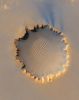
S-PIA08812.jpgCape Verde and Cabo Frio (1)77 visiteThis image from the High Resolution Imaging Science Experiment on NASA's Mars Reconnaissance Orbiter shows the Mars Exploration Rover Opportunity near the rim of "Victoria Crater." Victoria is an impact crater about 800 meters (half a mile) in diameter at Meridiani Planum near the equator of Mars. Opportunity has been operating on Mars since January, 2004. Five days before this image was taken, Opportunity arrived at the rim of Victoria, after a drive of more than 9 kilometers (over 5 miles). It then drove to the position where it is seen in this image.
Shown in the image are "Duck Bay," the eroded segment of the crater rim where Opportunity first arrived at the crater; "Cabo Frio," a sharp promontory to the south of Duck Bay; and "Cape Verde," another promontory to the north. When viewed at the highest resolution, this image shows the rover itself, wheel tracks in the soil behind it, and the rover's shadow, including the shadow of the camera mast. After this image was taken, Opportunity moved to the very tip of Cape Verde to perform more imaging of the interior of the crater.
This view is a portion of an image taken by the High Resolution Imaging Science Experiment (HiRISE) camera onboard the Mars Reconnaissance Orbiter spacecraft on Oct. 3, 2006. The complete image is centered at minus7.8 degrees latitude, 279.5 degrees East longitude. The range to the target site was 297 kilometers (185.6 miles). At this distance the image scale is 29.7 centimeters (12 inches) per pixel (with 1 x 1 binning) so objects about 89 centimeters (35 inches) across are resolved. North is up. The image was taken at a local Mars time of 3:30 PM and the scene is illuminated from the west with a solar incidence angle of 59.7 degrees, thus the sun was about 30.3 degrees above the horizon. At a solar longitude of 113.6 degrees, the season on Mars is northern summer.
Images from the High Resolution Imaging Science Experiment and additional information about the Mars Reconnaissance Orbiter are available online at: http://www.nasa.gov/mro or http://HiRISE.lpl.arizona.edu.
|
|
S-PIA08813_modest.jpgVictoria Crater, from MRO87 visitenessun commento
|
|

S-PIA08816.jpgCape Verde and Cabo Frio (2)70 visiteThis image from the High Resolution Imaging Science Experiment on NASA's Mars Reconnaissance Orbiter shows the Mars Exploration Rover Opportunity near the rim of "Victoria crater." Victoria is an impact crater about 800 meters (half a mile) in diameter at Meridiani Planum near the equator of Mars. Opportunity has been operating on Mars since January, 2004. Five days before this image was taken, Opportunity arrived at the rim of Victoria crater, after a drive of more than 9 kilometers (over 5 miles). It then drove to the position where it is seen in this image.
Shown in the image are "Duck Bay," the eroded segment of the crater rim where Opportunity first arrived at the crater; "Cabo Frio," a sharp promontory to the south of Duck Bay; and "Cape Verde," another promontory to the north. When viewed at the highest resolution, this image shows the rover itself, wheel tracks in the soil behind it, and the rover's shadow, including the shadow of the camera mast. Since this image was taken, Opportunity has moved to the very tip of Cape Verde to perform more imaging of the interior of the crater.
This view is a portion of an image taken by the High Resolution Imaging Science Experiment (HiRISE) camera onboard the Mars Reconnaissance Orbiter spacecraft on Oct. 3, 2006. The complete image is centered at minus7.8 degrees latitude, 279.5 degrees East longitude. The range to the target site was 297 kilometers (185.6 miles). At this distance the image scale is 29.7 centimeters (12 inches) per pixel (with 1 x 1 binning) so objects about 89 centimeters (35 inches) across are resolved. The image shown here has been map-projected to 25 centimeters (10 inches) per pixel and north is up. The image was taken at a local Mars time of 3:30 PM and the scene is illuminated from the west with a solar incidence angle of 59.7 degrees, thus the sun was about 30.3 degrees above the horizon. At a solar longitude of 113.6 degrees, the season on Mars is northern summer.
Images from the High Resolution Imaging Science Experiment and additional information about the Mars Reconnaissance Orbiter are available online at: http://www.nasa.gov/mro or http://HiRISE.lpl.arizona.edu.
|
|
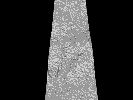
SHARAD-1.gifUnder the Ice... (1)67 visiteRadar Sounder Instruments orbiting Mars have looked beneath the Martian Surface and opened up the Third Dimension for Planetary Exploration.
The technique's success is prompting scientists to think of all the other places in the Solar System where they would like to use Radar Sounders.
The first Radar Sounder at Mars was the Mars Advanced Radar for Subsurface and Ionospheric Sounding (MARSIS) on the European Space Agency's Mars Express Orbiter. It has been joined by the complementary Shallow Subsurface Radar (SHARAD), operating at a different wavelength aboard NASA's Mars Reconnaissance Orbiter.
The data in this animation are from SHARAD.MareKromium
|
|
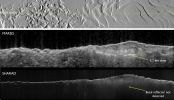
SHARAD-2.jpgUnder the Ice... (2)104 visiteTwo complementary Radar Sounder Instruments work together to discover hidden Martian secrets. They are the Mars Advanced Radar for Subsurface and Ionospheric Sounding (MARSIS) on the European Space Agency's Mars Express orbiter and the Shallow Subsurface Radar (SHARAD) on NASA's Mars Reconnaissance Orbiter.
MARSIS was designed to penetrate deep and it has delivered on its promise. This figure shows the base of Mars' South Polar Layered Deposits at the deepest recorded point of 3,7 Km (2,3 miles).
In contrast, SHARAD was designed as a High-Resolution Radar for a maximum penetration of 1 Km (0,6 mile) has difficulty detecting the base of these layered deposits.
MARSIS was funded by NASA and the Italian Space Agency and developed by the University of Rome, Italy, in partnership with NASA's Jet Propulsion Laboratory, Pasadena, Calif. Italy provided the instrument's digital processing system and integrated the parts. The University of Iowa, Iowa City, built the transmitter for the instrument, JPL built the receiver and Astro Aerospace, Carpinteria, Calif., built the antenna. JPL is a division of the California Institute of Technology in Pasadena. Additional information about Mars Express is at www.esa.int/marsexpress.
SHARAD was provided by the Italian Space Agency (ASI). Its operations are led by the University of Rome and its data are analyzed by a joint U.S.-Italian science team. JPL, a division of the California Institute of Technology, Pasadena, manages the Mars Reconnaissance Orbiter for the NASA Science Mission Directorate, Washington.MareKromium
|
|
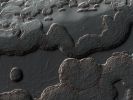
SPLD-PIA13269-0.jpgSouth Polar Layered Deposits and Residual Cap (Natural Colors; credits for the additional process. and color.: NASA/JPL-Caltech and Univ. of Arizona)81 visiteThis image from NASA's Mars Reconnaissance Orbiter (MRO) shows a variety of surface textures within the South Polar Residual Cap of Mars.
It was taken during the Southern Spring, when the Surface was covered by seasonal CO2 Frost, so that Surface relief is easily seen. Illumination is from the bottom left, highlighting long Troughs at to the right and round pits and irregular Mesas to the left of center.
These unique landforms are common in the South Polar Residual Cap, which is known from previous Mars Global Surveyor images to be eroding rapidly in places. Right of center, SPLDs are exposed on a Sun-facing Scarp. These Deposits are older than the Residual Ice Cap, and the Layers are thought to record climate variations on Mars similar to ice ages on Earth. MareKromium
|
|
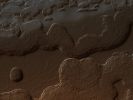
SPLD-PIA13269-PCF-LXTT2.jpgSouth Polar Layered Deposits and Residual Cap (Absolute Natural Colors; credits for the additional process. and color.: Dr Paolo C. Fienga - Lunexit Team)100 visiteThis image from NASA's Mars Reconnaissance Orbiter (MRO) shows a variety of surface textures within the South Polar Residual Cap of Mars.
It was taken during the Southern Spring, when the Surface was covered by seasonal CO2 Frost, so that Surface relief is easily seen. Illumination is from the bottom left, highlighting long Troughs at to the right and round pits and irregular Mesas to the left of center.
These unique landforms are common in the South Polar Residual Cap, which is known from previous Mars Global Surveyor images to be eroding rapidly in places. Right of center, SPLDs are exposed on a Sun-facing Scarp. These Deposits are older than the Residual Ice Cap, and the Layers are thought to record climate variations on Mars similar to ice ages on Earth. MareKromium
|
|
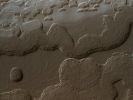
SPLD-PIA13269-PCF-LXTT3.jpgSouth Polar Layered Deposits and Residual Cap (Natural Colors; credits for the additional process. and color.: Dr Paolo C. Fienga - Lunexit Team)83 visiteThis image from NASA's Mars Reconnaissance Orbiter (MRO) shows a variety of surface textures within the South Polar Residual Cap of Mars.
It was taken during the Southern Spring, when the Surface was covered by seasonal CO2 Frost, so that Surface relief is easily seen. Illumination is from the bottom left, highlighting long Troughs at to the right and round pits and irregular Mesas to the left of center.
These unique landforms are common in the South Polar Residual Cap, which is known from previous Mars Global Surveyor images to be eroding rapidly in places. Right of center, SPLDs are exposed on a Sun-facing Scarp. These Deposits are older than the Residual Ice Cap, and the Layers are thought to record climate variations on Mars similar to ice ages on Earth.MareKromium
|
|
| 2236 immagini su 187 pagina(e) |
 |
|
|
|
|
181 | |
|
|
|
|








