Mars Reconnaissance Orbiter (MRO)
|
|
|
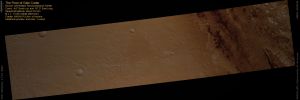
Psp_009650_1755_red.jpgCrater Floor and Central Mound in Gale Crater (natural colors; credits: Lunexit)66 visitenessun commentoMareKromium
|
|
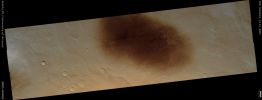
Psp_009652_2115_red.jpgOlivine Deposits (possible True Colors; credits: Lunar Explorer Italia)82 visiteMars Local Time: 15:25 (early afternoon)
Coord. (centered): 31,0° North Lat. and 79,6° East Long.
Spacecraft altitude: 289,5 Km (such as about 180,9 miles)
Original image scale range: 29,0 cm/pixel (with 1 x 1 binning) so objects ~57,9 cm across are resolved
Map projected scale: 25 cm/pixel
Map projection: EQUIRECTANGULAR
Emission Angle: 6,4°
Phase Angle: 39,7°
Solar Incidence Angle: 46° (meaning that the Sun is about 44° above the Local Horizon)
Solar Longitude: 114,0° (Northern Summer)
Credits: NASA/JPL/University of Arizona
Additional process. and coloring: Lunar Explorer ItaliaMareKromium
|
|
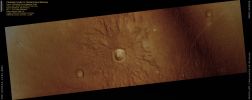
Psp_009654_2245_red.jpgPedestal Crater in Deuteronilus Mensae (natural colors; credits: Lunexit)79 visiteThis crater with spectacular ejecta is located in the Northern Mid-Latitudes in the Deuteronilus Mensae, located near the dichotomy boundary, where the Southern Highlands transition into the Northern Lowlands.
The crater has raised, fluidized ejecta. Scientists think that fluidized ejecta forms when an impact occurs into ice-rich material. The interior of the crater shows some material, particularly on the West wall, that has detached and is flowing into the crater center. This suggests the presence of ground ice.MareKromium
|
|

Psp_009657_2660_red.jpgSmall Crater on the North Polar Layered Deposits (possible True Colors; credits: Lunar Explorer Italia)84 visiteMars Local Time: 12:33 (early afternoon)
Coord. (centered): 86,0° North Lat. and 255,9° East Long.
Spacecraft altitude: 317,4 Km (such as about 198,4 miles)
Original image scale range: 31,8 cm/pixel (with 1 x 1 binning) so objects ~95 cm across are resolved
Map projected scale: 25 cm/pixel
Map projection: EQUIRECTANGULAR
Emission Angle: 1,7°
Phase Angle: 64,5°
Solar Incidence Angle: 63° (meaning that the Sun is about 27° above the Local Horizon)
Solar Longitude: 114,2° (Northern Summer)
Credits: NASA/JPL/University of Arizona
Additional process. and coloring: Lunar Explorer ItaliaMareKromium
|
|
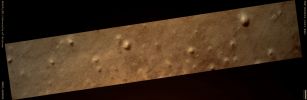
Psp_009659_2425_red.jpgTerrain in Vastitas Borealis (possible True Colors; credits: Lunar Explorer Italia)81 visiteMars Local Time: 15:08 (early afternoon)
Coord. (centered): 62,4° North Lat. and 241,9° East Long.
Spacecraft altitude: 309,5 Km (such as about 193,4 miles)
Original image scale range: 61,9 cm/pixel (with 1 x 1 binning) so objects ~1,86 mt across are resolved
Map projected scale: 50 cm/pixel
Map projection: EQUIRECTANGULAR
Emission Angle: 0,3°
Phase Angle: 50,8°
Solar Incidence Angle: 51° (meaning that the Sun is about 39° above the Local Horizon)
Solar Longitude: 114,3° (Northern Summer)
Credits: NASA/JPL/University of Arizona
Additional process. and coloring: Lunar Explorer ItaliaMareKromium
|
|
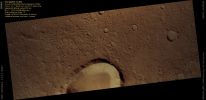
Psp_009665_1525_red.jpgElongated Crater (natural colors; credits: Lunexit)73 visiteThis scene captures about half of a crater with an elongated rim.
When craters form, they typically have a circular shape. This crater has been modified since it formed, possibly by tectonic processes or excavation, although its raised rim indicates that these processes have not heavily eroded the rim since formation.
The terrain surrounding the crater consists of megaripples, degraded craters, and rough terrain, possibly due to ancient lava flows from the nearby Hadriaca Patera.
Determining the age of these features and the processes that formed them may be possible; one such process is the interaction between the ripples and bedrock. The Transverse Aeolian Ripples (or "TARs") with a N-S wind direction appear to be lithified because the rugged bedrock, impact craters, and ejecta overlay the ripples, indicating that the ripples are older.
In the larger craters, brighter (possibly newer) ripples suggest a dominant wind direction from the North-West.MareKromium
|
|
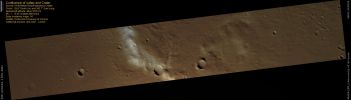
Psp_009669_1500_red.jpgConfluence of Valley and Crater (natural colors; credits: Lunexit)90 visiteThis image shows the South-Eastern Rim of a large degraded Impact Crater where a Valley breaches the Crater Rim. The Valley itself, no longer pristine, is difficult to locate in the image.
However, it appears to be in the center, near the right of the Crater Rim. It is possible that this Valley transported water into the Crater, forming a lake in the ancient past.
The scene is peppered with craters of various sizes and states of degradation, indicating that the surface is not young.
A few craters are young enough to still have raised rims. One of these, located on the floor of the larger crater, has distinct raised ejecta radiating out from it.
The crater also has dunes on its floor, indicating that aeolian processes have modified it since it formed.MareKromium
|
|
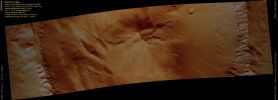
Psp_009677_2135_red.jpgBacolor Crater (natural colors; credits: Lunexit)78 visiteBacolor Crater is a pristine crater in the Northern Hemisphere. The linear striations visible at both sides (Sx and Dx) of the image are from the blast of the formation impact. This crater has a Central Peak, other mounds and terraces on its floor.
All of these features appeared during the final stages of crater formation.
The Northern Wall of the crater has landslides which have sculpted the Crater Rim. The Southern Wall has Gullies, thought to form by fluvial processes.
The Gullies here are more incised (cut into the slope) than the landslides are.MareKromium
|
|
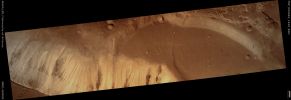
Psp_009683_1830_red.jpgPossible "Intravalley Paleolake" in Shalbatana Vallis (possible True Colors; credits: Lunar Explorer Italia)77 visiteMars Local Time: 15:30 (middle afternoon)
Coord. (centered): 3,0° North Lat. and 316,7° East Long.
Spacecraft altitude: 272,1 Km (such as about 170,1 miles)
Original image scale range: 54,4 cm/pixel (with 1 x 1 binning) so objects ~1,63 mt across are resolved
Map projected scale: 50 cm/pixel
Map projection: EQUIRECTANGULAR
Emission Angle: 5,5°
Phase Angle: 50,1°
Solar Incidence Angle: 55° (meaning that the Sun is about 35° above the Local Horizon)
Solar Longitude: 115,1° (Northern Summer)
Credits: NASA/JPL/University of Arizona
Additional process. and coloring: Lunar Explorer ItaliaMareKromium
|
|
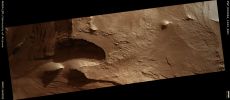
Psp_009684_1695_red.jpgExposure of Light-Toned Layering along Wallrock in Coprates Chasma (possible True Colors; credits: Lunar Explorer Italia)71 visiteMars Local Time: 15:32 (middle afternoon)
Coord. (centered): 10,2° South Lat. and 290,8° East Long.
Spacecraft altitude: 260,8 Km (such as about 163,0 miles)
Original image scale range: 26,1 cm/pixel (with 1 x 1 binning) so objects ~78 cm across are resolved
Map projected scale: 25 cm/pixel
Map projection: EQUIRECTANGULAR
Emission Angle: 2,5°
Phase Angle: 59,7°
Solar Incidence Angle: 62° (meaning that the Sun is about 28° above the Local Horizon)
Solar Longitude: 115,1° (Northern Summer)
Credits: NASA/JPL/University of Arizona
Additional process. and coloring: Lunar Explorer ItaliaMareKromium
|
|
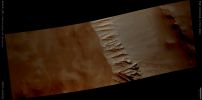
Psp_009698_1705_red.jpgNoctis Labyrinthus Region (possible True Colors; credits: Lunar Explorer Italia)103 visiteMars Local Time: 15:26 (early afternoon)
Coord. (centered): 9,3° South Lat. and 266,9° East Long.
Spacecraft altitude: 268,1 Km (such as about 167,5 miles)
Original image scale range: 26,8 cm/pixel (with 1 x 1 binning) so objects ~80 cm across are resolved
Map projected scale: 25 cm/pixel
Map projection: EQUIRECTANGULAR
Emission Angle: 19,2°
Phase Angle: 75,1°
Solar Incidence Angle: 60° (meaning that the Sun is about 30° above the Local Horizon)
Solar Longitude: 115,7° (Northern Summer)
Credits: NASA/JPL/University of Arizona
Additional process. and coloring: Lunar Explorer ItaliaMareKromium
|
|
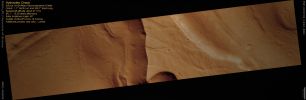
Psp_009709_1810_red.jpgA "segment" of Hydraotes Chaos (natural colors; credits: Lunexit)68 visiteHydraotes Chaos is an Equatorial Region of Chaotic Terrain located near some of the large outflow channels on Mars. Chaotic terrain near the Outflow Channels (ancient flood channels) is thought to form when ices beneath the surface rapidly become liquid or gaseous and escapes, and the remaining solid material collapses.
Chaotic terrain is called “chaotic” because it consists of a large jumble of randomly shaped Mesas (Hills) and Troughs. Many regions of Chaotic Terrain are located at the head (start) of the outflow channels, suggesting that the origins of the two classes of feature might be related to each other.
The Mesa located in the center of the image has elongated depressions that might be evidence of past fluvial activity.
Nota: questo dettaglio si riferisce ad una zona "famosa" per gli Eso-Archeologi...Quale?
Ma è la zona su cui dovrebbe sorgere la famosa "Città di Hydraotes Chaos", la Città del Bacino Alluvionale che è stata "vista" da illustri personaggi quali il Dr J. Skipper, il Dr R. Hoagland ed il nostrano Ing. E. Piccaluga.
Ora, avendo questa immagine davanti (che PARLA DA SOLA!), noi ci aspetteremmo due reazioni da questi personaggi:
1) se vogliono essere coerenti, allora devono dire che l'immagine è falsa o che è stata taroccata, per nascondere la "Città" oppure
2) se vogliono essere onesti devono cospargersi il capo di cenere, chiedere scusa alle migliaia di Appassionati presi per il fondo-schiena e quindi dedicarsi ad altra professione.
Purtroppo, però, costoro non faranno nulla di tutto ciò: costoro ignoreranno l'immagine e continueranno per la loro strada, fatta di bugie, traveggole e speculazioni pseudo-scientifiche a sfondo commerciale.MareKromium
|
|
| 2236 immagini su 187 pagina(e) |
 |
|
|
|
|
175 | |
|
|
|
|








