Mars Reconnaissance Orbiter (MRO)
|
|
|
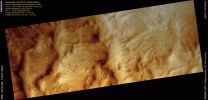
Psp_009548_1420_red.jpgEnigmatic Terrain in Hellas Planitia (Saturated Natural Colors; credits for the additional process. and color.: Dr Paolo C. Fienga - Lunexit Team)95 visiteHellas Planitia is the low-lying plain on the floor of the Hellas Basin, an ancient impact crater over 2000 Km wide. This Basin includes the lowest point on the surface of Mars.
A variety of unusual landforms occur on the floor of the basin due to the low elevation. One hypothesis is that Hellas may once have held lakes or seas, possibly with thick ice that might account for some of these features.
This image shows a small portion of Western Hellas, in a Region of "Enigmatic Ridges".
These ridges form an intricate pattern, enclosing kilometer-wide depressions. These strange features are still not well-understood; one possibility is that they formed in lake-bottom sediments when ice covering the lake touched bottom and shoved wet, loose material to the side.
This HiRISE image reveals that the ridges contain many boulders; sediments deposited on the bottom of a lake might be fine-grained, although they may have hardened to rock later. The image also shows lineations, probably outcropping layers, running between the large ridges.
Because the resolution of HiRISE images is sufficient to see details such as the abundance of boulders and the presence of thin sedimentary layers, images of this and other poorly-understood terrains will be important in interpreting the geological and climatological history of Mars.
This observation is part of a stereo pair along with PSP_007834_1420.MareKromium
|
|
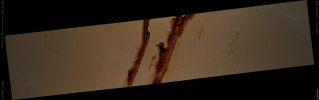
Psp_009557_1905_red.jpgChannels in Athabasca Valles (Natural Colors; credits for the additional process. and color.: Dr Paolo C. Fienga - Lunar Explorer Italia)66 visiteMars Local Time: 15:32 (middle afternoon)
Coord. (centered): 10,3° North Lat. and 157,0° East Long.
Spacecraft altitude: 292,6 Km (such as about 182,9 miles)
Original image scale range: 29,3 cm/pixel (with 1 x 1 binning) so objects ~88 cm across are resolved
Map projected scale: 25 cm/pixel
Map projection: EQUIRECTANGULAR
Emission Angle: 19,7°
Phase Angle: 35,8°
Solar Incidence Angle: 52° (meaning that the Sun is about 38° above the Local Horizon)
Solar Longitude: 110,6° (Northern Summer)
Credits: NASA/JPL/University of Arizona
Additional process. and coloring: Lunar Explorer ItaliaMareKromium
|
|
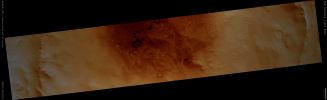
Psp_009565_1905_red.jpgDark Material on the Floor of an Unnamed Crater (Enhanced Natural Colors; credits for the additional process. and color.: Dr Paolo C. Fienga - Lunar Explorer Italia)68 visiteMars Local Time: 15:27 (early afternoon)
Coord. (centered): 10,3° North Lat. and 297,2° East Long.
Spacecraft altitude: 273,8 Km (such as about 171,1 miles)
Original image scale range: 27,4 cm/pixel (with 1 x 1 binning) so objects ~82 cm across are resolved
Map projected scale: 25 cm/pixel
Map projection: EQUIRECTANGULAR
Emission Angle: 2,5°
Phase Angle: 48,8°
Solar Incidence Angle: 51° (meaning that the Sun is about 39° above the Local Horizon)
Solar Longitude: 110,9° (Northern Summer)
Credits: NASA/JPL/University of Arizona
Additional process. and coloring: Lunar Explorer ItaliaMareKromium
|
|

Psp_009571_1755_red.jpgCrater Floor and Central Mound in Gale Crater (Natural Colors; credits for the additional process. and color.: Dr Paolo C. Fienga - Lunar Explorer Italia)66 visitenessun commentoMareKromium
|
|
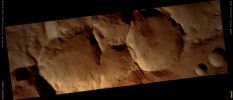
Psp_009572_1620_red.jpgSecondary Craters in Hesperia Planum (Enhanced and Saturated Natural Colors; credits for the additional process. and color.: Dr Paolo C. Fienga - Lunar Explorer Italia)73 visiteMars Local Time: 15:33 (middle afternoon)
Coord. (centered): 17,7° South Lat. and 109,6° East Long.
Spacecraft altitude: 257,5 Km (such as about 160,9 miles)
Original image scale range: 25,8 cm/pixel (with 1 x 1 binning) so objects ~77 cm across are resolved
Map projected scale: 25 cm/pixel
Map projection: EQUIRECTANGULAR
Emission Angle: 3,8°
Phase Angle: 63,7°
Solar Incidence Angle: 66° (meaning that the Sun is about 24° above the Local Horizon)
Solar Longitude: 111,1° (Northern Summer)
Credits: NASA/JPL/University of Arizona
Additional process. and coloring: Lunar Explorer Italia
Nota Lunexit: la caption NASA originale titola la foto "Fresh or Well-Preserved Chain of Impact Craters". A nostro avviso, le features di questo frame NON sono rappresentative di Crateri da Impatto Primari bensì - ed al limite - da Crateri da Impatto Secondari (è la loro forma, infatti, alquanto irregolare e squadrata, che ci suggerisce di escludere l'ipotesi per cui si tratti di Primary Impact Craters).MareKromium
|
|
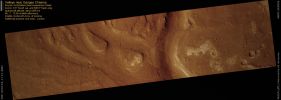
Psp_009578_1715_red.jpgValleys Near Ganges Chasma (natural colors; credits: Lunexit)77 visiteSeveral valleys as well as light-toned material are visible in this HiRISE image of a portion of Allegheny Vallis along the Plains West of Ganges Chasma.
The main valley, which starts in a pit called Ophir Cavus and extends for 155 Km into Ganges Chasma, is visible in the center of the image from left to right. Smaller and shallower valleys can be seen mostly to the north (Sx) of the image.
The observation that there are several valleys here suggests that water flowed for some extended period of time or multiple times in order to change direction and produce different valleys.
Light-toned material is visible on the upper surfaces of the plains but not inside the valleys, perhaps because smaller amounts of water could interact with the lava plains at these higher elevations, while in the valleys larger amounts of flowing water eroded and removed the plains unit. The light-toned nature on the upper surfaces could have resulted from chemical alteration of the lava plains or deposition of evaporites as the water disappeared and left behind minerals once carried in the water.MareKromium
|
|
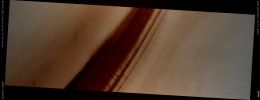
Psp_009589_2675_red.jpgHigh-Latitude Exposure of North Polar Layered Deposits (possible True Colors; credits: Lunar Explorer Italia)69 visiteMars Local Time: 15:35 (middle afternoon)
Coord. (centered): 87,5° North Lat. and 327,0° East Long.
Spacecraft altitude: 328,0 Km (such as about 205,0 miles)
Original image scale range: 32,8 cm/pixel (with 1 x 1 binning) so objects ~98 cm across are resolved
Map projected scale: 25 cm/pixel
Map projection: EQUIRECTANGULAR
Emission Angle: 15,8°
Phase Angle: 52,4°
Solar Incidence Angle: 64° (meaning that the Sun is about 26° above the Local Horizon)
Solar Longitude: 111,8° (Northern Summer)
Credits: NASA/JPL/University of Arizona
Additional process. and coloring: Lunar Explorer ItaliaMareKromium
|
|
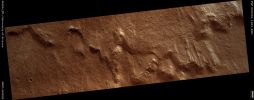
Psp_009593_1365_red.jpgGeometry of Ramparts for Crater in Middle Southern Latitudes (possible True Colors; credits: Lunar Explorer Italia)72 visiteMars Local Time: 15:35 (middle afternoon)
Coord. (centered): 43,4° South Lat. and 258,9° East Long.
Spacecraft altitude: 251,3 Km (such as about 157,0 miles)
Original image scale range: 50,3 cm/pixel (with 1 x 1 binning) so objects ~1,51 mt across are resolved
Map projected scale: 50 cm/pixel
Map projection: EQUIRECTANGULAR
Emission Angle: 8,3°
Phase Angle: 88,9°
Solar Incidence Angle: 83° (meaning that the Sun is about 7° above the Local Horizon)
Solar Longitude: 111,9° (Northern Summer)
Credits: NASA/JPL/University of Arizona
Additional process. and coloring: Lunar Explorer ItaliaMareKromium
|
|
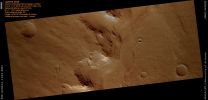
Psp_009601_1920_red.jpgLayered Shelf (possible natural colors; credits: Lunexit)79 visiteThis image shows the edge of a Layered Shelf in a large Impact Crater. Sediments form a bench with a flat top and steep edge along part of the interior wall. This site shows part of the steep edge of those deposits.
The bench is formed by an upper layer that is relatively hard and resistant, while lower rocks are soft. Once the upper cap layer is removed, the weaker material below is easily eroded. This structure can be seen here: at the very top of the bench is a relatively steep lip, while material below has a muted appearance. A few steep outcrops lower on the slope suggest that there could be other strong layers.
Because of pervasive dust cover, it is difficult to learn much about the nature of the rocks here. Dust builds up by settling out after the many large Martian Dust Storms. (The dark streaks running downhill are seen in many dusty parts of Mars and are thought to be traces of dust avalanches). However, some small-scale structures are visible through the dust. Some fine layering is also visible, particularly near the base of the slope.
The layers are probably still covered by dust, but not enough to completely obscure the underlying structure.MareKromium
|
|

Psp_009619_1630_red.jpgDouble Impact Crater (natural colors; credits: Lunexit)116 visiteThis image shows a double impact crater in Syria Planum, and probably formed when a binary asteroid pair (two asteroids closely orbiting each other, while also orbiting the Sun) struck the Surface. The asteroids must have been about the same size, on the order of a few hundred meters across, to produce these craters.
How is it possible to say that the double crater is due to a binary asteroid, instead of two independent impacts? Neither crater shows signs of burial by ejecta from the other. More importantly, the ejecta (material thrown out of the craters) shows signs of interacting; the ridges extending to the southeast of the crater probably formed when ejecta from the craters collided in midair, causing more debris to pile up at certain points.
This means that the impacts occurred within moments of each other.
Ejecta interaction features like this can also form in association with “secondary” craters (craters made by debris from other impacts, rather than by asteroids), since many secondary craters form at once. In this case, however, a binary asteroid is the likely cause. The very large size is one indicator (secondary craters are generally much smaller than the “primary” crater), and there is not an obvious nearby source crater. While secondary craters are common, binary impacts are expected to occur as well, since binary asteroid pairs are observed.
This crater pair is also of geologic interest since it exposes a cross-section of the local rocks. Thin, flat layers are visible in the upper walls. Since this region has seen extensive volcanic activity, these may be a mix of old lava flows and other volcanic debris. Exposures like this provide evidence for the extent and thickness of these deposits. MareKromium
|
|
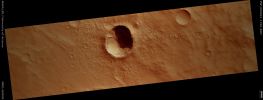
Psp_009622_1590_red.jpgMedium-size Impact Crater (possible True Colors; credits: Lunar Explorer Italia)90 visiteMars Local Time: 15:31 (middle afternoon)
Coord. (centered): 20,9° South Lat. and 184,4° East Long.
Spacecraft altitude: 257,3 Km (such as about 160,8 miles)
Original image scale range: 51,5 cm/pixel (with 1 x 1 binning) so objects ~1,54 mt across are resolved
Map projected scale: 50 cm/pixel
Map projection: EQUIRECTANGULAR
Emission Angle: 3,5°
Phase Angle: 70,5°
Solar Incidence Angle: 68° (meaning that the Sun is about 22° above the Local Horizon)
Solar Longitude: 112,9° (Northern Summer)
Credits: NASA/JPL/University of Arizona
Additional process. and coloring: Lunar Explorer ItaliaMareKromium
|
|
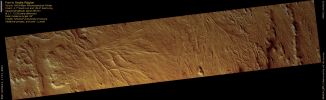
Psp_009623_1755_red.jpgFan in Aeolis Planum Region (natural colors; credits: Lunexit)93 visiteThis image shows a "Fan" of long raised ridges in the Aeolis Region of Mars.
These ridges are thought to be Inverted Stream Channels, where formerly low-lying streambeds have been hardened and then turned into ridges when the surrounding material was eroded.
This can occur if the stream deposited minerals, filling in pore spaces and hardening the streambed.
The assortment of ridges here is extremely complex, with strands cutting across each other. However, the actual stream system here could have been simpler, with ridges preserving different time periods in the history of the system. This possibility is supported by several sites where one ridge runs smoothly across another without disruption. One way for this to occur would be to have one streambed hardened and buried, with the stream subsequently changing course and cutting across its buried old route.
Although not all of the channels were active at once, this site clearly preserves a complex history, probably requiring thousands of years to foMareKromium
|
|
| 2236 immagini su 187 pagina(e) |
 |
|
|
|
|
174 | |
|
|
|
|








