Mars Reconnaissance Orbiter (MRO)
|
|
|
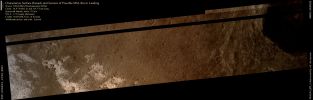
Psp_008891_2050_red.jpgCharacterize Surface Hazards and Science of Possible MSL Rover Landing - Mawrth Vallis (natural colors; credits: Lunexit)71 visitenessun commentoMareKromium
|
|
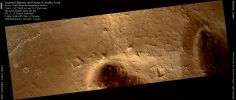
Psp_008982_1965_red.jpgLayered Deposits in Arabia Terra Region (natural colors; credits: Lunexit)69 visiteThis image shows the floor of an Unnamed Impact Crater in Arabia Terra that has Layered Deposits. There are many craters in this Region, where layering is observed.
These layers are often exposed along the sides of large isolated mounds, small knobs and mesas, and other positive relief features. In some cases, the layering is expressed as narrow sinuous ridge-like structures along crater floors.
The presence of Layered Deposits is of particular interest because these materials are not likely to be related to the impact event, but rather post-impact infill of the Crater. Modification of the Deposits has now revealed layers of material.
HiRISE and other instruments onboard the Mars Reconnaissance Orbiter may provide more clues to the origin of the these deposits.MareKromium
|
|

Psp_009011_1705_red.jpg"Apparent Valley", West of Ganges Chasma (natural colors; credits: Lunexit)84 visiteThis image shows an "Apparent Valley" North of a 37-Km long pit called Ophir Cavus. This valley is just West of another 155-Km long valley system called Allegheny Vallis, that also emanates from the pit.
The association of valleys with the pit suggests that water was released when the pit formed, perhaps when volcanic eruptions melted ice in the surface or subsurface.
The HiRISE image reveals light-toned units along portions of the plains and these could be minerals deposited by the flowing water or alteration of the plains by the water that once flowed here.MareKromium
|
|
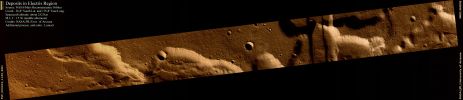
Psp_009029_1430_red.jpgDeposits in Electris Region (natural colors; credits: Lunexit)87 visiteThis observation reveals a portion of a long outcrop of a deposit in the Electris Region of Mars.
The Electris' Deposits occur over a range of landforms and relief and the process(es) responsible for their emplacement remain speculative.
Close examination of the outcrops reveal layering that in some places appear to include meter-scale blocks. Comparison with other HiRISE images of the deposit will enable more detailed mapping of its extent and nature and should provide new insight into the origin of these enigmatic materials.MareKromium
|
|

Psp_009207_1765_red.jpgCharacterize Surface Hazards and Science of MSL Rover Landing Site - Equatorial Regions/Meridiani Planum (natural colors; credits: Lunexit)81 visitenessun commentoMareKromium
|
|
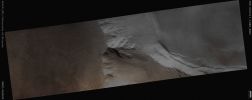
Psp_009317_1980_red~0.jpgPortion of the Southern Wall of Olympus Mons Caldera (Absolute Natural Colors; credits for the additional process. and color: Dr Paolo C. Fienga - Lunexit Team)151 visiteMars Local Time: 15:21 (early afternoon)
Coord. (centered): 17,8° North Lat. and 226,6° East Long.
Spacecraft altitude: 259,3 Km (such as about 162,1 miles)
Original image scale range: 51,9 cm/pixel (with 1 x 1 binning) so objects ~1,56 mt across are resolved
Map projected scale: 50 cm/pixel
Map projection: EQUIRECTANGULAR
Emission Angle: 3,3°
Phase Angle: 50,1°
Solar Incidence Angle: 47° (meaning that the Sun is about 43° above the Local Horizon)
Solar Longitude: 102,1° (Northern Summer)
Credits: NASA/JPL/University of Arizona
Additional process. and coloring: Dr Paolo C. Fienga - Lunar Explorer Italia MareKromium
|
|
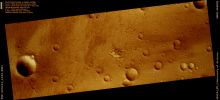
Psp_009319_1650_red.jpgDust Devil Tracks in Gusev Crater (Extremely Enhanced Natural Colors; credits for the additional process. and color.: Dr Paolo C. Fienga - Lunexit Team)75 visiteGusev Crater is decorated by tracks made by Dust Devils that have been observed by the Mars Exploration Rover Spirit, Mars Orbiter Camera (MOC), and HiRISE images.
Dust Devils are of interest because they may clean the Solar Panels that provide power to Spirit, and are partially responsible for dust transportation on the surface of Mars.
Dust Devils are actually giant convective vortices that form as a result of atmospheric vertical instability. Solar radiation warms the surface, forcing air to rise to an atmospheric convective boundary, where it then cools. The denser, cold air parcel descends and generates a circulation that creates a suction effect.
As the Dust Devil picks up material from the bright dust-mantled surface, it exposes the darker basaltic substrate. These scribble marks will follow the prevailing winds and tend to cluster together as the lower albedo surface heats up more quickly.
Scientists are trying to understand the relationship between Dust Devils and craters and other topographic features that generate multiple wind directions.MareKromium
|
|

Psp_009342_2650_red.jpgNorthern Dunes (possible True Colors; credits: Lunar Explorer Italia)71 visiteMars Local Time: 13:43 (early afternoon)
Coord. (centered): 84,9° North Lat. and 234,4° East Long.
Spacecraft altitude: 319,4 Km (such as about 199,6 miles)
Original image scale range: 32,0 cm/pixel (with 1 x 1 binning) so objects ~96 cm across are resolved
Map projected scale: 25 cm/pixel
Map projection: EQUIRECTANGULAR
Emission Angle: 6,5°
Phase Angle: 55,9°
Solar Incidence Angle: 61° (meaning that the Sun is about 29° above the Local Horizon)
Solar Longitude: 103,0° (Northern Summer)
Credits: NASA/JPL/University of Arizona
Additional process. and coloring: Lunar Explorer ItaliaMareKromium
|
|

Psp_009346_1985_red.jpgThila Crater (extremely enhanced natural colors; credits: Lunar Explorer Italia)68 visiteMars Local Time: 15:24 (early afternoon)
Coord. (centered): 18,1° North Lat. and 155,5° East Long.
Spacecraft altitude: 284,2 Km (such as about 177,6 miles)
Original image scale range: 28,4 cm/pixel (with 1 x 1 binning) so objects ~85 cm across are resolved
Map projected scale: 25 cm/pixel
Map projection: EQUIRECTANGULAR
Emission Angle: 6,0°
Phase Angle: 42,3°
Solar Incidence Angle: 48° (meaning that the Sun is about 42° above the Local Horizon)
Solar Longitude: 103,1° (Northern Summer)
Credits: NASA/JPL/University of Arizona
Additional process. and coloring: Lunar Explorer ItaliaMareKromium
|
|

Psp_009352_1770_red.jpgLight Toned Materials and Plains in Southern Meridiani Planum (Extremely Enhanced Natural Colors; credits: Lunexit)65 visitenessun commentoMareKromium
|
|

Psp_009353_1550_red~0.jpgLadon Valles (possible True Colors; credits: Lunar Explorer Italia)64 visiteMars Local Time: 15:30 (middle afternoon)
Coord. (centered): 24,6° South Lat. and 329,1° East Long.
Spacecraft altitude: 261,2 Km (such as about 163,3 miles)
Original image scale range: 52,3 cm/pixel (with 1 x 1 binning) so objects ~1,57 mt across are resolved
Map projected scale: 50 cm/pixel
Map projection: EQUIRECTANGULAR
Emission Angle: 2,5°
Phase Angle: 72,6°
Solar Incidence Angle: 71° (meaning that the Sun is about 19° above the Local Horizon)
Solar Longitude: 103,4° (Northern Summer)
Credits: NASA/JPL/University of Arizona
Additional process. and coloring: Lunar Explorer ItaliaMareKromium
|
|
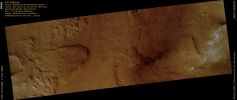
Psp_009368_1720_red.jpgIus Chasma (natural colors; credits: Lunexit)75 visiteThis image spans the floor of Ius Chasma’s Southern Trench. Ius Chasma is located in the Western Region of Valles Marineris, the Solar System’s largest canyon. This canyon is well known for its fine stratigraphic layers modified by wind and water.
The outcrops contain interchanging layers of dark and bright rocks. The layered deposits consist of dark basalt lava flows and bright sedimentary layers. The sediments are likely to be from atmospheric dust, sand, or alluvium from an ancient water source. The layers are visible on the gentle slopes above the canyon floor, in pitted areas, and in small mesa buttes. The floor of the canyon is littered with megaripples that are aligned in a North-South direction.
Ius Chasma is believed to have been shaped by a process called "sapping" that occurred when water seeped from the layers of the cliffs and evaporated before it reached the canyon floor. This process is thought to have dominated during the Amazonian Period.
Ius Chasma also has several structural features such as East trending normal Faults and Grabens that deformed the canyons. Recent geomorphological events include Mass Wasting (Avalanches) and minor Sapping from Gullies that continued to erode the canyon walls.MareKromium
|
|
| 2236 immagini su 187 pagina(e) |
 |
|
|
|
|
170 | |
|
|
|
|








