Mars Reconnaissance Orbiter (MRO)
|
|
|
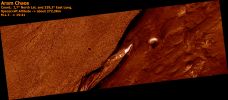
Psp_002839_1825_red.jpgAram Chaos' Sediments (False Colors)66 visiteAram Chaos appears to be a former impact crater. The terrain is disrupted, giving it a chaotic appearance (hence the name "chaos"). Scientists have postulated that a lake may have once existed inside the crater and sediments were laid down within the lake.
The mineral Hematite (rich in Iron) has been detected by orbiting spacecraft within Aram Chaos. Hematite has been identified in several other locations on Mars, including at the MER Landing Site in Meridiani Planum. The Hematite at both Meridiani and Aram Chaos most likely formed by precipitation in water.
This HiRISE image shows the light-toned sediments inside Aram Chaos that could have formed in a former lake. Unfortunately, dark debris now obscures much of this sediment, making it difficult to view and interpret the rocks. The light-toned layered deposit in the south (Dx) of the image is higher standing and has a pitted surface.
Circular structures with dark centers are likely to be impact craters that have been partly filled with dark debris, including sand. More irregular depressions appear to result from erosion of layered beds within the sediments. Wind could erode materials that are slightly weaker more quickly and produce the irregular topography seen along the surface of the deposit.
|
|
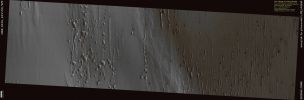
Psp_007242_2650_red.jpgChasma Boreale (natural colors; credits: Lunexit)78 visitenessun commentoMareKromium
|
|
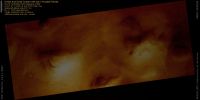
Psp_008210_2415_red~0.jpgKnobs and Small Craters with Ice in Northern Arcadia Planitia (natural colors; credits: Lunexit)78 visitenessun commentoMareKromium
|
|
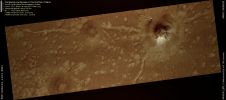
Psp_008216_2325_red.jpgPeriglacial Surface Features in the Northern Plains (natural colors; credits: Lunexit)64 visitenessun commentoMareKromium
|
|

Psp_008222_1640_red.jpgCollpse Pits along Claritas Rupes (Saturated and Enhaced Natural Colors; credits for the additional process. and color.: Dr Paolo C. Fienga - Lunexit Team)89 visitenessun commentoMareKromium
|
|
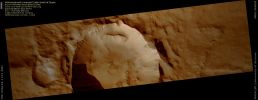
Psp_008238_1555_red.jpgWell-Preserved Unnamed Crater South of Gusev Crater (natural colors; credits: Lunexit)71 visitenessun commentoMareKromium
|
|
Psp_008240_2500_red.jpgLouth Crater South Rim (Extremely Enhanced Natural Colors; credits for the additional process. and color: Dr Paolo C. Fienga - Lunexit Team)67 visitenessun commentoMareKromium
|
|

Psp_008680_2050_red.jpgCharacterize Surface Hazards and Science of Possible MSL Rover Landing - Mawrth Vallis (natural colors; credits: Lunexit)65 visitenessun commentoMareKromium
|
|
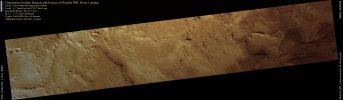
Psp_008706_1765_red.jpgCharacterize Surface Hazards and Science of Possible MSL Rover Landing Site - Equatorial Regions/Meridiani Planum (natural colors; credits: Lunexit)65 visitenessun commentoMareKromium
|
|

Psp_008719_1815_red.jpgCharacterize Surface Hazards and Science of MSL Rover Landing Site - Equatorial Regions/Meridiani Planum (natural colors; credits: Lunexit)69 visitenessun commentoMareKromium
|
|
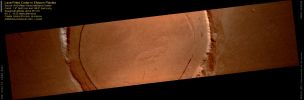
Psp_008753_1880_red.jpgLava-filled Crater in Elysium Planitia (natural colors; credits: Lunexit)79 visiteElysium Planitia is a part of the Martian Lowlands that has been repeatedly covered by vast floods of lava. This image shows an older Impact Crater that has been filled by one of the youngest of those lava floods.
Only sections of the circular rim of the Crater remain uncovered. The lava surface consists of ridged plates that have rafted apart with smoother lava filling between the plates. The ridges formed as the solidifying lava crust was crumpled by compression, and the gaps between the plates formed as the crust was pulled apart. Similar compression and extension of lava crust has been observed in the largest lava flows in Iceland.
The most puzzling aspect of this image is that the lava in the floor of the Crater appears to have sunk down compared to its surroundings. This happened after a thick crust had formed on the lava. The most likely explanation is that the last molten lava inside the flow drained away through a now buried gap in the crater rim.
A final point of interest are the small circular cones visible near the center of the Crater. These formed when ground water (or ice) was turned to steam by the heat of the lava flow. This steam exploded through the flow, producing the small cratered cones.MareKromium
|
|

Psp_008779_1905_red.jpgThe Head of Athabasca Valles (natural colors; credits: Lunexit)65 visiteThis observation is located at the head of the Athabasca Valles Channel System, which lies just North of Mars’ Equator, in a low-elevation Region known as Elysium Planitia.
Athabasca Valles has an interesting geologic history. It was probably carved by one or more catastrophic floods of water, but more recently, a flood of lava coursed through the channel system. Both the water and the lava erupted from a few discrete points (or “vents”) along the Cerberus Fossae, a 1600-Km(1000-mile) long network of extensional (or “normal”) faults. The two prominent troughs that cut across the Southern end of this HiRISE image are part of the Cerberus Fossae. They are distinct fault segments that overlap at their tips, as one tapers in and the other pinches out.
They were not always as wide as they are today. Erosional processes have widened the troughs over time. Major eruptions occurred along both of the fault segments seen in this image, though they occurred to either side of the imaged area itself. Lava that erupted from the western vent covers the northern half of the image. The lava has raised, lobate margins and is slightly darker in tone than the older cratered plains it embays. The lava also has a banded appearance of subtly contrasting lighter and darker tones, that correspond to variations in surface roughness.
The bands are concentric to a vent located immediately west of the imaged area. Unfortunately, vents along the Cerberus Fossae are not well preserved.MareKromium
|
|
| 2236 immagini su 187 pagina(e) |
 |
|
|
|
|
169 | |
|
|
|
|








