Mars Reconnaissance Orbiter (MRO)
|
|
|

Psp_001700_2505_red-00~0.jpgLauth Crater and the Frozen "Pseudo-Lake" of Vastitas Borealis (CTX Frame - Absolute Natural Colors; credits for the additional process. and color.: Dr Paolo C. Fienga - Lunexit Team)344 visiteThe right side of PSP_001700_2505 shows a portion of a Frost Patch on a Mound inside a Northern Hemisphere Crater (unofficially known as "Lauth Crater").
The Frost Patch has remained largely stable at least since the Viking era (late 1970s). The bright Frost Region is bounded by a Dunefield on the North-East. Several sizes of Dunes are visible. The size classes probably represent generations of Dunes that formed under a variety of dominant wind conditions. MareKromium
|
|

Psp_001700_2505_red-01.jpgThe "Frozen Lake" of Vastitas Borealis...is not a Lake, according to NASA (EDM - Enhanced Natural Colors; credits for the additional process. and color.: Dr Paolo C. Fienga - Lunexit Team)71 visiteThis EDM shows the Dunes and Frost boundary up-close. The Frost is largely absent over the Dunes and is more stable over the ground that does not have dune-shaped landforms.
|
|
Psp_001700_2505_red-01.jpgLauth Crater and the Frozen "Pseudo-Lake" of Vastitas Borealis (CTX Frame - Absolute Natural Colors; credits for the additional process. and color.: Dr Paolo C. Fienga - Lunexit Team)329 visiteThis EDM shows the Dunes and Frost boundary up-close. The Frost is largely absent over the Dunes and is more stable over the Ground that does not have Dune-shaped Landforms.MareKromium
|
|
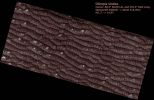
Psp_001736_2605_red.jpgThe Dunes of Olympia Undae (MULTISPECTRUM; credits: Lunexit)77 visiteThis HiRISE image shows dark dunes and light polygonal terrain in Olympia Undae, also known as the North Polar Erg.
Two sets of dunes are obvious. The major set trends ~North-South, indicating winds from the East or West. Between the crests of these dunes is a second set oriented mostly East-West.
Zooming in on the dunes, a rippled texture is apparent, probably due to redistribution of sand at the scale of meters and less. Near the crests of some dunes are channel-like features, with some branching downslope.
The origin of these channels is unknown, but they may result from the flow and displacement of sand that was fluidized by sublimating CO2 or water frost.
Bright patches of ground are found in some inter-dune areas, with many having a polygonal texture. Polygons on Earth form from contraction induced by stresses from dehydration, cooling, and other processes, so these features may have a similar origin.
The CRISM instrument on MRO and OMEGA on Mars Express indicates that many dunes in Olympia Undae are rich in the mineral gypsum. MareKromium
|
|
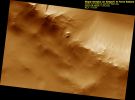
Psp_001808_1875_red.jpgSlope Streaks (or "Seeps"?) in Terra Sabaea92 visiteSlope streak formation is among the few known processes currently active on Mars. While their mechanism of formation and triggering is debated, they are most commonly believed to form by downslope movement of extremely dry sand or very fine-grained dust in an almost fluidlike manner (analogous to a terrestrial snow avalanche) exposing darker underlying material. Other ideas include the triggering of slope streak formation by possible concentrations of near-surface ice or scouring of the surface by running water from aquifers intercepting slope faces, spring discharge (perhaps brines) and/or hydrothermal activity.
Several of the slope streaks visible here, particularly the 3 longest darker streaks, show evidence that downslope movement is being diverted around obstacles such as large boulders. Several streaks also appear to originate at boulders or clumps of rocky material.
In general, the slope streaks do not have large deposits of displaced material at their downslope ends and do not run out onto the crater floor suggesting that they have little reserve kinetic energy. The darkest slope streaks are youngest and can be seen to cross cut and superpose older and lighter-toned streaks. The lighter-toned streaks are believed to be dark streaks that have lightened with time as new dust is deposited on their surface.
MareKromium
|
|
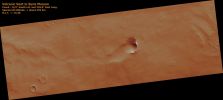
Psp_001840_1660_red.jpgVolcanic Vent in Syria Planum (natural colors; credits: Lunar Explorer Italia)68 visitePrevious images of this area by other space missions indicate that this is a shield volcano with very shallow slopes. What HiRISE reveals is that it is completely covered by a blanket of dust.
While volcanic featues remain obscure, the dust does exhibit some very strange patterns. As you zoom into the middle of the image, the ground appears covered with a fine network of light and dark polygons. But at full resolution, it can be seen that these polygons are actually the edges of small scallops.
The dust is apparently held together by some unknown means, giving it sufficient strength to be carved into this strange pattern.MareKromium
|
|
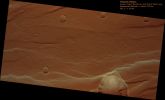
Psp_001840_2000_red.jpgTharsis' Plains (natural colors; credits: Lunar Explorer Italia)64 visiteThis HiRISE image samples the plains between the large shelf volcanoes in the Tharsis Region of Mars.
The long scarps in the area have been formed by faults as the ground was pulled apart. The large circular depression on the edge of the image is a giant collapse pit that appears to be related to the opening up of crust.
If you look at this image carefully, much of the plains appears blurry, as if the picture was out of focus. But HiRISE remains in perfect focus and it is Mars that is actually this blurry. Soft wind-blown dust mutes all the features in the area to create this effect.MareKromium
|
|

Psp_001860_1685_red.jpgLight-colored terrain in the Southern Highlands (possible True Colors; credits: Lunar Explorer Italia)76 visiteThis HiRISE image shows part of the floor of a large impact crater in the southern highlands, north of the giant Hellas impact basin. Most of the crater floor is dark, with abundant small ripples of wind-blown material. However, a pit in the floor of the crater has exposed light-toned, fractured rock.
The light-toned material appears fractured at several different scales. These fractures are called joints, and result from stresses on the rock after its formation.
Joints are similar to faults, but have undergone virtually no displacement. With careful analysis, joints can provide insight into the forces that have affected a unit of rock, and thus into its geologic history. The fractures appear dark; this may be due to trapping of dark, wind-blown sand in the crack, to precipitation of different minerals along the fracture, or both.MareKromium
|
|
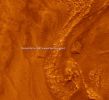
Psp_002098_2220_red-01.jpgMantles and Flows in Moreux Crater, with a "small" Surface Anomaly (EDM - False Colors)79 visiteSegnalataci dal Dr Barca (ottimo "occhio"!), la possibile Anomalìa di Superficie si sostanzia in una traccia di colore scuro che ci appare incongrua, nella sua direzione, rispetto alle altre fratture (anche modeste) della superficie ripresa, rispetto alla generale direzione assunta da dune e ripples e rispetto a tutte le altrei stratificazioni visibili.
Di che si tratta? Potrebbe essere un image-artifact (la definizione del frame, sebbene eccellente, non è tale da consentirci di escludere l'ipotesi del vizio fotografico), così come potrebbe trattarsi di una recente frattura del suolo (magari di origine sismica) o anche di uno "scalino" roccioso (un layer sedimentario parzialmente esumato).
Certo, se fossimo degli Eso-Archeologi illuminati ed immaginifici, ci saremmo già diretti verso l'ipotesi (decidete Voi se è "esotica" o meno) della "possibile evidenza di una struttura superficiale artificiale".
Ma noi non siamo Eso-Archeologi.
E, purtroppo, non siamo neppure illuminati ed immaginifici, però...però, se proprio dovessimo "azzardare"...diremmo che il rilievo scuro, in questo frame, potrebbe anche essere un'ombra. Di che cosa? Beh, questo "azzardatelo" Voi!...
|
|

Psp_002419_1675_red-02.jpgFrozen Waterfalls or just Layers and Dark Debris in Melas Chasma?76 visiteThis HiRISE sub-image shows layering in a light-toned deposit in Melas Chasma.
The layers are sedimentary in origin, but there are many processes that could have deposited them, such as volcanic airfall from explosive eruptions, dust-size particles settling out of the atmosphere due to cyclic changes and deposition in standing bodies of water.
By looking at the slopes in the layers and how the layers intersect each other, scientists can rule out various origins. A darker material can be seen covering much of the layered deposit. Some of this dark material is loose and can be seen accumulating as debris aprons at the base of steep slopes. Other dark material appears indurated and has been eroded by the wind to form etched edges with topographic expressions.
The lack of impact craters on the layered deposit indicates that it is a relatively young deposit, or the craters have been removed by the wind, or the deposit was quickly buried and is now being exhumed.MareKromium
|
|
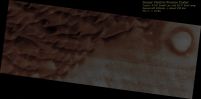
Psp_002455_1320_red-PCF-LXTT.jpgDunes in Proctor Crater (Absolute Natural Colors; credits for the additional process. and color.: Dr Paolo C. Fienga - Lunexit Team)127 visiteThis image shows the edge of a Dark Dunefield on the Floor of Proctor Crater, an approx. 150 Km diameter Impact Crater located in the Southern Highlands of Mars.
Many smaller and brighter "Bed-Forms", most likely small dunes or Granule Ripples, cover the substrate between the larger Dark Dunes as well as most of the Floor of Proctor Crater. In many locations, large (Erratic) Boulders are seen on the same surfaces as the bright Bed-Forms.
The Dark Dunes stratigraphically overlie the small bright Bed-Forms, indicating that the Dark Dunes formed more recently. However in several areas, the Dark Dunes appear to influence the orientation of the small Bright Dunes, possibly by wind flowing around the larger ones, suggesting that both Dark and Bright Bed-Forms are coeval.MareKromium
|
|

Psp_002538_1720_red.jpgJust like Thaumasia: more "bright" dunes in Ius Chasma64 visiteIus Chasma is one of several canyons that make up Valles Marineris, the largest canyon system in the Solar System.
The canyons likely formed by extension in association with the development of the Tharsis plateau and volcanoes to the West. Wind and possibly water have modified the canyons after they formed.
This HiRISE image shows the floor of Ius Chasma. The floor is bounded to the North and South by higher standing wallrock, with a few exposures of wallrock seen in the North (Sx) of the picture. Much of the floor is covered by ripples that are oriented approximately North-South, indicating an East to West wind flow, parallel to the orientation of Ius Chasma.
Layered deposits and bright patches of material are also seen along portions of the Ius Chasma floor. The layered deposits appear distinct in morphology from the nearby wallrock. These layered deposits could be lava flows, sediments deposited in a former lake, or fines that settled out from the atmosphere over time, such as dust or volcanic ashes.
The bright outcrops visible further south in the image have been seen elsewhere in Valles Marineris as well as other locations on Mars and tend to have mineral signatures consistent with sulfates. Data from the CRISM instrument (also on Mars Reconnaissance Orbiter) of the composition of these bright patches in Ius Chasma could shed insight into their origin. MareKromium
|
|
| 2236 immagini su 187 pagina(e) |
 |
|
|
|
|
168 | |
|
|
|
|








