Mars Reconnaissance Orbiter (MRO)
|
|
|
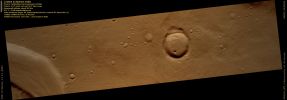
PSP_010630_2115_RED_abrowse-00.jpgCraters and possible "Pingo" in Mamers Vallis (ctx frame - Natural Colors; credits: Lunar Explorer Italia)80 visiteThis image was suggested by Mr. Dennis Mitchell's 8th grade NASA team, Evergreen Middle School, Cottonwood, CA, as part of the HiRISE Quest Student Image Challenge.
They write: "Located near Mamers Valles, this image shows numerous fluvial features that indicate this area was once rich with water. The lineated valley fill suggests an ice-rich soil. [Of particular interest] is a small cone-like feature [located on the floor of a 2 Km-diameter] impact crater in the center of the ctx frame.MareKromium
|
|
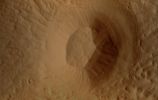
PSP_010630_2115_RED_abrowse-01.jpgCraters and possible "Pingo" in Mamers Vallis (edm - Natural Colors; credits: Lunar Explorer Italia)101 visite"At first this resembles a cinder cone volcano on Earth. However, when magnified, it reveals a feature [found in Arctic regions] on Earth called "Pingo". These are caused by ice protruding through the soil creating a positive-relief geologic feature. If you examine the smaller craters in the surrounding terrain you'll see a checkerboard pattern in each one. These closely resemble melted Pingos on Earth, again suggesting an area of Mars that was once rich with water."
While the student's suggestion that the mound-like structure is a Pingo is reasonable, there is yet no scientific consensus for the origin of these interesting structures.
Nota Lunexit: con tutto il rispetto per le brillanti intuizioni dei ragazzini "sponsorizzati" dalla NASA, l'idea del "Pingo" non stà - davvero - nè in cielo, nè in Terra. Eppure, come leggete, anche a queste boutades (perchè provengono da fanciulli - probabilmente - "quotati" a tutti i livelli), viene dato spazio. Poi però, se chiedi ai Signori di Pasadena o della University of Arizona, ad esempio, cosa potrebbe essere la Silver Sphere (o altri rilievi anomali simili, a parer nostro - e NON SOLO nostro - MOLTO più intriganti dello "pseudo Pingo")...Ecco che cala il silenzio più totale.
Che tristezza...MareKromium
|
|
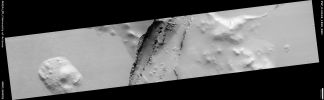
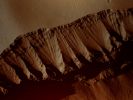
PSP_010638_1890_RED_abrowse-00.jpgAngular Unconformity in Cerberus Fossae (ctx RAW frame)104 visiteThis HiRISE image shows a part of the Cerberus Fossae, a long system of aligned fissures. The Cerberus Fossae were the source of the youngest major volcanic eruption on Mars that covered much of the surrounding area in lava. The region has also seen much other volcanic activity.
The walls of the fissures typically reveal lava layers. At this site, they have cut through an older hill that protrudes above the surrounding plains. The layers within the hill are tilted relative to the overlying rock, which appears to drape the region and runs continuously over the hill and plains.
This tilted contact is known as an Angular Unconformity. It is most likely that this formed when horizontal layers were tilted by faults before the most recent volcanic eruptions, forming the irregular hills.
The hills represent relatively old rock, while the smooth plains and the thin draping cover were formed more recently.MareKromium
|
|
PSP_010638_1890_RED_abrowse-01.jpgAngular Unconformity in Cerberus Fossae (edm; possible True Colors; credits: Lunar Explorer Italia)94 visitenessun commentoMareKromium
|
|
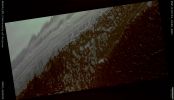
PSP_010716_2640_RED_abrowse.jpgNorth Polar Cavi Scarp with Unconformity (Natural Colors; credits: Lunar Explorer Italia)106 visiteMars Local Time: 14:14 (early afternoon)
Coord. (centered): 83,9° North Lat. and 165,7° East Long.
Spacecraft altitude: 322,0 Km (such as about 201,3 miles)
Original image scale range: 64,4 cm/pixel (with 1 x 1 binning) so objects ~ 1,93 mt across are resolved
Map projected scale: 50 cm/pixel
Map projection: EQUIRECTANGULAR
Emission Angle: 3,5°
Phase Angle: 71,4°
Solar Incidence Angle: 74° (meaning that the Sun is about 16° above the Local Horizon)
Solar Longitude: 154,4° (Northern Summer)
Credits: NASA/JPL/University of Arizona
Additional process. and coloring: Lunar Explorer ItaliaMareKromium
|
|
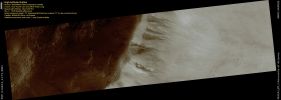
PSP_010833_1275_RED_abrowse.jpgHigh-Latitude Gullies (Natural Colors; credits: Lunar Explorer Italia)94 visitenessun commentoMareKromium
|
|
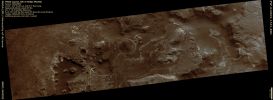
PSP_010839_1525_RED_abrowse.jpgPitted Layers, N/E of Hellas Planitia Region (Natural Colors;: credits: Lunexit)94 visitenessun commentoMareKromium
|
|
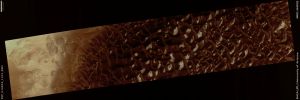
PSP_010854_1325_RED_abrowse.jpgProctor Crater Dunes (Natural Colors; credits: Lunar Explorer Italia)93 visiteIn the winter the dunes in Proctor Crater are covered with seasonal carbon dioxide frost (dry ice). In the spring, the frost gradually evaporates but lingers in protected regions. In this color image bright ice deposits in sheltered areas highlight the ripples on the dunes.
These dunes were imaged during the first year of MRO’s mission. Images taken now in the second Martian spring can be compared to the previous year to study interannual variability.
Mars Local Time: 15:59 (middle afternoon)
Coord. (centered): 47,2° South Lat. and 34,0° East Long.
Spacecraft altitude: 254,5 Km (such as about 159,1 miles)
Original image scale range: 50,9 cm/pixel (with 1 x 1 binning) so objects ~1,53 mt across are resolved
Map projected scale: 50 cm/pixel
Map projection: EQUIRECTANGULAR
Emission Angle: 8,2°
Phase Angle: 70,3°
Solar Incidence Angle: 77° (meaning that the Sun is about 13° above the Local Horizon)
Solar Longitude: 160,1° (Northern Summer)
Credits: NASA/JPL/University of Arizona
Additional process. and coloring: Lunar Explorer ItaliaMareKromium
|
|
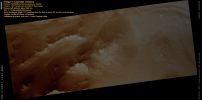
PSP_010857_1650_RED_abrowse.jpgRidge in Coprates Chasma (Natural Colors; credits: Lunar Explorer Italia)89 visitenessun commentoMareKromium
|
|
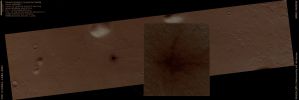
PSP_010862_1880_RED_abrowse-00-PCF-LXTT.jpgRecent Impact in Amazonis Planitia (Absolute Natural Colors; credits for the additional process. and color.: Dr Paolo C. Fienga - Lunexit Team)112 visitenessun commentoMareKromium
|
|
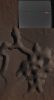
PSP_010875_1785_e_Mariner_9-PCF-LXTT.jpgAvernus Cavi (a MRO and Mariner 9 Image-Comparison by Dr Paolo C. Fienga - Lunexit Team)211 visiteMars Local Time: 15:45 (Middle Afternoon)
Coord. (centered): 1,7° South Lat. and 173,6° East Long.
Spacecraft altitude: 272,0 Km (such as about 170,0 miles)
Original image scale range: 54,4 cm/pixel (with 1 x 1 binning) so objects ~ 1,63 mt across are resolved
Map projected scale: 50 cm/pixel
Map projection: EQUIRECTANGULAR
Emission Angle: 1,6°
Phase Angle: 55,6°
Solar Incidence Angle: 57° (meaning that the Sun is about 33° above the Local Horizon)
Solar Longitude: 160,9° (Northern Summer)
Credits: NASA/JPL/University of Arizona
Additional process. and coloring: Lunar Explorer Italia
Nota Lunexit: questa comparazione fra immagini la cui qualità è profondissimamente diversa (con tutto il rispetto per quanto ottenuto dalla Sonda Mariner 9) l'abbiamo ritenuta necessaria al fine di dare una modestissima - ma, riteniamo, doverosa - risposta a recenti (ed immense) sciocchezze che abbiamo avuto la sventura di leggere su un Forum Amico.
Massimo rispetto per il Forum in oggetto ed i suoi Amministratori, sia chiaro, ma, a nostro parere, anche la "Libertà di Parola" - specialmente allorchè essa si risolve nell'espressione quotidiana ed assillante di immense stupidaggini - dovrebbe trovare qualche temperamento.
Se ciò non venisse fatto, credeteci, la conseguenza del "laissez faire et laissez passer" a tutti i costi, darà luogo ad un unico (e NEFASTO) risultato: questa Materia, già resa vacillante dai deliri di prezzolati pseudo-ricercatori (Hoagland su tutti, anche se i cosiddetti "de-bunkers" hanno dato e stanno dando un pesantissimo contributo disinformativo), precipiterà nel più incontrollato ed incontrollabile delirio intellettuale e poi nel ridicolo.
Attenzione, quindi: scrivere e discutere si, sempre. Ma A CONDIZIONE che si abbia realmente qualcosa di sensato da scrivere e discutere!
Se poi vogliamo dar voce, per forza e per principio, anche a persone abissalmente ignoranti o mentalmente disturbate, lo si faccia pure, ma nella consapevolezza che un tale agire non produrrà la diffusione nè di Cultura nè di Democrazia, ma solo di cialtronaggine (una lebbra che ha già fatto milioni di vittime, in innumerevoli Campi, ormai già da tempo, tanto tempo...).MareKromium
|
|
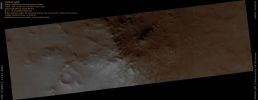
PSP_010877_1610_RED_abrowse-PCF-LXTT.jpgCentral Uplift (Absolute Natural Colors; additional process.: Dr Paolo C. Fienga - Lunexit Team)107 visitenessun commentoMareKromium
|
|
| 2236 immagini su 187 pagina(e) |
 |
|
|
|
|
164 | |
|
|
|
|








