Mars Reconnaissance Orbiter (MRO)
|
|
|

PSP_009488_1745_RED_abrowse-01.jpgMartian Caves (edm n. 1 - possible natural colors; credits: Lunexit)77 visiteThe pair of Pit Craters visible here are the smallest “anomalous” pits known to exist at this time. These have either vertical or sub-vertical interior walls (sub-vertical means that they are not visible from a nearly overhead viewing perspective), and each pit is deep enough that sunlight does not hit the floor when the Sun is at or near the Zenith.
Unfortunately, the only thermal-infrared camera currently orbiting Mars cannot resolve features this small, so the temperature characteristics of these pits must remain unknown for now, underscoring the need for a high-resolution thermal instrument on future missions.
Intriguingly, when pit craters on Earth have similar characteristics to the pair shown here, they often have cave entrances in their bases connecting to large underground networks. Current investigations are determining whether the anomalous Martian Pits may be shown to contain such entrances.MareKromium
|
|

PSP_009488_1745_RED_abrowse-02.jpgMartian Caves (edm n. 2 - possible natural colors; credits: Lunexit)98 visiteThe ability to detect and explore Martian caves is of intense interest to many disciplines in Planetary Science. Caves, in fact, may expose entire sets of stratigraphic layers, providing windows into Mars’ Geologic and Atmospheric histories.
MareKromium
|
|

PSP_009488_1745_RED_abrowse-03.jpgMartian Caves (edm n. 3 - possible natural colors; credits: Lunexit)76 visiteCave environments can also protect organic life from extremely harsh conditions on the Martian Surface, and may provide future human explorers with secure habitats. Accordingly, caves are considered among the most promising locations to find preserved evidence of past or present microbial life.
Furthermore, the challenges associated with Mars cave exploration may inspire a full range of new technologies, such as advanced robotics and target-specific landing capabilities.MareKromium
|
|
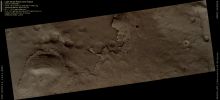
PSP_009523_2165_RED_abrowse.jpgLight-Toned Rock and Scarps (Natural Colors; credits: Lunexit)66 visitenessun commentoMareKromium
|
|
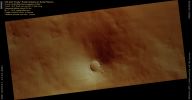
PSP_009527_1670_RED.JPGOld and "Dusty" Volcano in Syria Planum (natural colors; credits: Lunexit)77 visiteThis image shows an old volcano in Syria PlanumRegion, near the edge of the Tharsis volcanic rise. This is a Region where extensive volcanism has occurred; in many places, the upper walls of Valles Marineris have cut through lava flows.
The basic shape of the old volcano is visible here, but the entire region has been coated by dust.
This makes it difficult to learn more about the volcanic processes that have occurred at this site. However, the mantle is interesting by itself. It has probably settled out of the atmosphere, either as dust or possibly volcanic ash, since it seems to coat the entire region uniformly. (Mars has frequent, massive Dust Storms which could create large deposits over time.) This mantle has a regular, scalloped texture that is visible at several scales.
The texture is not well understood; it is common in volcanic terrains, but also occurs on some other rock outcrops.
HiRISE scientists are studying images like this one to determine how it forms.MareKromium
|
|
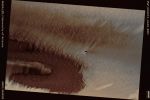
PSP_009655_2620_RED.jpgSmall Crater on the North Polar Layered Deposits (possible True Colors; credits: Lunar Explorer Italia)77 visiteMars Local Time: 14:02 (early afternoon)
Coord. (centered): 81,8° North Lat. and 333,1° East Long.
Spacecraft altitude: 318,6 Km (such as about 199,1 miles)
Original image scale range: 31,9 cm/pixel (with 1 x 1 binning) so objects ~96 cm across are resolved
Map projected scale: 25 cm/pixel
Map projection: EQUIRECTANGULAR
Emission Angle: 4,9°
Phase Angle: 64,3°
Solar Incidence Angle: 60° (meaning that the Sun is about 30° above the Local Horizon)
Solar Longitude: 114,1° (Northern Summer)
Credits: NASA/JPL/University of Arizona
Additional process. and coloring: Lunar Explorer ItaliaMareKromium
|
|
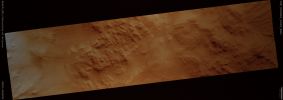
PSP_009660_2020_RED.jpgWest Olympus Mons (Extremely Saturated Natural Colors; credits for the additional process. and color.: Dr Paolo C. Fienga - Lunar Explorer Italia)74 visiteMars Local Time: 15:25 (early afternoon)
Coord. (centered): 21,5° North Lat. and 221,9° East Long.
Spacecraft altitude: 280,3 Km (such as about 175,2 miles)
Original image scale range: 28,0 cm/pixel (with 1 x 1 binning) so objects ~56,1 cm across are resolved
Map projected scale: 25 cm/pixel
Map projection: EQUIRECTANGULAR
Emission Angle: 0,4°
Phase Angle: 47,5°
Solar Incidence Angle: 47° (meaning that the Sun is about 43° above the Local Horizon)
Solar Longitude: 114,3° (Northern Summer)
Credits: NASA/JPL/University of Arizona
Additional process. and coloring: Lunar Explorer ItaliaMareKromium
|
|
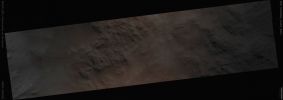
PSP_009660_2020_RED~0.jpgWest Olympus Mons (Absolute Natural Colors; credits for the additional process. and color.: Dr Paolo C. Fienga - Lunar Explorer Italia) 144 visiteMars Local Time: 15:25 (early afternoon)
Coord. (centered): 21,5° North Lat. and 221,9° East Long.
Spacecraft altitude: 280,3 Km (such as about 175,2 miles)
Original image scale range: 28,0 cm/pixel (with 1 x 1 binning) so objects ~56,1 cm across are resolved
Map projected scale: 25 cm/pixel
Map projection: EQUIRECTANGULAR
Emission Angle: 0,4°
Phase Angle: 47,5°
Solar Incidence Angle: 47° (meaning that the Sun is about 43° above the Local Horizon)
Solar Longitude: 114,3° (Northern Summer)
Credits: NASA/JPL/University of Arizona
Additional process. and coloring: Dr Paolo C. Fienga - Lunar Explorer Italia MareKromium
|
|
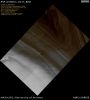
PSP_009663_2635_RED-00.jpgSmall Crater on the North Polar Layered Deposits (CTX Frame - Saturated and Enhanced Natural Colors; credits for the additional process. and color.: Dr Paolo C. Fienga - Lunexit Team) 102 visiteThe North Polar Layered Deposits, and the bright Ice Cap that covers them, are very young (by geologic standards) features. To try and figure out the age of an area, or how quickly it's being resurfaced, planetary scientists count up the number of craters at different sizes. An older surface has more time to accumulate more craters whereas a younger surface, or one that has a lot of geologic activity that destroys craters, doesn't have many impact craters.
These Polar Deposits have a very low crater count so it is possible that the Ice Cap (bright white in this image) might only by about 10.000 years old and the surface of the layered deposits (orange-brown in this image) may be only a few million years old.
This sounds like a long time but is very short compared to other surfaces on Mars.
HiRISE is enabling a more detailed study of these Polar Craters and the target of this observation is visible in the center of the image.MareKromium
|
|
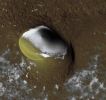
PSP_009663_2635_RED-01.jpgSmall Crater on the North Polar Layered Deposits (EDM - Enhanced Natural Colors; credits for the additional process. and color.: Dr Paolo C. Fienga - Lunexit Team) 77 visiteThis crater proved to be a surprise in a few ways. Its shape is non-circular which is quite unusual for an impact crater. One possibility is that flow of the ice beneath the surrounding terrain has deformed the crater; however, ice-flow rates are thought to be very low on Mars today.
The crater also contains a patch of bright ice despite being surrounded by terrain that has mostly lost its ice cover. This seems typical for these polar craters and it may be that ice within these craters is protected from ablation by shading from the crater walls.MareKromium
|
|

PSP_009696_2575_RED.JPGDunes and Translucent Ice-Spot in the Northern Plains (Saturated and Enhanced Natural Colors; credits for the additional process. and color.: Dr Paolo C. Fienga - Lunexit Team) 67 visiteThis Terrain is located near the North Pole. The bright patch of material is ice, which might have been deposited in the previous Winter.
After ice in the form of surface frost is deposited from the Atmosphere, it experiences changes throughout the Martian Year. Some of the ice has a polygonal texture which probably formed when temperature variations created stress and cracks in the ice.
The dark features scattered throughout the scene are Dunes. The streaks emanating from the Dunes trending in the South/West direction indicate the dominant direction of the wind in recent times.MareKromium
|
|
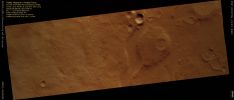
PSP_009706_2125_RED.jpgValley Network in Arabia Terra (Saturated and Enhanced Natural Colors; credits for the additional process. and color.: Dr Paolo C. Fienga - Lunexit Team)65 visiteThe central portion of this image includes a portion of a Valley Network in Arabia Terra. In lower resolution images, this meander (a bend in a valley) appeared discontinuous - hence its selection as a target for HiRISE. However, at HiRISE resolution the valley is visible throughout its course.
This is a mid-latitude scene where ground ice is believed to be stable relatively near the surface today. The mottled terrain visible throughout the image could be a sublimation texture. Sublimation occurs when ice goes directly to the gas phase.
When this happens, the space beneath the subsurface that the ice previously occupied is now empty, allowing the remaining surface to collapse and form the observed texture.
Several of the craters in this scene have flattened appearances, which may have resulted from ice-rich material being driven by gravity into the crater centers.MareKromium
|
|
| 2236 immagini su 187 pagina(e) |
 |
|
|
|
|
151 | |
|
|
|
|








