Mars Reconnaissance Orbiter (MRO)
|
|
|
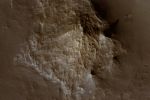
PSP_009161_1450_RED-01.jpgLong Shadows over Ariadnes Colles (edm - natural colors; credits: Lunexit)66 visiteThis edm shows one of the hills in detail.
The hill appears criss-crossed by long fractures and most of them made apparent by the shadows they cast.
The shadows indicate that the fractures “stick out” from their surroundings, and hence that they are more resistant to erosion. In terrestrial environments this occurs when fluids flow along the fractures, leaving behind cementing minerals or when fractures are filled by igneous materials.MareKromium
|
|

PSP_009162_1570.jpgFresh 5-Kilometer Diameter Rayed Crater (False Colors; credits: Dr M. Faccin)71 visiteThe crater featured in this scene formed on top of ejecta from a nearby rampart crater, located to the North.
The crater’s distinct rim indicates that it is relatively young. There is bright material on many of the crater walls that might be landslides of dust or another bright substance.
The mounds of material on the crater floor probably formed during late stages of crater’s own formation. The crater floor is speckled with even smaller craters.MareKromium
|
|
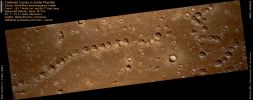
PSP_009177_1985_RED.jpgCratered Cones in Isidis Planitia (natural colors; credits: Lunexit)75 visiteThis image shows part of a broad field of cratered cones in the Isidis Planitia region of Mars. The cones occur over a wide area and are commonly aligned in chains, like those here.
The cratered-cone morphology suggests formation by eruption of some material. The cones resemble small volcanoes on Earth called cinder cones, and are approximately the same size. Another possibility is that these are mud volcanoes, formed by eruption of wet, pressurized mud. This has been suggested as an important process in some parts of Mars. The aligned chains probably indicate sites of weakness, perhaps faults, where lava or mud could preferentially rise.
The scene is relatively bland in color, but this could be due to a thin coating of dust veiling color differences. The cones are clearly not very young or pristine; they have a battered, pitted appearance. However, they have not been heavily eroded, as features like the cone rims are still sharp in most cases. This state is typical of the cones in Isidis region.
MareKromium
|
|
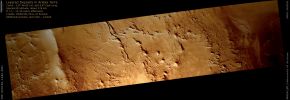
PSP_009180_1840_RED.jpgLayered Deposits within Unnamed Crater in Arabia Terra (natural colors; credits: Lunexit)72 visiteArabia Terra is an area of Mars that has an abundance of Layered Deposits within Impact Craters.
The Region of Arabia has plateau material that is thought to be part of the ancient highland crust that is Noachian in age according to Martian timescale. Thus, the layered deposits may represent some of the earliest eroded and infilled materials on Mars.
In this Unnamed Crater, we see layering exposed along the margins of a scarp-like bench.
The layering is of particular interest because on Earth, they may represent multiple sequences of deposited material or some geologic process (subaerial or subaqueous) that has modified and/or deposited material on the surface in some constant fashion.
If the layered sequences are consistently the same, we can infer that the conditions of their deposition were the same for some period of time. If the layers changed in some way (e.g., thickens and thins), then we can infer that some condition(s) caused this to happen.
From these observations and analyses, scientists can attempt to quantify and reconstruct what the ancient conditions were like in this Region of Mars.MareKromium
|
|
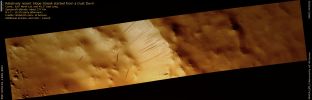
PSP_009192_1890_RED-00.jpgRelatively Recent Slope Streak started from a Dust Devil (ctx frame - natural colors; credits: Lunexit)77 visiteThis Slope Streak occurred in the time between a Viking image of the bottom of this crater (713A57, which saw no streak) and a MOC image (R12/01917, as reported by Schorghofer et al. (2007).
That paper suggested that the Slope Streak may have been caused by a Dust Devil that had passed by (its track is visible in the MOC image). Our HiRISE image shows that there isn’t a small hill or anything at this Slope Streak’s apex, but that the dust devil track really does intersect with the apex. It is likely that the Dust Devil may have caused this Slope Streak.
Dark Slope Streaks are visible in many places on the Martian surface, often where the dust cover is thick.
One explanation for Dark Slope Streaks is that they are little avalanches in the dust. The apexes of Slope Streaks (such as the point where they start from) are often at little hills or ridges on a larger slope, with the thinking that the dust here is already close to being too steep, and then any little perturbation will start one of these tiny avalanches.
Small craters have also been seen at slope streak apexes.MareKromium
|
|
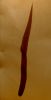
PSP_009192_1890_RED-01.jpgRelatively Recent Slope Streak started from a Dust Devil (edm - natural colors; credits: Lunexit)73 visitenessun commentoMareKromium
|
|
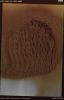
PSP_009233_2535_RED_abrowse-00.jpgEvolution of North Polar Dunes (ctx frame - natural colors; credits: Lunexit)82 visiteThis small unnamed crater is adjacent to the North Polar Erg and contains a fascinating Dunefield. Scientists are interested in the source of the dunes in the crater and the evolution of the Dunefield’s circular shape.
Wind transports material and shapes the dunes; the dominant wind comes from a Westerly-SouthWesterly direction and forms barchans (crescent-shaped) and barchanoid dunes. Secondary winds also play a role in shaping the dunes.
This can be seen in the Southern part of the Dunefield where the barchans transition into transverse dunes. On the northern edge of the dune field are opposite facing barchans formed by winds from the North-East.MareKromium
|
|

PSP_009233_2535_RED_abrowse-02.jpgEvolution of North Polar Dunes (edm - natural colors; credits: Lunexit)65 visiteThe circular shape of this Dunefield is interesting because the outer dunes reflect changing winds whereas the central dunes do not.
This could indicate several distinct stages in the formation of the Dunefield. On top of the dark dunes are tiny ripples similar to those seen on top of sand dunes on Earth.
It is likely that these dune ripples are active, as shown by avalanches (grainflow) from the crest of the dunes.MareKromium
|
|
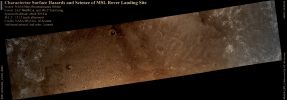
PSP_009260_2050_red.jpgCharacterize Surface Hazards and Science of Possible MSL Rover Landing - Mawrth Vallis (natural colors; credits: Lunexit)88 visitenessun commentoMareKromium
|
|
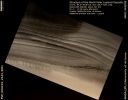
PSP_009293_2645_RED.jpgStructure of the North Polar Layered Deposits (natural colors; credits: Lunexit)64 visiteThe North Polar Layered Deposits on Mars are thought contain a record of global climate changes, similar to ice ages on Earth. This image shows that the geologic history of the NPLD has been complex enough to form angular unconformities.
An angular unconformity represents a gap in the geologic record, where erosion has removed material followed by deposition of more material on the eroded surface. In this image, the angular unconformities are recognized by the truncation, or cutting off of layers, for example right of center and at bottom center.
Also visible in this image are numerous streaks, perhaps caused by recent redistribution of frost by winds.MareKromium
|
|
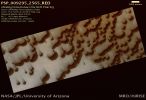
PSP_009295_2565_RED.jpgAbrading Dunes in the North Polar Erg (natural colors; credits: Lunexit)66 visiteThis location is where Mars Global Surveyor (a.k.a.: MGS) saw evidence of dunes that either shrank or completely disappeared over a span of a few years. HiRISE provides new details at higher resolution.
As seen here, the dunes show clear evidence of erosion.
Based on the shape of the dunes in this picture, the strongest winds have blown from the upper right (South-East) to lower left (North-West).
Streamers of dark sand are visible on the white, frost-covered surface downwind of the dunes. This is particularly prominent at the “horns” of the barchan dunes (these are the dunes with the prominent points at their edges).
Scientists believe these dunes are cemented, by ice, such that the wind is progressively eroding them over time. Future observations by HiRISE will determine if the dunes shrink as indicated by MGS, or maybe even migrate, over time.MareKromium
|
|
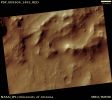
PSP_009304_1495_RED.jpgSmooth Hills (possible True Colors; credits: Lunar Explorer Italia)63 visiteMars Local Time: 15:31 (middle afternoon)
Coord. (centered): 30,2° South Lat. and 227,9° East Long.
Spacecraft altitude: 253,6 Km (such as about 158,5 miles)
Original image scale range: 50,7 cm/pixel (with 1 x 1 binning) so objects ~1,52 mt across are resolved
Map projected scale: 50 cm/pixel
Map projection: EQUIRECTANGULAR
Emission Angle: 0,3°
Phase Angle: 74,9°
Solar Incidence Angle: 75° (meaning that the Sun is about 15° above the Local Horizon)
Solar Longitude: 101,7° (Northern Summer)
Credits: NASA/JPL/University of Arizona
Additional process. and coloring: Lunar Explorer ItaliaMareKromium
|
|
| 2236 immagini su 187 pagina(e) |
 |
|
|
|
|
147 | |
|
|
|
|








