Mars Reconnaissance Orbiter (MRO)
|
|
|

PSP_009039_1660_RED.jpgCraters in South-Eastern Syria Planum (natural colors; credits: Lunexit)77 visiteThis image shows two landforms that appear similar, but are the result of two very different geologic processes.
These two depressions are craters. The smaller, rounder crater formed when an asteroid collided with Mars. This impact blasted out the pre-existing rocks, forming this quasi-circular crater.
The larger, more irregular-shaped crater is a Pit Crater. These types of craters form through collapse of the ground surface into large underground voids. In this Region of Mars, these underground voids are likely caused by the movement of magma (molten rock) through the subsurface. As the magma moves underground, it forces the rock apart and forms large “caverns.” These voids are structurally unstable and can lead to collapse of the overlying rock, forming pit craters at the surface.
Impact Craters are distinguished from Pit Craters by the presence of a raised rim. Rock blasted out during the impact falls back to the ground and accumulates near the crater, forming this raised rim. Upward warping of the ground during the impact process also contributes to the raised appearance of the crater rim. Since Pit Craters form through collapse, their rims are at the same level, or perhaps slightly lower, than surrounding ground surface.
The Impact Crater has a bright streak extending South-East (toward the upper right). The bright material is dust, deposited downwind of the crater by prevailing winds. Zooming into the streak, small bedforms, presumably composed of dust or dust aggregates, are visible. Similar features are seen in other dusty regions of Mars.MareKromium
|
|

PSP_009087_2550_RED-PCF-LXTT.jpgUnnamed Crater with Dunefield in Vastitas Borealis (Absolute Natural Colors; credits for the additional process. and color: Dr Paolo C. Fienga - Lunexit Team)74 visiteThis North Polar Dunefield is bounded by a small Unnamed Crater about 11 Km in diameter in the Vastitas Borealis Region. This crater captured deposits of basaltic sand that may have been transported from the North Polar Erg, a massive sea of sand that surrounds the Martian North Pole.
This Region experiences a variety of winds that blow from various directions during different seasons and times of day, and the winds are also affected by the topography of the crater itself. This influences the movement of sand within the crater and the dunes that they shape.
This image shows many transitioning dunes which indicate changes of wind direction. The wind direction can be inferred from the location of the steeper side of the dune (called the slip-face) which is downwind of the dominant wind direction. The barchans and barchanoid dunes form crescent shapes and are consistent with dominant winds from the South-West.
Towards the center of the Dunefield, the barchans transition from crescent shapes into irregular, more elongated dunes and merge.
The more northern part of the Dunefield consists of longitudinal dunes which extend from the horns of the modified barchans residing in its central part.
These longitudinal dunes form along the trend of southerly-southeasterly winds.
Because it is early Summer, solar radiation has heated the sand and there are only a few small patches of frost remaining on the dunes at this season. However, evidence of the arctic climate is visible in the polygons surrounding the dune field.
The polygons, like those found at the Phoenix Mission Landing Site, are produced by freeze-thaw cycles as the polar soil expands and contracts. MareKromium
|
|

PSP_009114_2645_RED.jpgEroding Dunes in Chasma Boreale (natural colors; credits: Lunexit)67 visiteSand moves along a planetary surface by a process scientists call “saltation”, whereby the individual grains are driven by the wind and bounce forward in short hops. In a process that is not yet completely understood, sheets of saltating sand grains organize themselves into sand dunes, visible in this image as the dark features.
Sand dunes move by having the wind push sand grains up and over the top of the dune where they then slide down to the base. The steep side of the dune that the sand grains slide down is called "slip-face" and it is the constant transport of sand from the downwind side of the dune to the "slip-face" that makes the dune move forward in this direction. HiRISE data allow us to see which side of these dunes has the steeper slope (such as the aforementioned "slip-face"), telling us what direction the dune — and strong near surface winds — are moving.
Yet something else is also happening to these particular dunes. Dark streaks lead away from the dunes toward the lower left of the image. These streaks are caused by sand grains being blown off the dunes and saltating away. This is not ordinarily a cause for concern because in a stable dune, individual grains are constantly added and removed; however, there does not appear to be any influx of sand upwind of these dunes, so they are probably being eroded.
It is also interesting that these streaks do not point in the same direction as the "slip-face". One possible scenario is that the dunes migrated Westward when sand supply was more plentiful. Today, the wind direction has shifted, blowing more toward the South-West, and the influx of new sand has ceased, such that in the future, the dunes will completely erode away. Repeated HiRISE observations will be able to look for changes in the shape and size of these dunes.MareKromium
|
|

PSP_009115_2040_red.jpgCharacterize Surface Hazards and Science of Possible MSL Rover Landing - Mawrth Vallis (natural colors; credits: Lunexit)67 visitenessun commentoMareKromium
|
|

PSP_009138_2025_RED-00.jpgMineralogical Diversity in Nili Fossae (ctx frame - natural colors; credits: Lunexit)64 visiteThere is evidence of phyllosilicate material (clays) throughout this Nili Fossae Region. The evidence comes from the OMEGA experiment on the European Space Agency’s Mars Express Spacecraft and CRISM on the Mars Reconnaissance Orbiter, Infrared Spectrometers that can identify minerals on the surface of Mars.
In the Nili Fossae Region, the spectrometers have found remarkable diversity in surface composition. Because of the evidence for clays and other interesting geology, Nili Fossae is also being considered as a Landing Site for the Mars Science Laboratory Rover.
HiRISE has targeted several places where OMEGA and CRISM show extreme diversity, with this being one example. In this specific area, low-calcium pyroxene (LCP) materials are adjacent to these clays.
The cracked terrain areas evident at the highest resolution - see the next edm frame - provide clues to the sequence of events which occurred in Nili Fossae.MareKromium
|
|
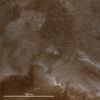
PSP_009138_2025_RED-01.jpgMineralogical Diversity in Nili Fossae (edm - natural colors; credits: Lunexit)77 visitenessun commentoMareKromium
|
|
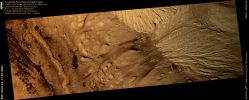
PSP_009149_1750_RED.jpgInverted Riverbed in Gale Crater (False Colors; credits: Lunexit)70 visiteGale Crater is a large, approximately 152 Km-diameter impact crater that lies near the Martian Equator. Contained within the crater is a massive central mound of layered material. With an average vertical thickness of almost 4 Km (about 2,4 miles), the Gale Crater Layered Deposits are twice as thick as the layers exposed along the Grand Canyon on Earth. Shown here is a portion of the mound with an inverted fluvial or river channel.
Topographic inversion occurs when sediments are cemented together, forming a harder layer that is resistant to later erosion. This later erosion has preferentially removed material outside the channel, leaving the former riverbed exposed as a ridge — such as a topographic high.
This inverted channel was originally detected by scientists using Mars Orbiter Camera (MOC) images onboard the Mars Global Surveyor Spacecraft.
Color variations visible in this image are mostly due to variable amounts of loose dark sediment that has accumulated unevenly across the scene.MareKromium
|
|
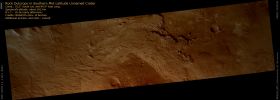
PSP_009151_1465_RED.jpgRock Outcrops in Southern Mid-Latitude Crater (natural colors; credits: Lunexit)78 visiteThis image shows part of the floor of a large Impact Crater in the Southern Hemisphere. The crater lies at the edge of the Hellas Impact Basin; although it is roughly 50 Km across, it is dwarfed by the giant Hellas structure, which has seen a varied and interesting geologic history.
This image captures a diverse range of rocks on the Crater Floor. A small cliff running across the middle of the image marks the edge of one rock unit, but variations in tone or texture in the northern part of the image suggest a varied history of deposition. Exposures of light, intermediate and dark materials may correspond to different types of deposition, or perhaps alteration after the rocks were laid down. Some units appear rich in boulders, suggesting that they are breaking up into blocks, while at other sites there are thin layers.
This diversity indicates a varied geologic history. Hellas Basin is a low Region, and may have once held lakes or seas where sediments could have been deposited.
This site is also just west of Hadriaca Patera, an old volcano. Sediment could also have been deposited by wind, or in streams on the surface. Unraveling the history of the region will require many images to illustrate the diversity of rocks and map out where they occur.MareKromium
|
|
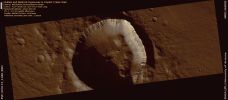
PSP_009155_1480_RED.jpgGullies and Bedrock Exposures in Impact Crater Wall (natural colors; credits: Lunexit)73 visiteThis image shows a rather pristine crater with Gullies and Bedrock Exposures. The Gullies are mostly on the South-Facing (such as the Poleward facing) wall. Some of the gully channels are very sharp, indicating that they have not been modified much since they formed.
Other channels criss-cross each other, demonstrating that there were multiple periods of activity. Scientists do not know how closely these were spaced in time.
The South and East walls of the Crater (upper right of the frame) have very distinct bright layers. These layers are possibly Ancient Bedrock. These walls also have what appear to be bright Landslides.MareKromium
|
|
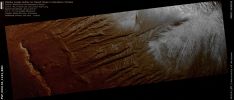
PSP_009156_1335_red_abrowse-PCF-LXTT.jpgGullies on a Massif Slope in Nereidum Montes (Absolute Natural Colors; credits for the additional process. and color.: Dr Paolo C. Fienga - Lunexit) 131 visitenessun commentoMareKromium
|
|
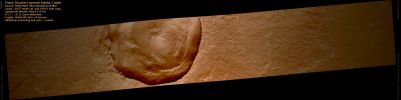
PSP_009160_2350_RED.JPGFresh Double-Layered Ejecta Crater (natural colors; credits: Lunexit)70 visiteThis scene features a High Latitude, Northern Hemisphere Crater with double-layered ejecta. The sharp rim and lack of small superposed craters indicates that this Crater is relatively young.
The semi-circular feature that parallels the Crater Rim is a terrace that probably formed as part of the Crater wall collapsed into the center. The circular mound in the center likely formed at the same time as the Crater itself.
Large craters on Mars can have central peaks; this Crater looks like it was on the cusp of having one. The linear features surrounding the Crater on its ejecta are striations that formed during the impact as material and wind exploded out from the center.
On the right side (Dx) of the scene, is a very distinct ejecta flow lobe (Lobate Ejecta). Lobate Ejecta is thought to form when an impact occurs on a surface with lots of volatiles — such as ices that quickly turn to gas when they are heated. The gases help make the ejecta flow like a fluid.MareKromium
|
|

PSP_009161_1450_RED-00.jpgLong Shadows over Ariadnes Colles (ctx frame- natural colors; credits: Lunexit)66 visiteAriadnes Colles is a labyrinth-like cluster of hills, mesas and knobs located near Terra Cimmeria, in the Southern Highlands of Mars.
This image, which covers a portion of that labyrinth, was acquired only a few Soles away from Winter Solstice.
Winter Solstice occurs in the shortest Sol of the year, when the Sun travels the lowest in the Martian sky, making shadows appear very long. These conditions are ideal to analyze modest relief features, that would pass unnoticed when illuminated from above but are highlighted when illuminated from the side.MareKromium
|
|
| 2236 immagini su 187 pagina(e) |
 |
|
|
|
|
146 | |
|
|
|
|








