Mars Reconnaissance Orbiter (MRO)
|
|
|

PSP_008778_1685_RED_abrowse.jpgMistery Mounds (MULTISPECTRUM; credits: Lunexit)74 visiteThis image was targeted because a previous MGS-MOC image (R1100035) showed an distinctive field of Mounds on the floor of an ancient, large, filled-in Unnamed Crater.
The origin of the Mounds was unclear, so we hoped that a HiRISE image with higher resolution and color would solve the mystery. The HiRISE image shows much more detail on the Mounds and other rough textures, indicating that this is an eroded bedrock surface, perhaps exposed by removal of an overlying layer of fine-grained materials by the wind.
But how did the rocks form, and why did they erode onto Mounds? It could have been lava or impact ejecta or fluvial sediments, perhaps altered and indurated by groundwater.
The Mounds could be due to how it was deposited — like hummocky Impact Ejecta — or how it was indurated. In other words, we haven't solved the mystery!...
Yet we may get new clues from future images of similar terrains in places where the origin is more interpretable, or from other datasets such as the mineral content determined by CRISM.MareKromium
|
|
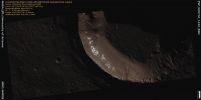
PSP_008792_1410_RED_abrowse.jpgLight-Toned Layers in Crater Wall (MULTISPECTRUM; credits: Lunexit)67 visiteThis approximately 8 Kilometer-diameter Impact Crater is interesting because of the light-toned band visible in the upper slopes of the Inner Crater Wall.
Because the light-toned materials are confined to a distinct elevation within the Crater, it is possible that it represents a well-defined Layer exposed in the Crater Walls.MareKromium
|
|
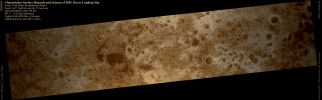
PSP_008825_2040_red.jpgCharacterize Surface Hazards and Science of Possible MSL Rover Landing - Mawrth Vallis (natural colors; credits: Lunexit)68 visitenessun commentoMareKromium
|
|
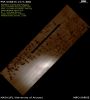
PSP_008839_2575_RED-00.jpgDunes and Polygons (ctx frame - natural colors; credits: Lunexit)97 visiteAt high Northern Latitudes, shallow troughs in the ice-rich ground form polygonal patterns. The polygons form over many years as the near-surface ice contracts and expands seasonally.
On top of this patterned ground in this image are dunes. Loose sand and dust are blown across the hard-cemented surface until collecting and forming a dune.
Streaks of dust are visible in the following edm-frame, coming from the horns of the dunes, while the higher portion of the dune blocks the dust from being blown across the surface.
Small ripples are also visible, and the small bright spots are the remnants of the seasonal Carbon Dioxide (CO2) Polar Cap that coats this area in the Winter.MareKromium
|
|
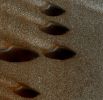
PSP_008839_2575_RED-01.jpgDunes and Polygons (edm - natural colors; credits: Lunexit)65 visitenessun commentoMareKromium
|
|

PSP_008842_1705_red-PCF-LXTT.jpgSmall Shield-Volcano and Caldera (Enhanced Natural Colors; credits for the additional process. and color.: Dr Paolo C. Fienga - Lunar Explorer Italia)213 visiteThis image is centered on the vent area of a small shield volcano located within the Summit Caldera of Arsia Mons, the southernmost of the large three Tharsis Montes Volcanoes.
Since the first details of the volcano were revealed by the Viking orbiters 30 years ago, the presence of a string of several small Shield Volcanoes across the Floor of the Caldera has been known. The resolution of the Viking images was insufficient to show more than the mere presence of small Shield Volcanoes and the fact that they appeared to line up along a linear trend across the Floor. And, it was suspected that the small Shield Volcanoes were the source of the lava flows that appeared to cover the floor of the Caldera, but details have been elusive.
This HiRISE image of the central small Shield Volcano on the Caldera Floor shows that there are numerous lava flows radiating from a small summit crater. To the North and South, the lavas have accumulated in lobes, some of which radiate smaller channels and lobes. About midway from the crater, to both left and right of the image, the surface appears very smooth and there are few details visible. Until detailed geologic mapping is done, it is difficult to conclude whether these smooth areas represent distal ponding of lavas that erupted from the summit crater of the small Shield Volcano, lava flows that have invaded from outside the image area at a time later than the formation of the small Shield Volcano, or later deposits of dust and ash that have simply covered the surface.
Whatever the relationships, it is clear that the Floor of the Largest Caldera on Mars is far from a bland surface of old lava flows. Numerous flows and multiple vents have all interacted to create a complex series of surfaces that record the geologic development of the Caldera Floor. MareKromium
|
|

PSP_008927_2010.jpgUnnamed Crater in Nili Fossae Region (True Colors; credits: Dr M. Faccin)65 visitenessun commentoMareKromium
|
|

PSP_008927_2010_RED-00.jpgPossible MSL Landing Site in Nili Fossae Trough (natural colors; credits: Lunexit)78 visiteNili Fossae Trough is a linear trough about 25 Km wide, formed in response to the creation of the Isidis Basin.
Nili Fossae has diverse deposits, some containing Phyllosilicates (Clay Deposits which typically form in the presence of water), and others with the minerals Olivine and Pyroxene.
This image is part of a series covering the 25 km Landing Ellipse; they are used to determine the safest possible Landing Site for the Mars Science Laboratory Rover. In this frame, relatively smooth rock exposures is visible, as well as sand ripples and some small knobs. There are few large rocks in the area, while the surface seems to be mostly flat, fractured rock.
This landscape is located in the South-Eastern part of the Landing Ellipse.MareKromium
|
|

PSP_008930_1880_RED.jpgStair-Stepped Mounds in Meridiani Planum (natural, but enhanced, colors; credits: Lunexit)72 visiteThis image shows layered sedimentary rocks that fill an impact crater in the Meridiani Planum Region of Mars.
These layered rocks may have formed through the accumulation of sediment (sand and dust) that were transported into this crater by blowing wind or flowing water. These sediments formed an extensive deposit that once covered the floor of the surrounding impact crater.
This crater is so large that the HiRISE image is entirely within it, and the crater rim is not visible. These sedimentary rocks were then eroded, likely by the wind. The original sand and dust were deposited in distinct layers within the crater; these layers now give the mounds their distinctive stair-stepped appearance, and are all that remain from this once extensive deposit.MareKromium
|
|

PSP_008963_1650_RED-01.jpgMER Spirit Rover at Martian Mid-Winter (edm - natural, but enhanced, colors; credits: Lunexit)67 visitenessun commentoMareKromium
|
|

PSP_008982_1965.jpgLayered Deposits in Arabia Terra Region (True Colors; credits: Dr M. Faccin & Lunexit)64 visiteThis image shows the floor of an Unnamed Impact Crater in Arabia Terra that has Layered Deposits. There are many craters in this Region where layering is observed.
These layers are often exposed along the sides of large isolated mounds, small knobs and mesas, and other positive relief features. In some cases, the layering is expressed as narrow sinuous ridge-like structures along crater floors.
The presence of Layered Deposits is of particular interest because these materials are not likely to be related to the impact event, but rather post-impact infill of the crater. Modification of the deposits has now revealed layers of material.
HiRISE and other instruments onboard the Mars Reconnaissance Orbiter may provide more clues to the origin of the these deposits.MareKromium
|
|

PSP_009003_1890_RED.jpgPseudo-Pyramid and Fissures in Cerberus Fossae (Extremely Enhanced and Saturated Natural Colors; credits for the additional process. and color.: Dr Paolo C. Fienga - Lunexit Team)155 visiteThis image shows a part of the Cerberus Fossae Region, a system of aligned fissures that lays East of Elysium.
The fissures were probably the source of floods of both water and lava. The most recent event was a massive outpouring of basaltic lava (a fluid-type of lava like that commonly erupted by Kilauea in Hawaii), which produced a host of volcanic features in the Region, as described by Jaeger et al. (2007).
Here, as at other locations, the fossae appear a dark red in the Lunexit Natural Color image. Dark red tones are usually associated with basaltic rock. The reddish ripples found on the trough floor could be wind-blown sand comprised of fine fragments of basalt. The upper plains are a relatively bland tone, perhaps due to a thin coating of dust; however, impact craters in the image also show reddish boulders and ripples, indicating that they have excavated the same basaltic rock layers cut by the fossae. This is typical of the Region, as floods of lava coat much of the area.
The mesas of older rock on the left side of the fissures are remnants of a former surface, now eroded. The surrounding Region has many knobs and larger protruding topography, which may be remnants of the same materials. The topmost layer in each mesa is very resistant to weathering, as in places it actually overhangs the lower rocks. This cap layer could be solidified lava, although it appears somewhat bland in color.
Although the mesa is clearly eroded and the cap rock breaks up into boulders, few rocks are visible at the bottom of the slope. The lava plains may have buried the former basal slope, or debris may have been swept away by lava or floodwater, that could also have contributed to eroding the mesa.MareKromium
|
|
| 2236 immagini su 187 pagina(e) |
 |
|
|
|
|
145 | |
|
|
|
|








